Artist unveils sculpture mocking ‘colonial’ TMX judges: ‘They’ve got blinders on’
George Rammell’s latest work included a performance element — critiquing the ‘B.C.’ courts and criminalization of land defenders
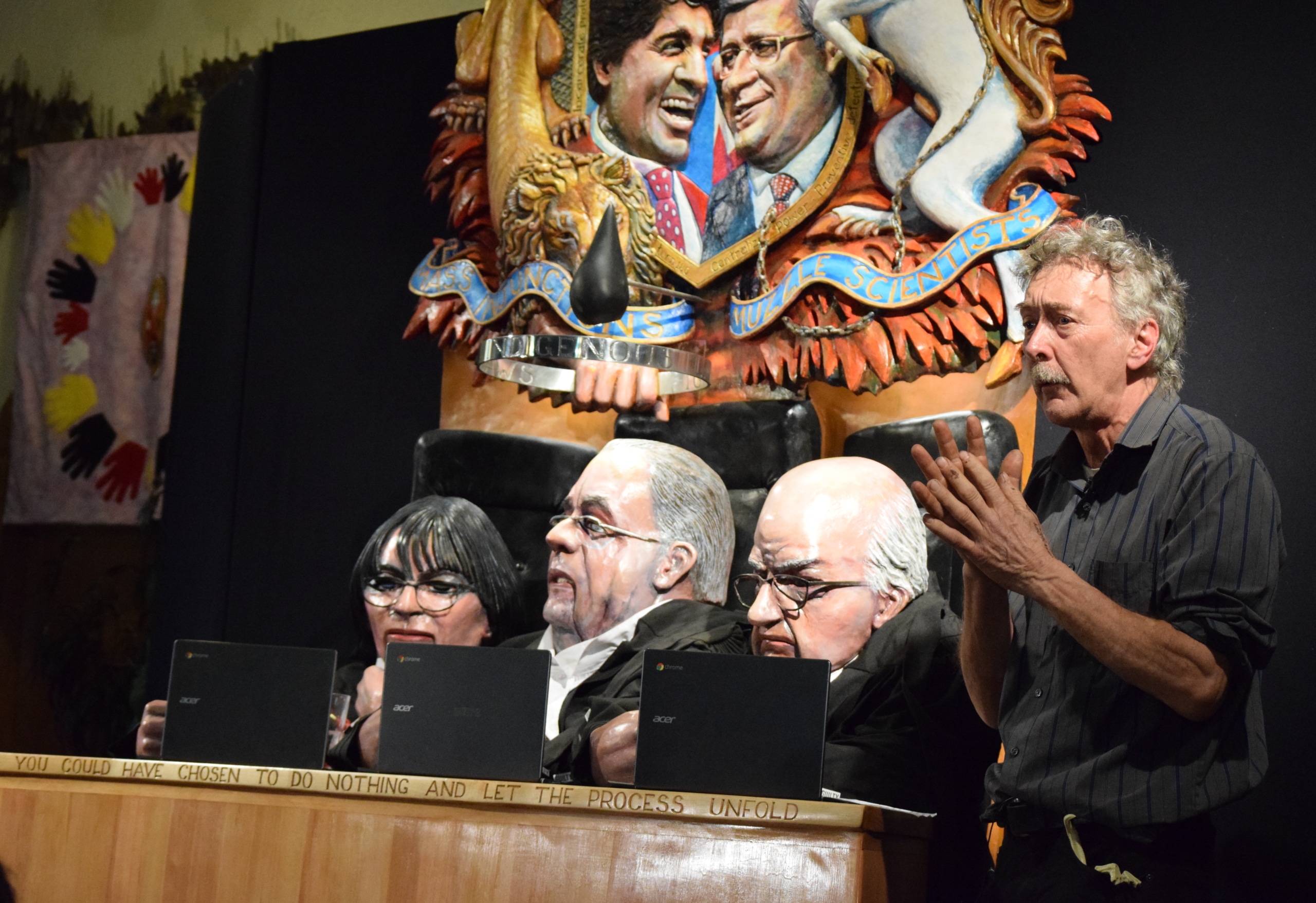
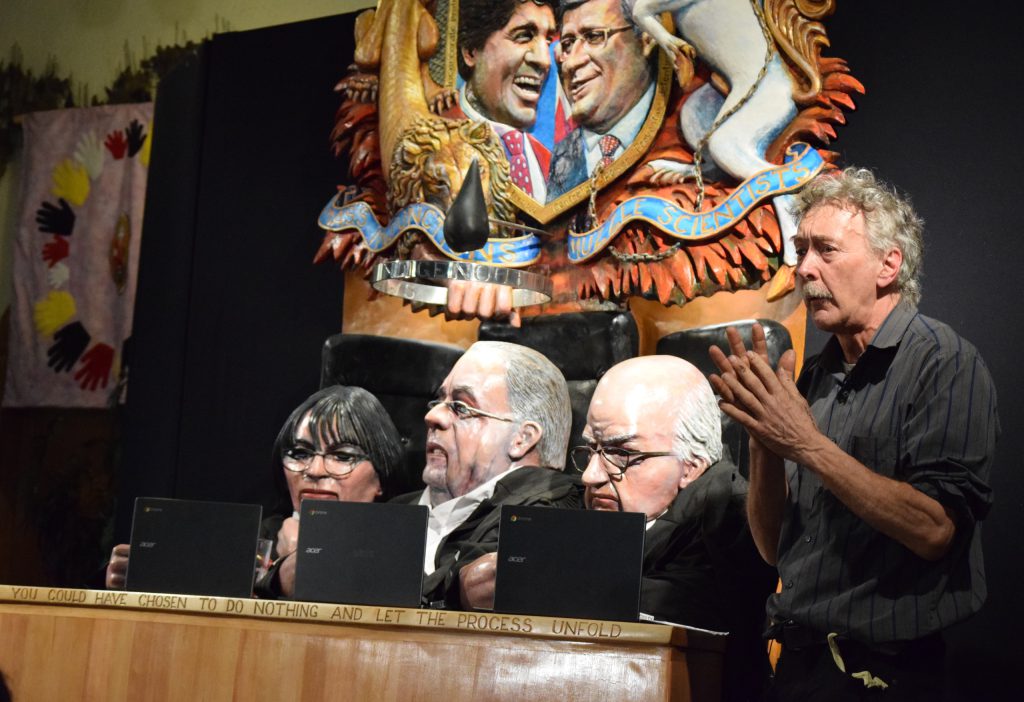
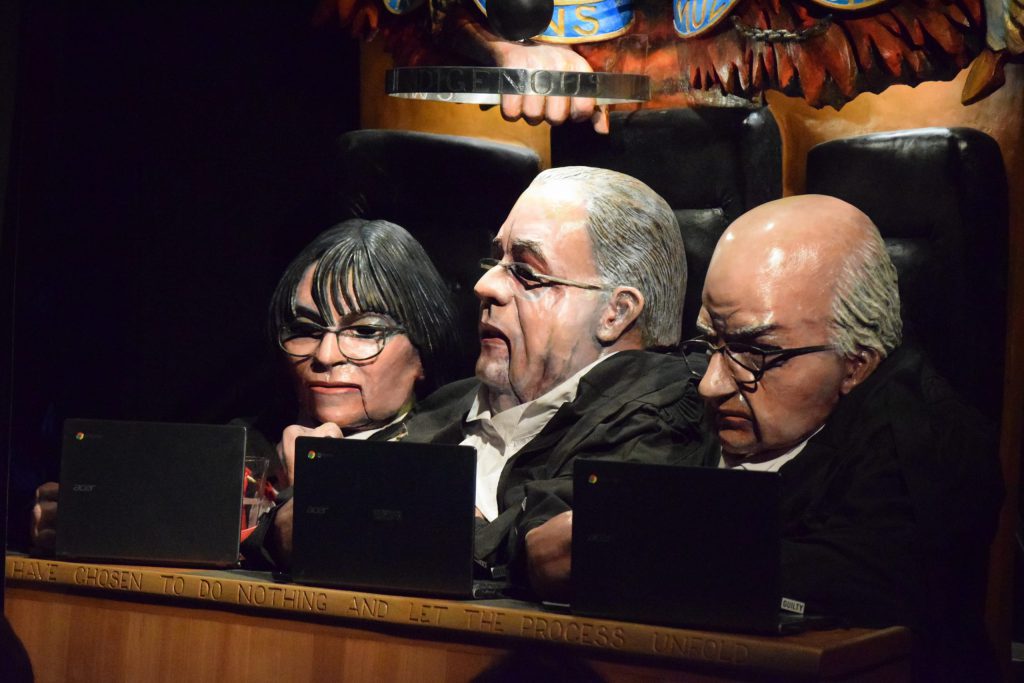
A caricature-like sculpture depicting three judges who have presided over pipeline injunction cases was unveiled on Tuesday — highlighting the absurd side of the colonial “justice” system.
The artwork by George Rammel features unflattering depictions of B.C. Supreme Court and Court of Appeal justices Kenneth Affleck, Robert Bauman and Shelley Fitzpatrick — the last of whom has recently been under fire for her treatment of Indigenous land defenders.
The piece also includes an ornate backdrop that depicts a nefarious-looking Prime Minister Justin Trudeau grinning alongside Stephen Harper.
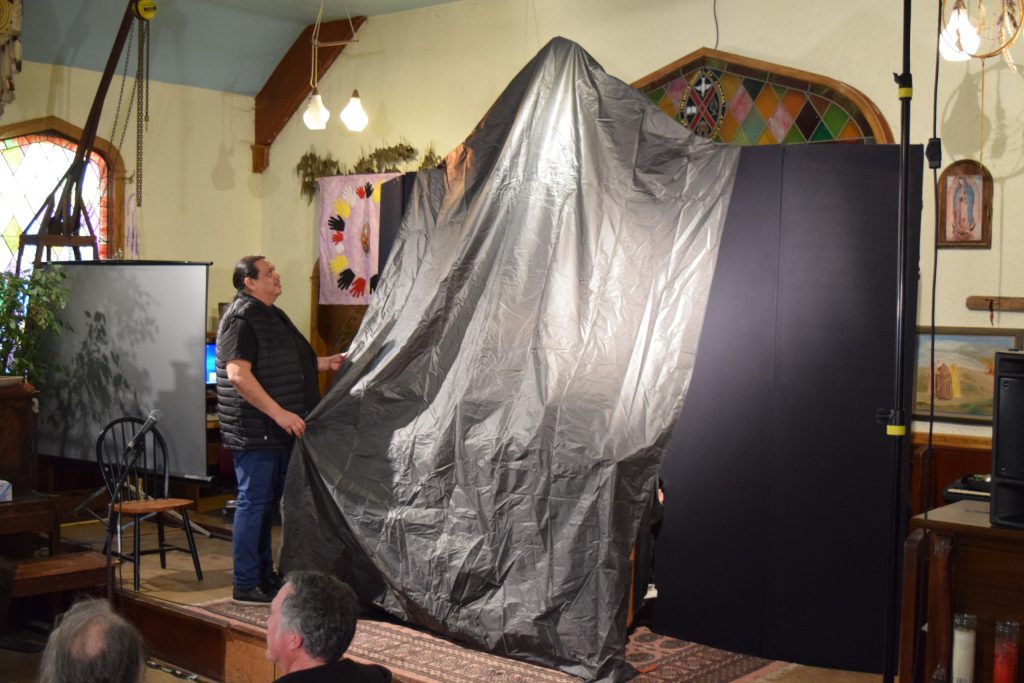
Rueben George of Tsleil-Waututh Nation uncovered the piece — titled “Chambers of Predetermined Outcomes: Gatekeepers of Justice” — to a crowd which packed an Indigenous church in “Vancouver.”
After George stepped aside, people taunted, cheered and threw objects at the sculpture, letting out their frustrations after several people in attendance had faced the judges in court.
Rammell himself has previously faced Affleck after defying a Trans Mountain pipeline expansion (TMX) injunction in “Burnaby.”
Tsleil-Waututh land defender Will George is currently in jail after being sentenced by Fitzpatrick, who also recently sentenced six people in Tkʼemlúps — stirring up outrage after she remarked on the evidence of graves at the former Kamloops Indian Residential School.
Art imitating life
After the unveiling of the sculpture, puppeteers behind the piece controlled the mouths of the “judges,” imitating statements they’ve made in the courtroom, in a performance that ridiculed perceived biases in the justice system.
“There are hundreds of you, but you’re all guilty!” said the puppeteer impersonating Affleck, as people in the crowd howled with laughter.
“Will George, how would you like it if someone parked in your driveway?” remarked the Fitzpatrick imitator, as strings were pulled to pound her sculpted fist on the table. “Where do the Tsleil-Waututh live, anyways? Does anybody know?”
“21 days for you! Take him away!” the Bauman mocker replied to a raucous person in the crowd. “There, that will keep him quiet.”
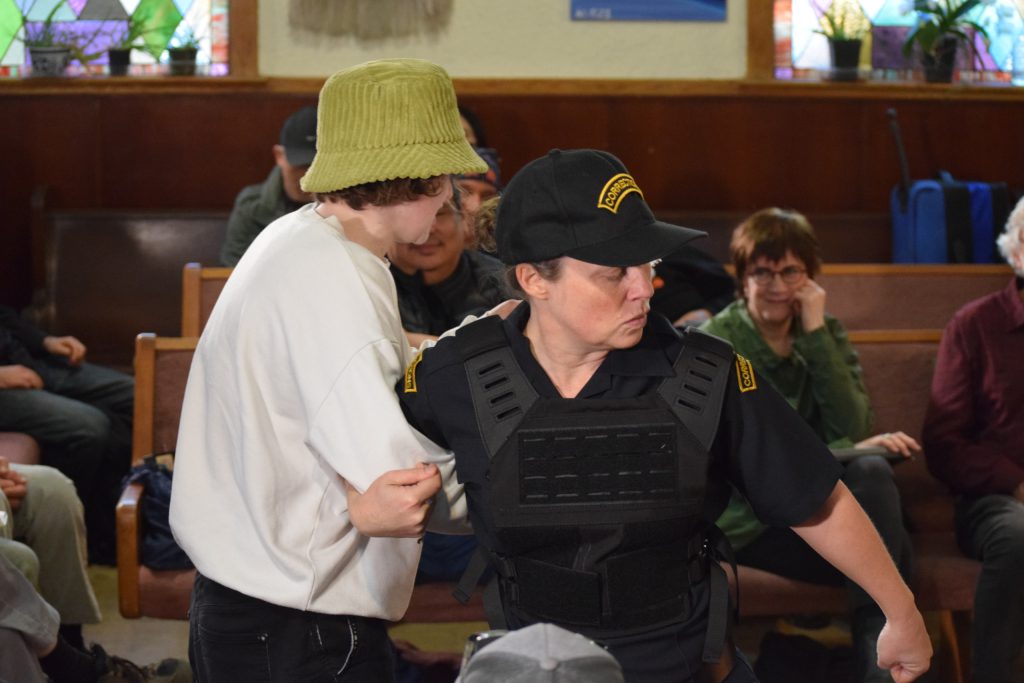
Emily Kelsall — another person who was sentenced by Fitzpatrick — was present in the crowd and stood up to “confront” the sculpted panel of judges.
“You hot-headed, limp-wristed, petulant fool,” Kelsall exclaimed, before another arrestee donning a sheriff’s costume, Maureen Curran, dragged her away.
‘Her courtroom is ugly’
When the performance had concluded, people in the room gave Rammell and the performers a standing ovation.
Rammell is a longtime artist and teacher who formerly worked as a studio sculptor for renowned Haida artist Bill Reid.
He pointed out some of the details in the artwork, such as two beavers holding a CSIS recruitment banner, and Trudeau’s arm holding a ring that says “ignore Indigenous law.”
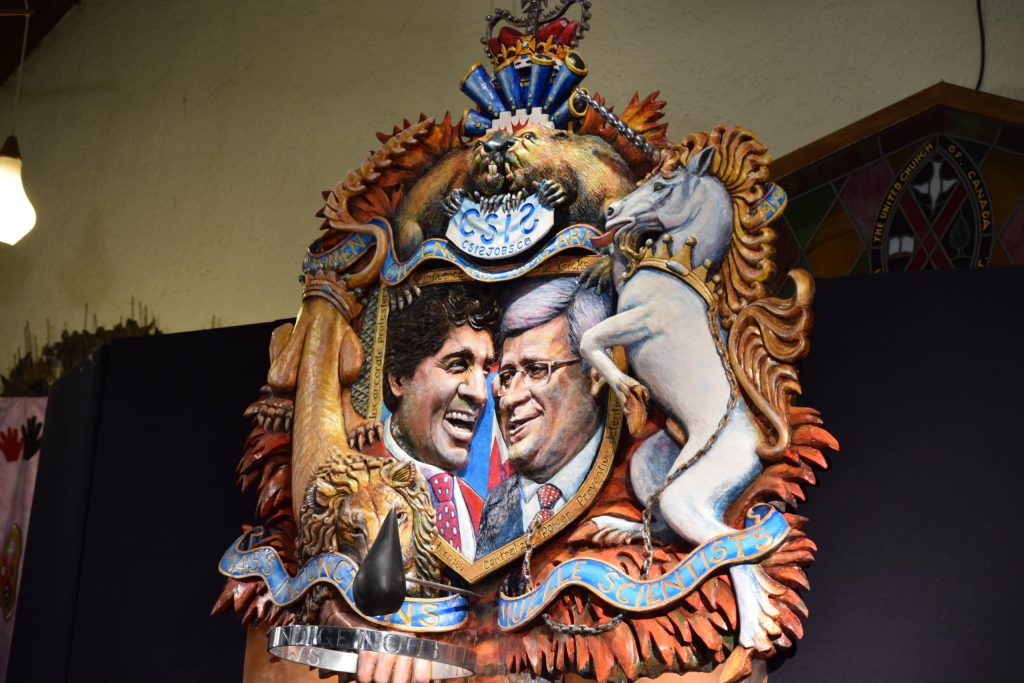
Above them is “Canada’s” coat of arms featuring British imagery that Rammell said is a “symbol of conquest.”
‘That’s what these judges are working under. That’s the mindset that they’re focused on,” Rammell said.
“They’ve got blinders on. They have such a limited worldview because that’s all they know.”
Rammell spoke about the “buffoonery” of the three judges, and went so far to say Fitzpatrick “needs to be removed from the bench.”
“Her courtroom is ugly. She treats Indigenous people like they don’t possess their own agency. And her courtroom is a colonial environment where she’s just pushing dispossession,” he said.
“You feel like you’re in the 1930s in her courtroom, it’s embarrassing.”
‘I am left with no choice’
Although Will George of Tsleil-Waututh couldn’t be present at the event because he was in jail, he released a statement last week standing by his decision to defy the TMX injunction.
“Canada is sending me to jail because I was doing the work the colonial government failed to do — protecting my territory and my nation from a catastrophic oil spill,” said George.
“Tsleil-Waututh Nation has worked for a decade to oppose the Trans Mountain pipeline, but Prime Minister Trudeau failed us, so I am left with no choice but to do whatever I can to stop it.”
Rueben George spoke about the importance of raising awareness — something he and his family have been doing for years as they try to prevent the TMX project from going further because of concerns about climate change and the impacts on the land and water.
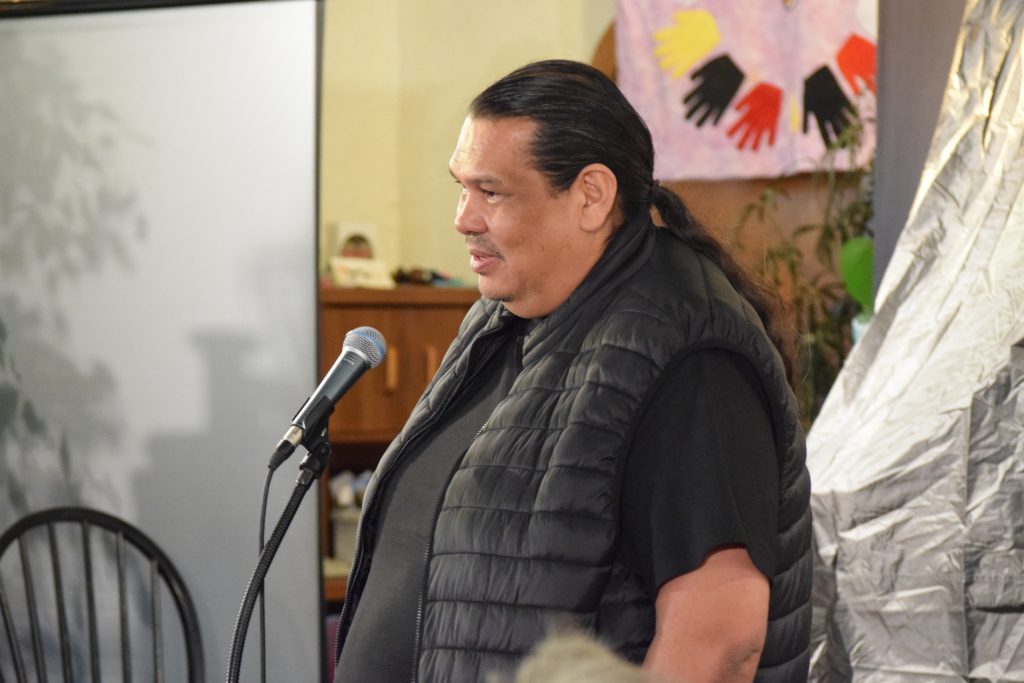
Alex Phillips, a sculptor who teaches at Emily Carr University, spoke after the performance piece about the concept of protest art and how it can make waves during troubling times. Rammell’s piece is set to be displayed at Emily Carr University this summer.
“Art in the service of protest is pretty good at creating common cause among activists and making everyone feel better when rubber and rhetorical bullets are flying,” Phillips said.
“Thank you, George. for employing your exceptional talent to give us all a little comic relief from some of the dinosaurs who populate our courts.”
Editor’s note: This is a corrected story. A previous version incorrectly identified Robert Bauman as a B.C. Supreme Court justice. In fact he is with the B.C. Court of Appeal.
Author
We live in a media ecosystem that thrives on misinformation. Big Tech and AI companies are consuming the work of real human beings and Canadian news has been banned on Facebook and Instagram.

And yet, I have hope for journalism because of the work we’re doing at IndigiNews.
At IndigiNews, we embody tâpwêwin — the Cree value of integrity and responsibility in truth-telling. We are committed to our independent, Indigenous-led newsroom rooted in community, accountability, and relationality. We believe storytelling is a sacred fire that connects our pasts, presents, and futures through the storytellers in our Storytelling Lodge. IndigiNews creates space for Indigenous journalists, storytellers, Knowledge Keepers, and communities to gather, learn, and share stories that matter.
As a registered charity, we are building a fire that allows our work not just to ignite but to thrive. Rather than relying on advertising or corporate acquisition, IndigiNews is sustained by people like you who believe Indigenous stories are important for the future of our communities.
Your support is making a real difference.
Our community of supporters, our Firekeepers, make it possible to grow our newsroom, publish award-winning journalism, train emerging Indigenous journalists through initiatives like the ReFocus Photojournalism Fellowship, and publish trustworthy stories that serve our communities across the country. Every story we publish helps fill in gaps left by mainstream media and ensures Indigenous perspectives are represented with care, accuracy and respect.
But there is still more work to do.
As the media landscape becomes more and more uncertain, community support is as necessary and essential as it’s ever been. Every new Firekeeper helps protect the independence of our newsroom and strengthens journalism that is accountable to our many and varied communities over corporations.
That’s why we’re inviting you to become a Firekeeper.
Firekeepers tend to and protect the sacred fire. Your monthly contributions directly support IndigiNews’s Storytelling Lodge, helps sustain our independent, Indigenous-led newsroom, and ensures future generations of Indigenous storytellers have the resources they need to do the work.
As a registered Canadian charity, all eligible donations receive a charitable tax receipt.
If you believe Indigenous stories matter, if you value independent journalism, and if you want to help build a strong future for Indigenous media, we invite you to join our circle of Firekeepers today.
Together, we can keep the fire burning.
— Eden Fineday, Publisher, IndigiNews
Support us nowLatest Stories
-

In the Okanagan desert, snakes offer lessons on protecting a fragile ecosystem
For two decades, researchers at the Nk’Mip Desert Cultural Centre have tracked snakes across syilx homelands — while helping people appreciate the often-feared creatures
-

Beloved on the powwow circuit, young boy’s connection to the drum inspires
Now four, Waseskwan Redcrow was dancing ‘before he could even fully walk’ — his family says participating in powwows has brought them joy and belonging