How to talk to children about residential schools
Educators share teaching resources from the classroom to assist speaking with children In the aftermath of a tragic discovery in Kamloops
This article contains content about residential schools that may be triggering. Support for survivors and their families is available. Call the Indian Residential School Survivors Society at 1-800-721-0066, 1-866-925-4419 for the 24-7 crisis line. The KUU-US Crisis Line Society also offers 24-7 support at 250-723-4050 for adults, 250-723-2040 for youth, or toll free at 1-800-588-8717.
In the aftermath of the shocking news of 215 children’s bodies being discovered in a mass burial site at the Kamloops Indian Residential School, IndigiNews spoke with educators to gather resources on how to engage with children and youth.
“Having conversations about the deaths of children at residential school with our young children is definitely not easy,” says Katie Lonsdale, a Grade One and Two educator at Qwam Qwum Stuwixwulh School on unceded Snuneymuxw territory.
Qwam Qwum is is co-governed and operated between the Snuneymuxw First Nation and Nanaimo Ladysmith Public Schools.
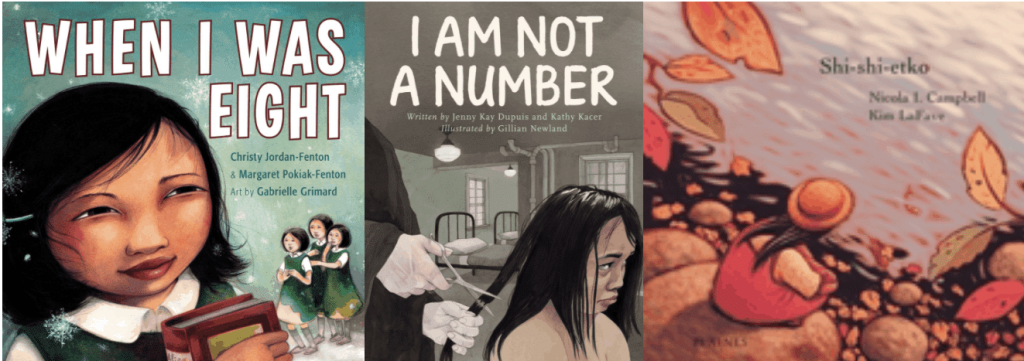
In Lonsdale’s classroom, which includes both Indigenous and non-Indigenous children, they have been introduced to Indian Residential Schools through the books Phyllis’s Orange Shirt by Phyllis Webstad and When We Were Alone by David A. Robinson and Julie Flett.
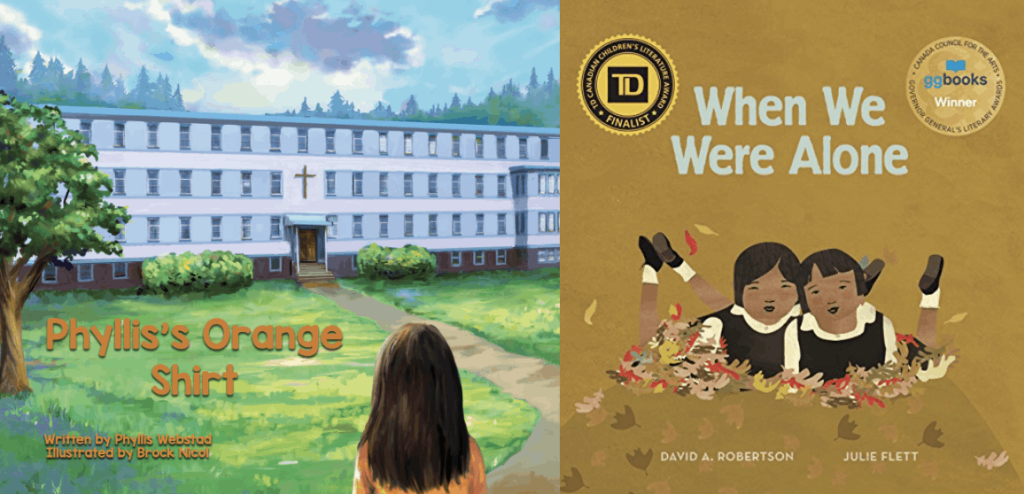
Lonsdale’s class also participates in Orange Shirt Day, which is inspired by Webstad’s experience at residential school at St. Joseph Mission in Williams Lake.
The Orange Shirt Day Society also has a teacher resource section to guide educators on readings and teachings in the classroom.
Anishinaabe educator Claire Shannon-Akiwenzie, who currently teaches grade six, suggested the picture books Shi-shi-etko and Shin-chi’s Canoe by Nicola I. Campbell. Shannon-Akiwenzie also suggested I Am Not a Number by Jenny Kay Dupuis and Kathy Kacer, and When I Was Eight by Gabrielle Grimard.
Shannon-Akiwenzie, who is a graduate of the Indigenous Teacher Education Program (NITEP) at the University of British Columbia, also suggests the teacher resources Gladys We Never Knew and Project of the Heart.
“You might want to also consider buying resources from Indigenous publishing companies and bookstores like Strong Nations, GoodMinds, Theytus Books, Kegedonce Press, Massy Books and Iron Dog Books,” she says.
Shannon-Akiwenzie also points to the First Nations Education Steering Committee and their resources for speaking with children about residential schools.
The National Centre for Truth and Reconciliation has a tool for educators on age appropriate books to read in class. A Stranger At Home: A True Story and Fatty Legs: A True Story, both by Christy Jordan-Fenton, Margaret Pokiak-Fenton, and illustrated by Liz Amini-Holmes, are suggested as resources.
IndigiNews also reached out to the B.C. Ministry of Education to ask how they will be supporting educators following the recent news, but did not receive a response in time for publication of this story.
Author
We live in a media ecosystem that thrives on misinformation. Big Tech and AI companies are consuming the work of real human beings and Canadian news has been banned on Facebook and Instagram.
And yet, I have hope for journalism because of the work we’re doing at IndigiNews.
At IndigiNews, we embody tâpwêwin — the Cree value of integrity and responsibility in truth-telling. We are committed to our independent, Indigenous-led newsroom rooted in community, accountability, and relationality. We believe storytelling is a sacred fire that connects our pasts, presents, and futures through the storytellers in our Storytelling Lodge. IndigiNews creates space for Indigenous journalists, storytellers, Knowledge Keepers, and communities to gather, learn, and share stories that matter.
As a registered charity, we are building a fire that allows our work not just to ignite but to thrive. Rather than relying on advertising or corporate acquisition, IndigiNews is sustained by people like you who believe Indigenous stories are important for the future of our communities.
Your support is making a real difference.
Our community of supporters, our Firekeepers, make it possible to grow our newsroom, publish award-winning journalism, train emerging Indigenous journalists through initiatives like the ReFocus Photojournalism Fellowship, and publish trustworthy stories that serve our communities across the country. Every story we publish helps fill in gaps left by mainstream media and ensures Indigenous perspectives are represented with care, accuracy and respect.
But there is still more work to do.
As the media landscape becomes more and more uncertain, community support is as necessary and essential as it’s ever been. Every new Firekeeper helps protect the independence of our newsroom and strengthens journalism that is accountable to our many and varied communities over corporations.
That’s why we’re inviting you to become a Firekeeper.
Firekeepers tend to and protect the sacred fire. Your monthly contributions directly support IndigiNews’s Storytelling Lodge, helps sustain our independent, Indigenous-led newsroom, and ensures future generations of Indigenous storytellers have the resources they need to do the work.
As a registered Canadian charity, all eligible donations receive a charitable tax receipt.
If you believe Indigenous stories matter, if you value independent journalism, and if you want to help build a strong future for Indigenous media, we invite you to join our circle of Firekeepers today.
Together, we can keep the fire burning.
— Eden Fineday, Publisher, IndigiNews
Support us nowLatest Stories
-
In the Okanagan desert, snakes offer lessons on protecting a fragile ecosystem
For two decades, researchers at the Nk’Mip Desert Cultural Centre have tracked snakes across syilx homelands — while helping people appreciate the often-feared creatures
-
Beloved on the powwow circuit, young boy’s connection to the drum inspires
Now four, Waseskwan Redcrow was dancing ‘before he could even fully walk’ — his family says participating in powwows has brought them joy and belonging