syilx Okanagan artist’s orange jerseys foster connections at sn’pinktn hockey game
Wynona Paul’s design honouring her nation and family was worn by the Penticton Vees team during a game last week


Artist Wynona Paul set out to honour her family and nation when she was designing orange jerseys for her local junior hockey team, the Penticton Vees.
The syilx Okanagan multidisciplinary artist’s design was worn by the entire team during its first “Indigenous night” home event on Jan. 31.
Seeing her work on the ice was a big career milestone for Paul — who described it as “amazing” to have the hockey players donning her work, which is deeply rooted in the lands the team is based on.
“It may seem like a simple thing like a game, but to me, it means a lot that Penticton is now able to represent where they are, and the people that took care of it beforehand,” said Paul, who is from the Penticton Indian Band (PIB).
“I want our communities to be together and to be able to work together. This is one step of many, I feel, that will come about and bring our community together.”
Design rooted in syilx Okanagan teachings
It all began last summer, when the Vees put out a call for an artist from PIB to create a design that would be worn during the team’s Indigenous night.
Paul answered the call by creating an orange jersey that centres the syilx Okanagan Nation’s four Food Chiefs, which is a teaching from their captikʷł (syilx oral teachings and principles) about the animal and plant people who helped determine how the people-to-be would live, and what they would eat.
The four Food Chiefs — skəmxist (Black Bear), n’tyxtix (Salmon), spitlem (Bitterroot) and siyaʔ (Saskatoon berry) — are found within the Vees’ logo in Paul’s design.
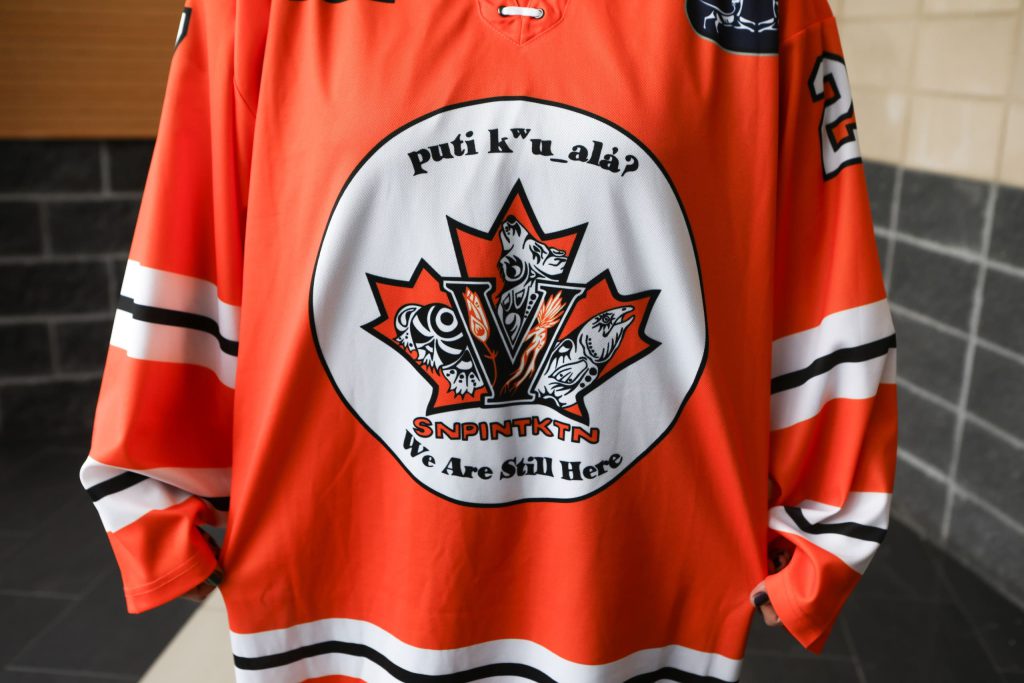
“I chose the four Food Chiefs because they’re very important in our culture. Chief Black Bear — skəmxist — he gave his life first for our people, and then the other Food Chiefs followed after him,” she explained.
“Without the four Food Chiefs, we wouldn’t have our music. We wouldn’t have our food. It also teaches us that reciprocity is very important — when you take something from the land, it’s very important that you give back to it. I try to live by that.”
Included in the design is PIB’s logo, and the placename snpink’tn, which is the original nsyilxcən name of the area in syilx Okanagan territory, from which the City of Penticton’s name is derived from.
The phrase “puti kʷu‿aláʔ,” which translates to “we are still here” from nsyilxcən to English, appears on the jersey also.
Paul said she wanted to honour the fact that the syilx Okanagan people are still here living on their ancestral homelands, despite “Canada’s” attempted genocide of her people through colonial efforts such as the residential “school” system.
“Me and my siblings are the first generation not to go to residential school. My mother, my uncles and my aunties ended up going to residential school, so this personally meant a lot to me,” she said.
“Our people made these sacrifices for us.”
By paying tribute to the Four Food Chiefs and their sacrifices, Paul said she was paying respect to the sacrifices made by her family, too.
“I take a lot of inspiration from skəmxist,” she said.
“When we were younger, we all had to take care of each other. … skəmxist sacrificed himself for his people. And my siblings sacrificed their time for me.”
Designing an athletic jersey felt like a full-circle moment for Paul — growing up as the second youngest in a family of seven children, she remembered the rest of her family excelling at sports.
She recalled feeling the pressure of living up to the “go-getter, hard-working” attitude that was set by her older siblings, but feeling like “a bit of a strange kid” because she favoured art over athletics.
“I started painting ever since I can remember,” Paul said.
“My first real painting that I showcased to my siblings was a painting I did for my mom for her 50th birthday. It was an angel holding a dove — she loved angels. I spent hours working on it. That’s when everyone realized that, ‘Hey, Wynona’s an artist.’”
Team leader wants Indigenous night to be first of many
Prior to the puck drop last Friday, Paul — along with her sister, her nephew and a fellow PIB member — sang the Okanagan Song to the crowd. The High Water Drummers also performed during the opening ceremony.
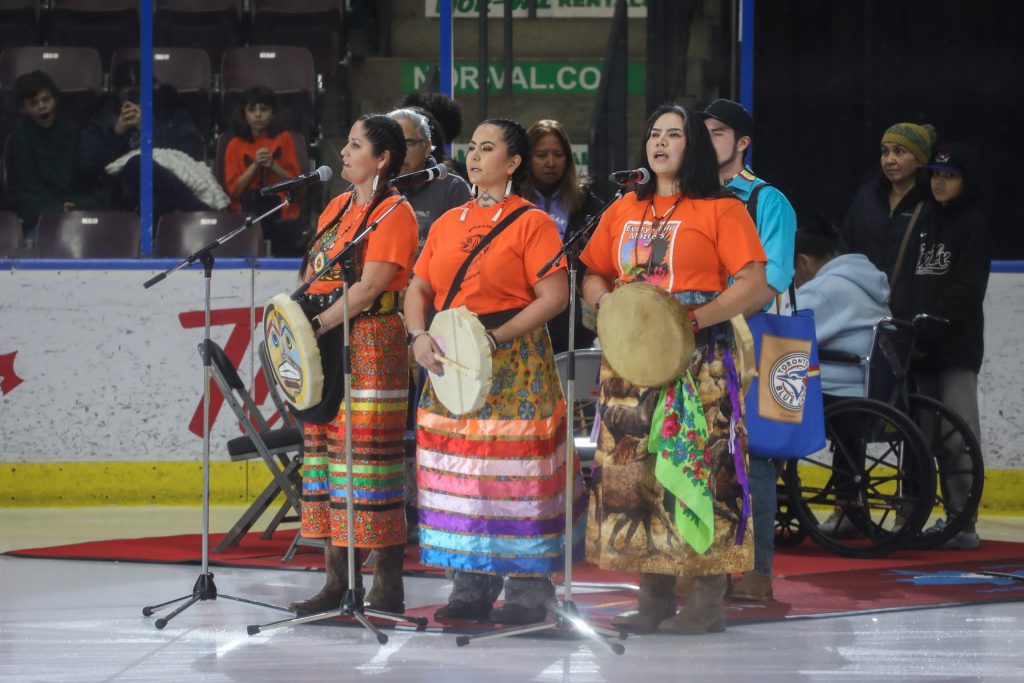
Family, friends and community members were in attendance to support Paul. Several fans in the stands wore orange shirts and jerseys to honour the theme of the night.
After the opening ceremony, PIB Chief Greg Gabriel and City of Penticton Mayor Julius Bloomfield — both wearing Paul’s jersey design — carried out the ceremonial puck-drop at centre ice.
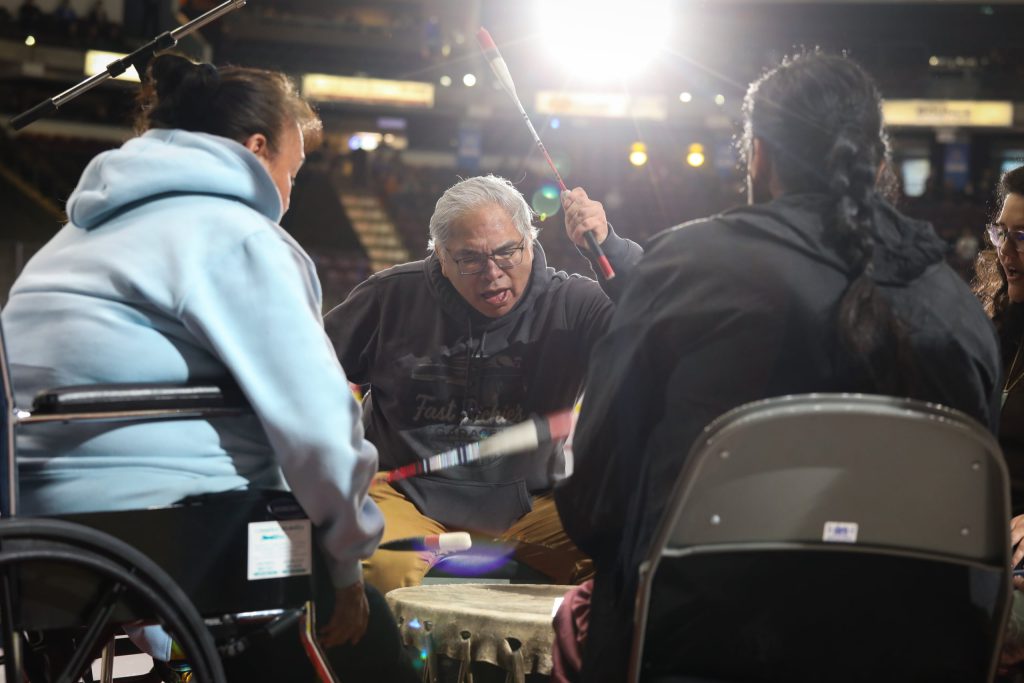
The Vees, all wearing Paul’s jerseys, then took to the ice to play the Cowichan Valley Capitals, whom they defeated 6-1.
According to Fraser Rodgers, the vice-president of business operations for the Penticton Vees, the team’s Indigenous night is designed to highlight the syilx Okanagan people and their culture, and to educate the public about the history of colonialism.
The initiative is a collaboration between the Vees, PIB and the Okanagan Nation Alliance (ONA). During intermissions, educational videos produced by ONA were broadcasted on the jumbotron.
This was the first year that the Vees hosted an Indigenous night in the team’s history, and Rodgers said that he hopes that the inaugural event last Friday can kickstart a yearly tradition.
“We’re trying to establish a several year partnership going forward — a year-over-year partnership with PIB and Okanagan Nation Alliance,” said Rodgers.
Rodgers said that Paul’s design was chosen because it told a story.
“She came up with a story that she wanted to tell with the Four Food Chiefs on the front. It turned out beyond my expectations for the jersey for the first time,” he said.
“I think the public is going to really receive it well and enjoy seeing these on the ice.”
The orange jerseys worn by the players will be auctioned off, Rodgers said, with all proceeds going towards the Orange Shirt Society.
Because of scheduling, he said that the team had to host the night in January, but he hopes that in the future, their Indigenous Night will be held closer to Orange Shirt Day — or the National Day of Truth and Reconciliation — at the end of September.
“Going forward, just having the night where we can do this and have local artists, local performers,” he said. “The jersey, hopefully, can change every year, too.”
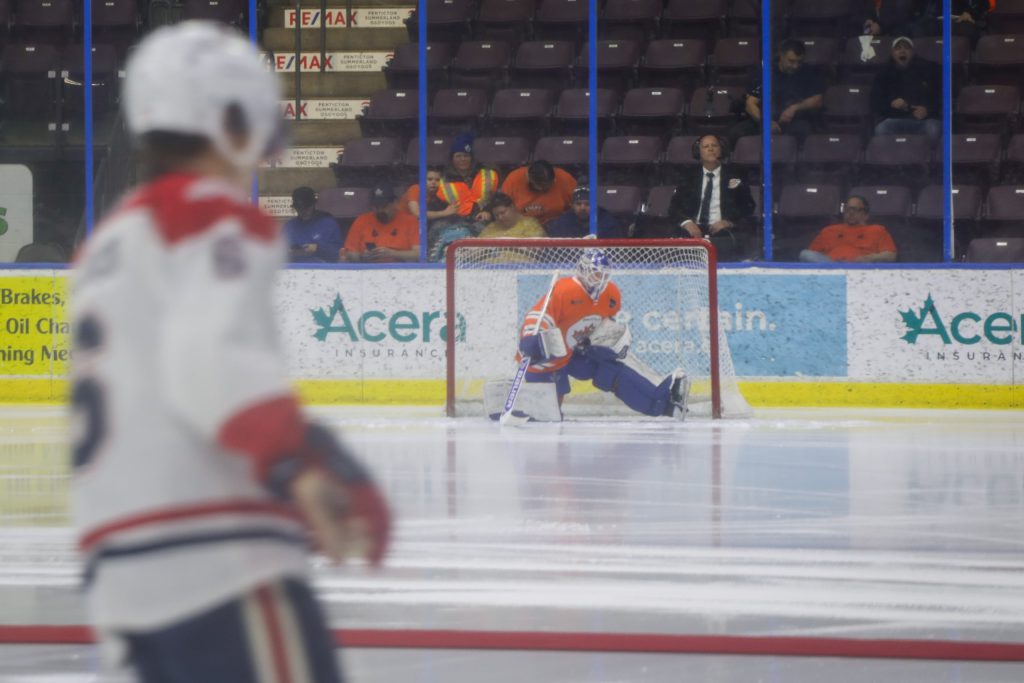
Author
We live in a media ecosystem that thrives on misinformation. Big Tech and AI companies are consuming the work of real human beings and Canadian news has been banned on Facebook and Instagram.
And yet, I have hope for journalism because of the work we’re doing at IndigiNews.
At IndigiNews, we embody tâpwêwin — the Cree value of integrity and responsibility in truth-telling. We are committed to our independent, Indigenous-led newsroom rooted in community, accountability, and relationality. We believe storytelling is a sacred fire that connects our pasts, presents, and futures through the storytellers in our Storytelling Lodge. IndigiNews creates space for Indigenous journalists, storytellers, Knowledge Keepers, and communities to gather, learn, and share stories that matter.
As a registered charity, we are building a fire that allows our work not just to ignite but to thrive. Rather than relying on advertising or corporate acquisition, IndigiNews is sustained by people like you who believe Indigenous stories are important for the future of our communities.
Your support is making a real difference.
Our community of supporters, our Firekeepers, make it possible to grow our newsroom, publish award-winning journalism, train emerging Indigenous journalists through initiatives like the ReFocus Photojournalism Fellowship, and publish trustworthy stories that serve our communities across the country. Every story we publish helps fill in gaps left by mainstream media and ensures Indigenous perspectives are represented with care, accuracy and respect.
But there is still more work to do.
As the media landscape becomes more and more uncertain, community support is as necessary and essential as it’s ever been. Every new Firekeeper helps protect the independence of our newsroom and strengthens journalism that is accountable to our many and varied communities over corporations.
That’s why we’re inviting you to become a Firekeeper.
Firekeepers tend to and protect the sacred fire. Your monthly contributions directly support IndigiNews’s Storytelling Lodge, helps sustain our independent, Indigenous-led newsroom, and ensures future generations of Indigenous storytellers have the resources they need to do the work.
As a registered Canadian charity, all eligible donations receive a charitable tax receipt.
If you believe Indigenous stories matter, if you value independent journalism, and if you want to help build a strong future for Indigenous media, we invite you to join our circle of Firekeepers today.
Together, we can keep the fire burning.
— Eden Fineday, Publisher, IndigiNews
Support us nowLatest Stories
-
Indigenous leaders give the UN a roadmap for protecting their peoples
Amidst prayers and vows of solidarity, UN Expert Mechanism on the Rights of Indigenous Peoples ends annual meetings with demands for ‘action we’re not seeing globally’
-
Indigenous people demand more say at the UN, as new crises hit their homelands
Indigenous nations live ‘on the frontlines’ of climate, conflict and new tech. But their voices remain sidelined in the global halls of power.