Winnipeg cops unveil ‘reconciliation’ cruiser — but critics are unimpressed
Force says the police car emblazoned with Indigenous art not for enforcement but education. Advocates say the gesture is ‘uncomfortable’ and ‘unsettling’ — especially amidst a drug-use crackdown they say targets Indigenous people
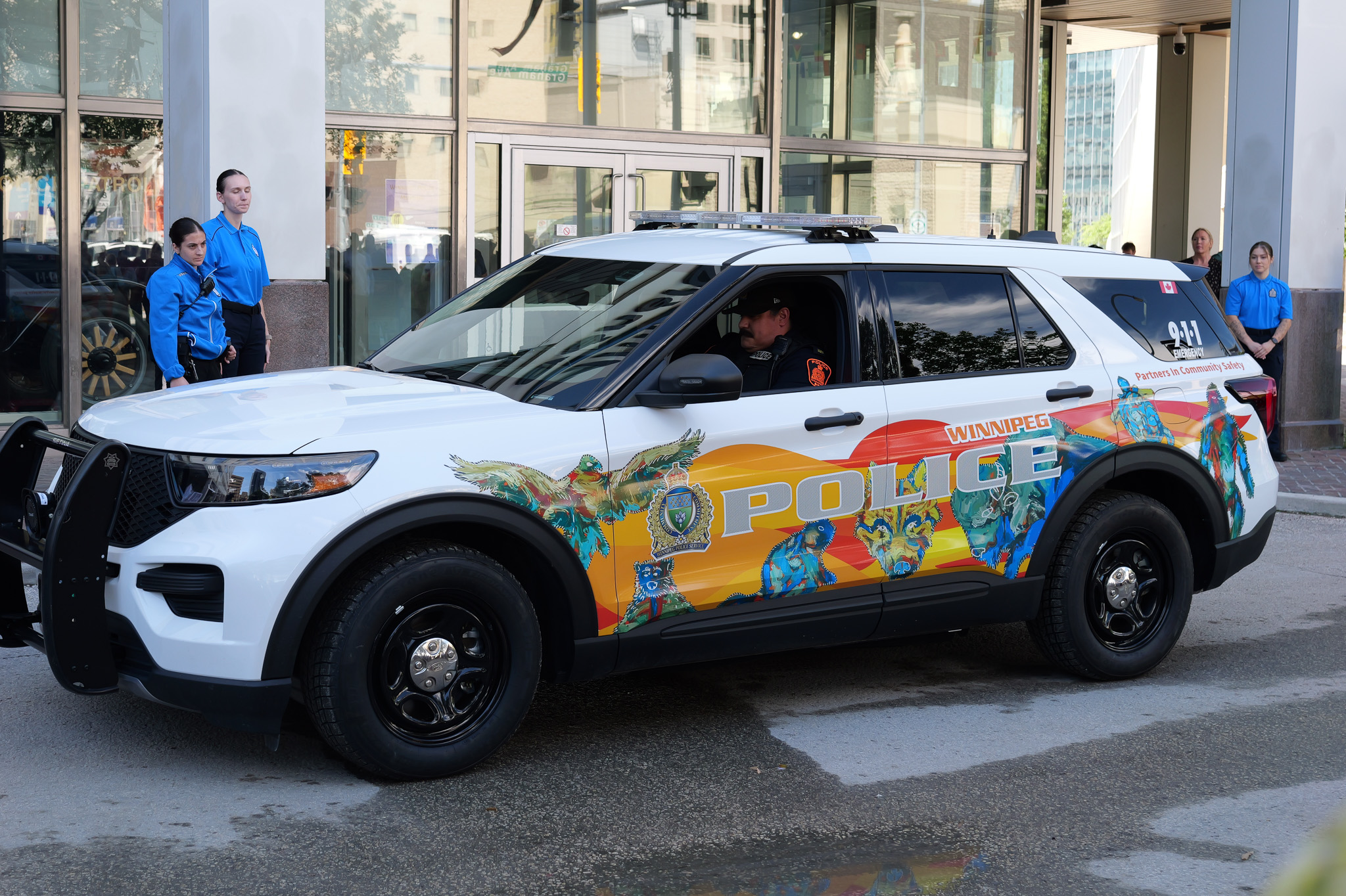
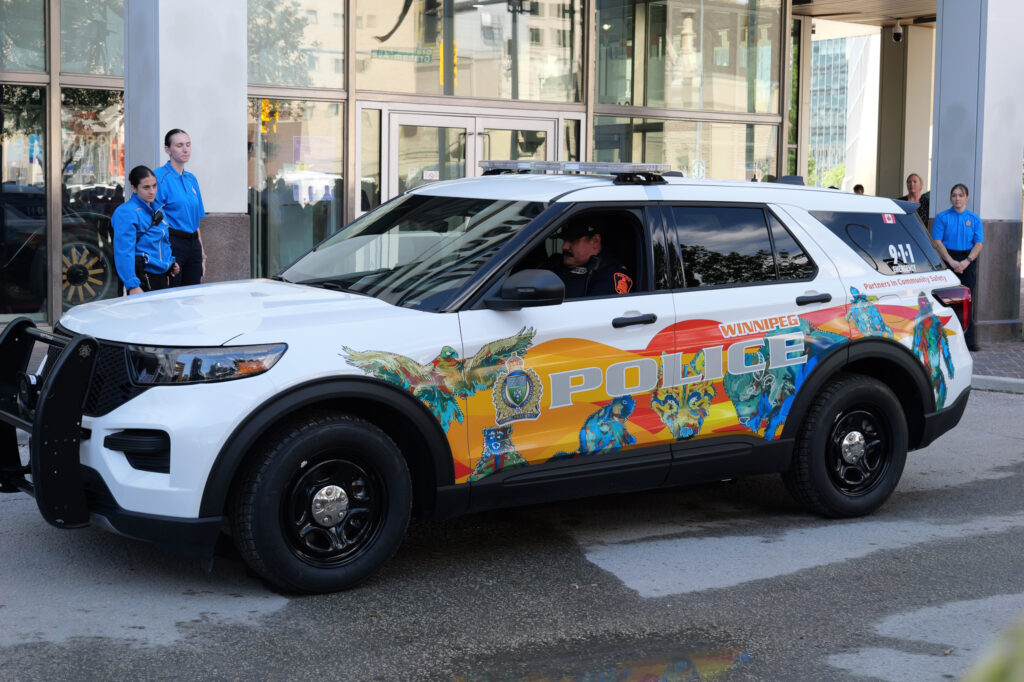
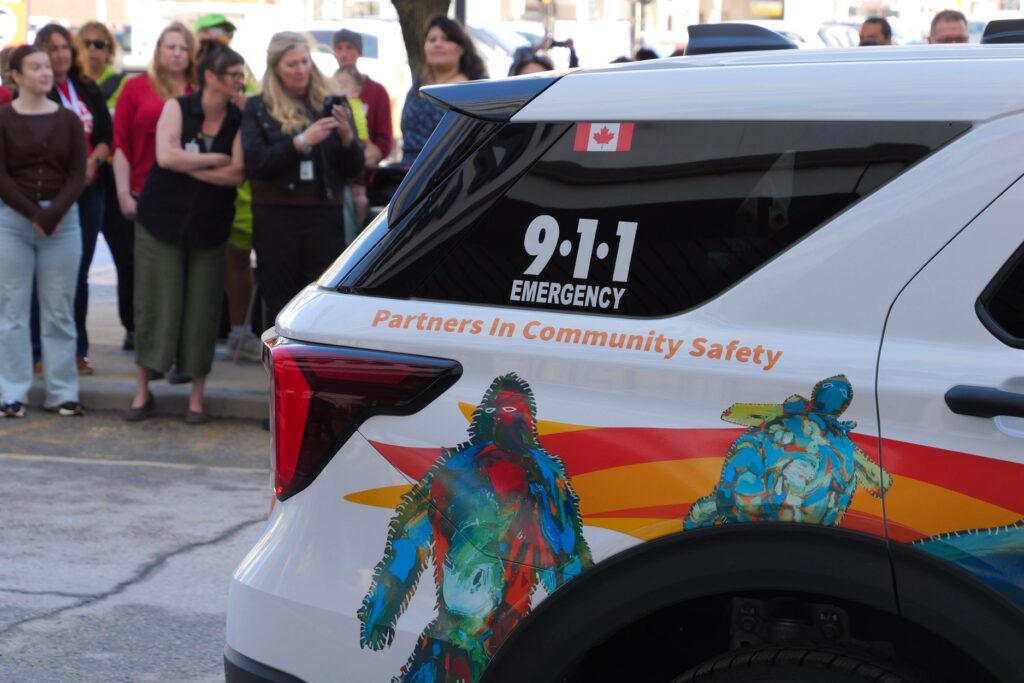
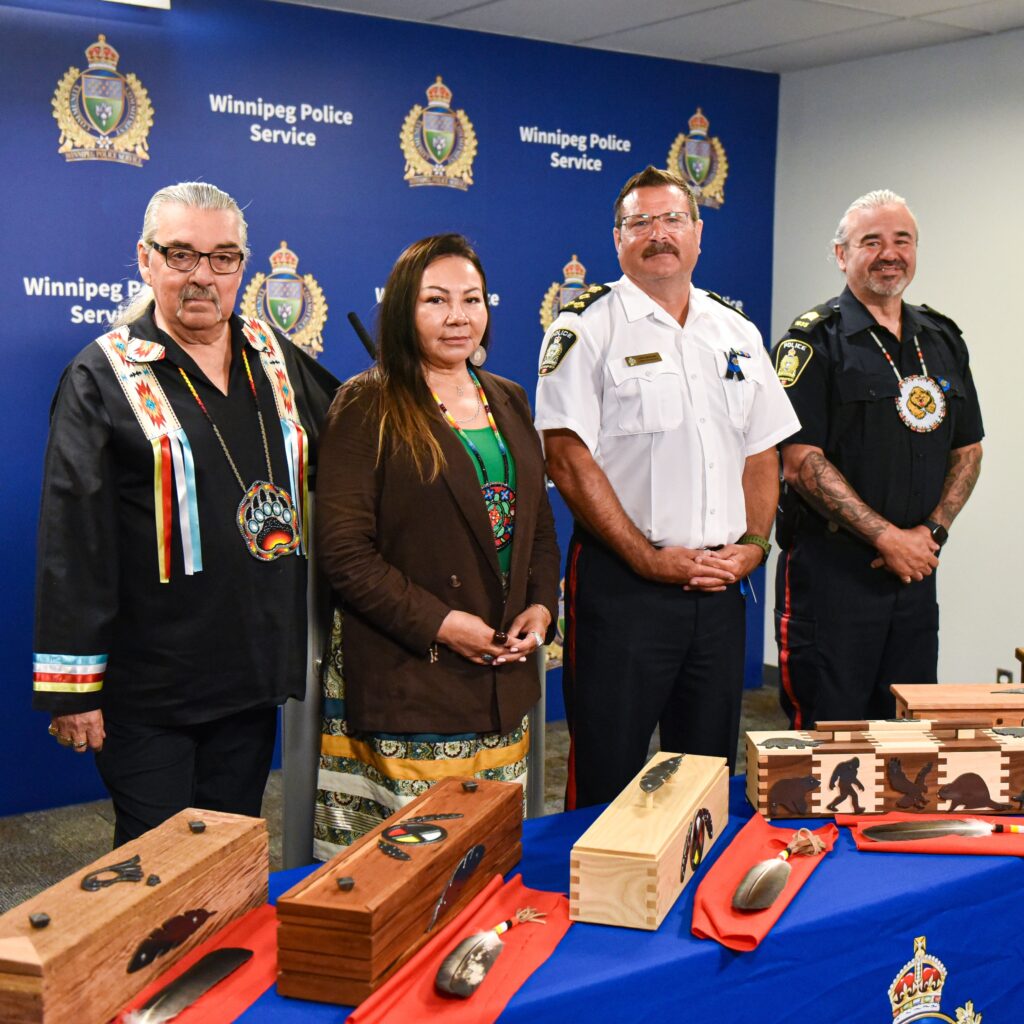
The Winnipeg Police Service (WPS) proudly showed off the newest tool in its law enforcement arsenal last week: a “reconciliation” cruiser, featuring symbols from Anishinaabe and Inuit cultures.
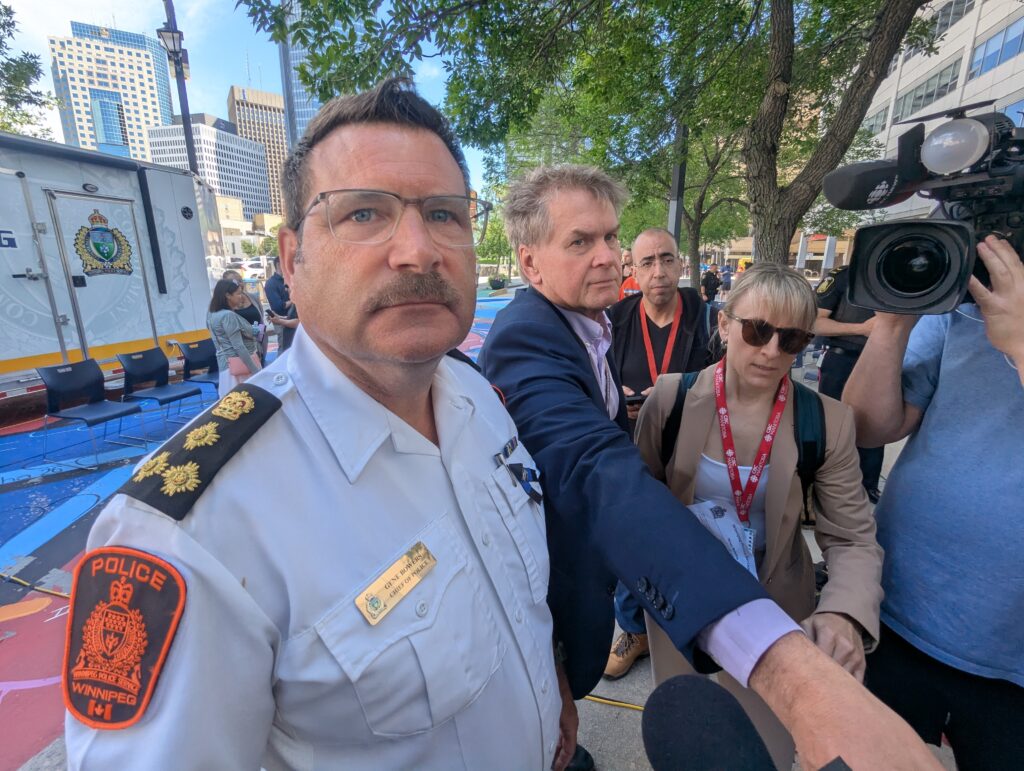
“Reconciliation requires action,” WPS Chief Gene Bowers told reporters on June 30. “This cruiser will be used to create spaces to share, listen and learn.”
But for the force’s critics, the timing of the symbolic gesture could not have been more inappropriate.
The event unveiling the cruiser — which includes animals from Anishinaabe culture’s Seven Sacred Teachings, and an ulu (blade) and kayak representing Inuit culture — coincided with a ten-day drug enforcement crackdown advocates say disproportionately harms Indigenous people.
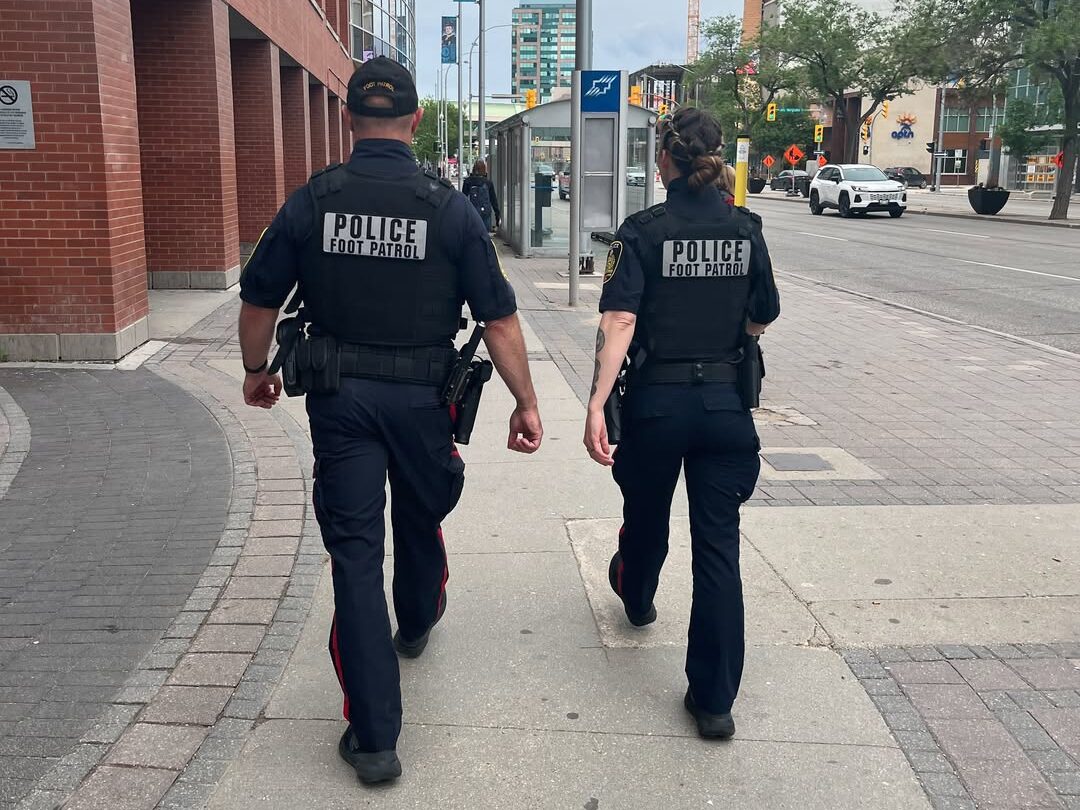
The policing blitz targets people who use drugs openly on the city’s streets.
Dawnis Kennedy, an associate criminal justice professor at the University of Winnipeg, found the new cruiser design “unsettling.”
“It doesn’t change that relationship, it doesn’t change that gut feeling,” the Roseau River Anishinabe First Nation member told IndigiNews.
“As an Anishinaabe woman, the sight of a police cruiser for me still generates fear from traumatic interactions with police.”

About twenty years ago, Kennedy recounted being knocked to the ground during a sweep in Winnipeg’s North End neighbourhood. Her son recently had a run-in with WPS officers, she added.
To her, “art is supposed to be uplifting.”
The timing of the reconciliation cruiser’s launch outside police headquarters came amidst questions about how the 10-day anti-drug sweep would affect the overrepresentation of Indigenous Winnipeggers caught up in a cycle of addictions and homelessness.
‘That’s not reconciliation’
Experts say disproportionate rates of poverty and addiction among Indigenous people are often rooted in experiences of colonial trauma — including from the foster care system, the Sixties Scoop, the intergenerational impacts of residential “schools,” and violence from authorities, particularly police.
Kennedy said repeated calls to action and community-based solutions to these overlapping crises — including from the Manitoba Justice Inquiry, the National Inquiry into Missing and Murdered Indigenous Women and Girls, and the Truth and Reconciliation Commission — are still being ignored.
“The strongest calls are about reestablishing Indigenous justice systems and investing in that,” she said.
But instead of heeding those calls for government investments, she added, most of the Indigenous justice system work in the community “is done on a shoestring budget,” often relying on grassroots fundraising campaigns and events.
Meanwhile Winnipeg police have seen annual increases to their budget. This year, the city increased its funding to $371 million, up five per cent from 2025, and nearly 12 per cent above the year before.
“Always responding with increased budgets for institutions that have perpetrated colonialism — to me, that’s not reconciliation,” Kennedy said.
“Traditional justice initiatives themselves are very underfunded, so doing harm reduction, addressing the intergenerational trauma and ongoing trauma of colonization, are often sidelined.”

For the first time since 2013, Winnipeg has seen an increase in the ratio of officers to the population — climbing to 166.8 police officers for every 100,000 people last year, up 1.2 per cent from the year before, according to an Environment on Policing in Winnipeg 2026 report.
She said putting more police officers on the street also comes with expanded powers.
For instance, police now have more discretionary authority under a law passed last October, the Protective Detention and Care of Intoxicated Persons Act.
Also known as Bill 48, it allows police to involuntarily incarcerate any person “so intoxicated by alcohol, drugs or other substances that they cannot safely remain in public” — in some cases for up to three days.
“They can detain people without formally arresting them,” said Bronwyn Dobchuk-Land, another University of Winnipeg associate professor of criminal justice.
The increase in both police powers and budgets coincides with multiple health crises in the city.
On May 7, Manitoba’s Chief Provincial Public Health Officer declared an emergency over skyrocketing HIV rates, which he linked to “the convergence of homelessness, mental health concerns, substance use and socio-economic inequality,” through which “Indigenous people are disproportionately affected.”
“When you police people’s survival strategies, you produce isolation, death,” added Dobchuk-Land.
“You make people go missing from the communities of people who love them and care about them.”
By increasing police powers, she argued, authorities are in fact doing the opposite of what WPS’s cruiser graphics signify.
“It feels like an attempt to rebrand what reconciliation is — and what we should accept,” Dobchuk-Land said.
“Increased police powers undermine self-determination and reconciliation.”
And if “reconciliation” is rebranded as new police car artwork, “then I think we’re being trained to lower our expectations.”
‘A meaningful step toward strengthening relationships’
Police Chief Bowers told reporters the police cruiser — which was designed by Métis artist and WPS detective Brian Hunter — will not be used for enforcement on city streets.
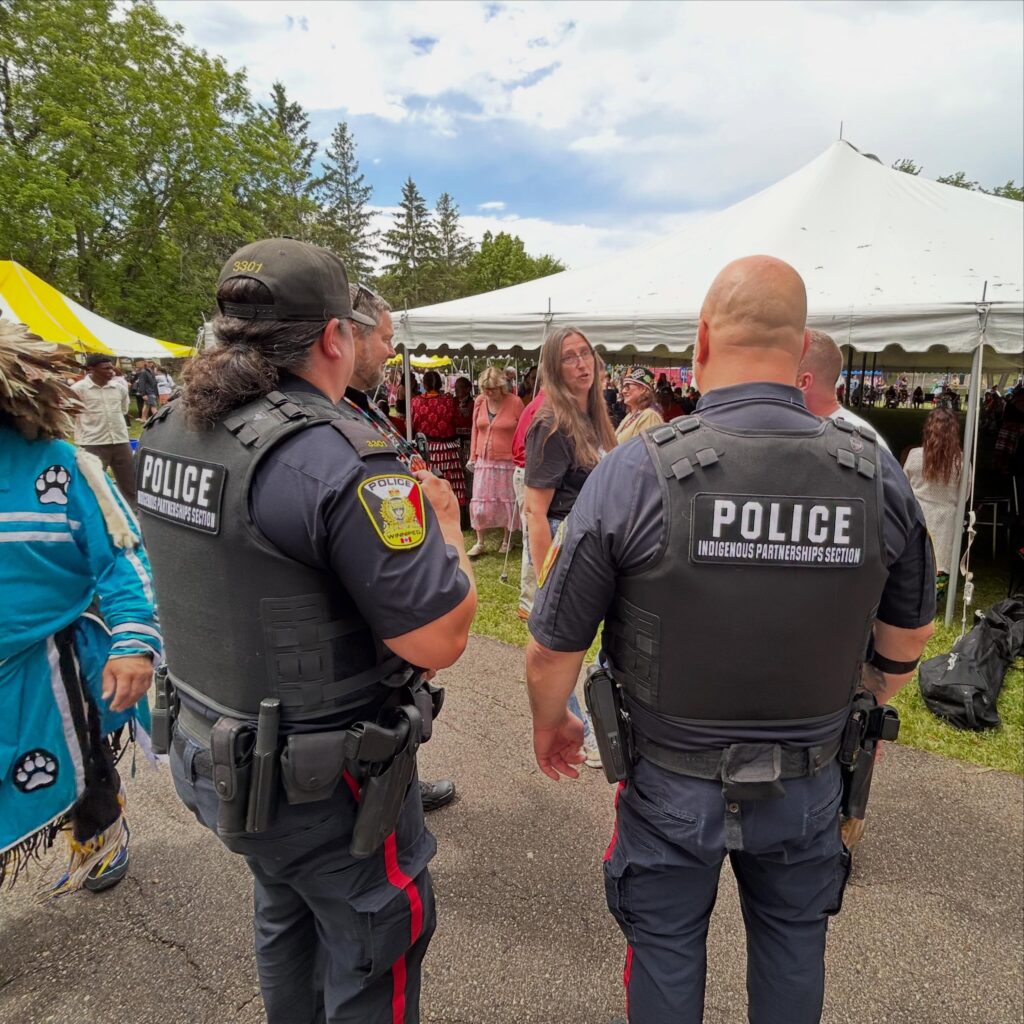
Rather, it will be deployed by the force’s community relations department at powwows and other public events.
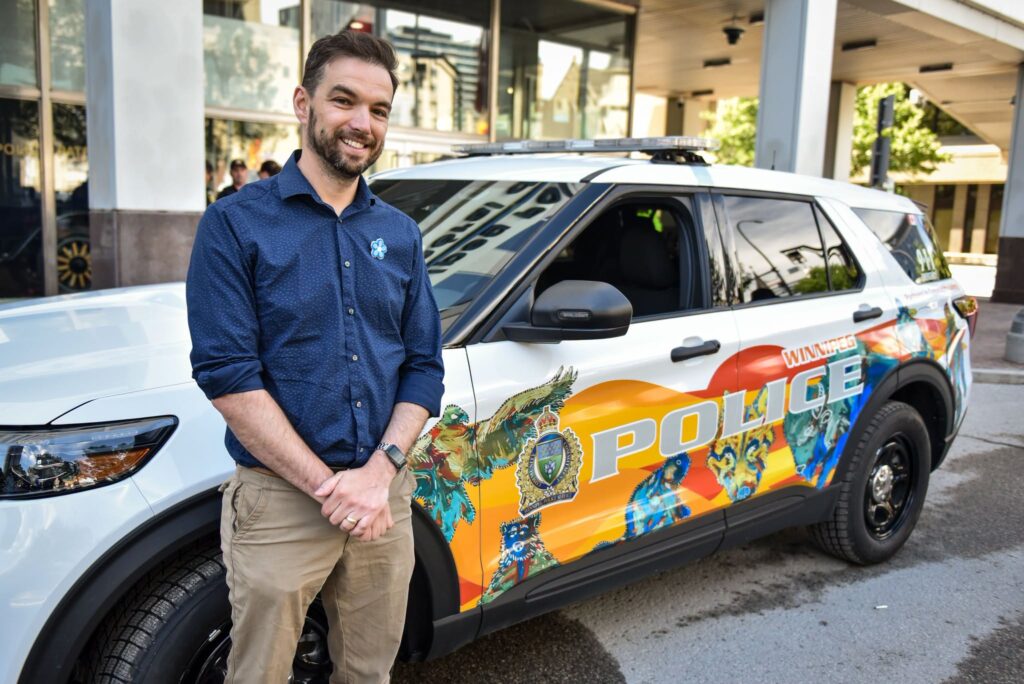
Hunter, the artist behind the cruiser design, explained that he chose its colours “to reflect the water, the sky and the land that we all live in together.”
He wanted to make the artwork appear stitched or sewn onto the vehicle, “a reference to the thoughtful work we’re all doing as a community, as well as the important work that still needs to be done,” he said.
“I was thinking about my own place as a person of Indigenous heritage working as a police officer, and the responsibility I carry being part of this colonial system.”
The new cruiser was created “in partnership” with the Assembly of Manitoba Chiefs (AMC), an advocacy group which represents 63 First Nations as well as the non-profit Tunngasugit, which helps Inuit adjust to city life.
“This collaboration represents a meaningful step toward strengthening relationships, fostering understanding, and continuing to work together,” the AMC posted on Facebook, “in support of First Nations families and communities impacted by the crisis of missing and murdered First Nations peoples.”
The unveiling of the cruiser came just after an open house at which AMC officially opened its own Missing and Murdered Persons Unit.

The WPS has supported AMC’s efforts advocating to search local landfill sites for missing and murdered Indigenous people.
“There has been a close relationship with that unit and the team at the Assembly of Manitoba Chiefs, working in collaboration with the Winnipeg Police Service, so I commend the [WPS] for this work that we’re seeing today, but also the work that will continue on,” said Kyra Wilson, AMC’s Grand Chief, as she presented Bowers with a ribbon shirt and moccasins.
“We come together to ensure the safety of everyone, of course, but also for our very vulnerable populations that we see here in the City of Winnipeg.”
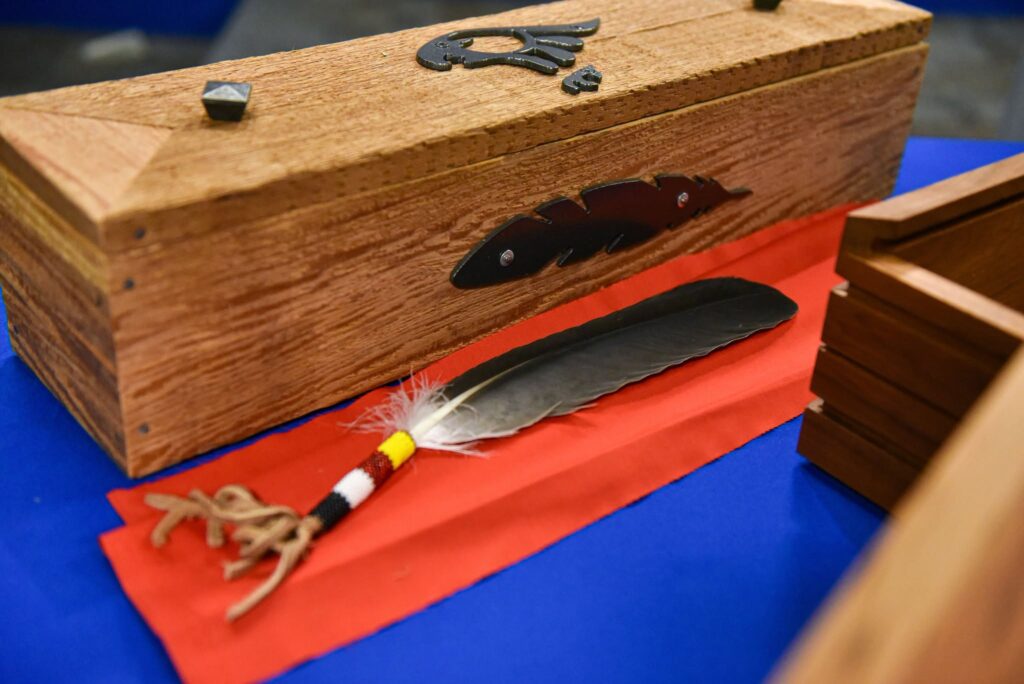
In addition to the new cruiser, the police force also began offering eagle feathers in the city’s four police districts as an option when people are required to swear a legal oath — instead of the currently accepted religious texts, such as the Bible, which many Indigenous people associate with abusive Christian indoctrination in residential “schools.”
According to Manitoba law, “an oath may be administered to any person while that person holds in their hand a copy of the Old or New Testament.”
(For those who won’t swear on a Bible, the law allows for an “alternate form of oath … with such ceremonies, as the person declares to be binding,” or else making a “solemn affirmation or declaration instead.”)
The new eagle feather option is “about making people feel … inclusion who are giving statements that are on some very difficult events often,” Bowers said, “but give them that power and that feeling that they’re being listened to and heard.”
‘10 days have been the hardest for us’
The police force’s anti-drug sweep has drawn criticism from frontline community organizations, including Indigenous non-profits Tunngasugit, Ka Ni Kanichihk, and the Aboriginal Health and Wellness Centre.
Bowers said he met with a coalition of groups after they released a joint statement on June 26 about the force’s anti-drug sweep.
The organizations said they were not consulted before the WPS carried out its operation, raising “urgent concerns about the impacts of enforcement on public health, access to care, and community safety.”
“This heightened enforcement comes just days after a local outreach worker publicly reported being racially profiled and wrongfully detained while carrying out their work in the community,” the coalition’s statement added.
After the end of the enforcement blitz, the coalition issued a second release decrying “the harms we were witnessing” against vulnerable residents.
“These last 10 days have been the hardest for us in a long time,” stated the joint statement.
They noted that one unhoused person had a fatal overdose “hiding in an unmonitored area,” away from the places being targeted by officers.
“In the coming weeks, we hope to meet with WPS to ensure accountability for this campaign including a transparent review of its outcomes,” the groups stated.
“We believe a co-ordinated Winnipeg-made response to these complex issues that is grounded in human dignity will increase public safety.”

At a June 26 press conference, Winnipeg Mayor Scott Gillingham said the “crackdown on open illegal drug use and drug trafficking” came as a result of “business owners, people who work in the downtown, and people who want to simply use public spaces safely.”
But for him it was also personal. “I’ve grown tired of looking out my office window and seeing the same thing,” he told reporters.
After receiving repeated complaints from merchants and other residents, Gillingham said he supports the force’s declared “zero tolerance” approach of confiscating substances and detaining individuals in a 72-hour detox centre.
“Over the past few weeks, Chief Bowers and I have been speaking together about this issue,” he said, “and I support his action and the action of his officers in these days through this initiative,.”
He insisted that he supports “more pathways off the street into care” for people with addictions — but warned “illegal open drug use and trafficking will not be tolerated in public spaces.”
“People across the city have been telling us that they’re tired of seeing fentanyl and other drugs used openly in bus shelters, parks and other public spaces,” he told reporters.
“This is about public safety and about the image of our city.”
He acknowledged Winnipeg shares similar social problems with most major cities in North America.
He said that “people need connection to resources, to treatment, to long-term recovery, and to housing” — but added that would not happen overnight.
Whose public safety, frontline workers ask
But not everyone agrees that his force’s crackdown is really about the public’s safety — noting that substance users are members of the public, and at significant risk.
“It hasn’t made anybody safer,” said community safety consultant Victor Mondaca, who co-founded Nahuen Consultation with his spouse Amanda. The couple offers training in harm reduction and reversing overdoses with naloxone.
“This actually increases the potential for individuals to die from drug poisoning.”
According to Health Canada, when people “hide their drug use or use drugs alone” it “puts them at risk of dying if they have an overdose” and “discourages them from seeking health and social services.”
Since 2016, the agency has recorded at least 56,631 deaths from apparent opioid toxicity. And Public Health Agency of Canada research found “the majority of opioid-related deaths occurred when the individual was alone, indoors.”
As Dobchuk-Land notes, the way for substance users to ensure their safety is by “using drugs together and in public,” and working to “organize themselves into groups” such as encampments.
“It’s a solution to the problem of being isolated and houseless,” she said.
“Same with using drugs together and in public — that’s actually a solution to the danger of a poisoned drug supply.”

For Mondaca, a frontline community worker with lived experience in recovery from addiction, the police’s 10-day anti-drug campaign was less about safety than “because the general public doesn’t want to see suffering anymore.”
“The police now have to go and sweep it under the rug,” he said. “It’s hiding the most vulnerable and the most suffering and removing them from plain sight, because it makes people uncomfortable.
“This isn’t stopping the suffering, the trauma, this isn’t stopping the substance use — this is only making it more dangerous for individuals to use substances.”
In the last month, Mondaca recounted using naloxone to save three people who overdosed.
“The only reason I find these individuals is because they’re visible to me, because they’re out in the open,” he explained.
“Had they been pushed out of those open spaces into back lanes and corners … we would not have found them, and we wouldn’t have been able to help.”
Part of the solution that Mondaca sees is by training Winnipeggers how to respond to overdoses, through teaching them how to give naloxone.
‘Moving the needle towards reconciliation’
IndigiNews asked Bowers — who leads a force founded in 1874 — how he reconciles his commitments to address colonialism with being just one individual within the policing system.
“I am one person, but I’m in a position of influence,” Bowers replied. “And I think that as a leader, I have that influence over not only my members, but the community.
“That goes a long way when leadership stands up and starts moving the needle towards reconciliation and respect and dignity to everybody in our community.”
But for Amanda Mondaca, Nahuen Consultation’s co-founder and operations lead, the new police “reconciliation” cruiser made her “deeply uncomfortable.”
“Reconciliation cannot be reduced to symbolism,” she wrote to IndigiNews, “while Indigenous communities continue to be overrepresented in homelessness, substance use related harms, and interactions with systems that too often respond to trauma with punishment instead of care.
“Artwork is easy. Real reconciliation means changing the systems that continue causing harm.”
Author
We live in a media ecosystem that thrives on misinformation. Big Tech and AI companies are consuming the work of real human beings and Canadian news has been banned on Facebook and Instagram.

And yet, I have hope for journalism because of the work we’re doing at IndigiNews.
At IndigiNews, we embody tâpwêwin — the Cree value of integrity and responsibility in truth-telling. We are committed to our independent, Indigenous-led newsroom rooted in community, accountability, and relationality. We believe storytelling is a sacred fire that connects our pasts, presents, and futures through the storytellers in our Storytelling Lodge. IndigiNews creates space for Indigenous journalists, storytellers, Knowledge Keepers, and communities to gather, learn, and share stories that matter.
As a registered charity, we are building a fire that allows our work not just to ignite but to thrive. Rather than relying on advertising or corporate acquisition, IndigiNews is sustained by people like you who believe Indigenous stories are important for the future of our communities.
Your support is making a real difference.
Our community of supporters, our Firekeepers, make it possible to grow our newsroom, publish award-winning journalism, train emerging Indigenous journalists through initiatives like the ReFocus Photojournalism Fellowship, and publish trustworthy stories that serve our communities across the country. Every story we publish helps fill in gaps left by mainstream media and ensures Indigenous perspectives are represented with care, accuracy and respect.
But there is still more work to do.
As the media landscape becomes more and more uncertain, community support is as necessary and essential as it’s ever been. Every new Firekeeper helps protect the independence of our newsroom and strengthens journalism that is accountable to our many and varied communities over corporations.
That’s why we’re inviting you to become a Firekeeper.
Firekeepers tend to and protect the sacred fire. Your monthly contributions directly support IndigiNews’s Storytelling Lodge, helps sustain our independent, Indigenous-led newsroom, and ensures future generations of Indigenous storytellers have the resources they need to do the work.
As a registered Canadian charity, all eligible donations receive a charitable tax receipt.
If you believe Indigenous stories matter, if you value independent journalism, and if you want to help build a strong future for Indigenous media, we invite you to join our circle of Firekeepers today.
Together, we can keep the fire burning.
— Eden Fineday, Publisher, IndigiNews
Support us nowLatest Stories
-
Indigenous leaders give the UN a roadmap for protecting their peoples
Amidst prayers and vows of solidarity, UN Expert Mechanism on the Rights of Indigenous Peoples ends annual meetings with demands for ‘action we’re not seeing globally’
-
Indigenous people demand more say at the UN, as new crises hit their homelands
Indigenous nations live ‘on the frontlines’ of climate, conflict and new tech. But their voices remain sidelined in the global halls of power.