Could conservationists buy a portion of Fairy Creek to protect it?
The Discourse answers community members’ questions about Fairy Creek.
This story was originally published on June 23 by our partners at The Discourse. For more analysis on Fairy Creek, sign up for The Discourse’s pop-up newsletter.
In response to our news coverage about the resistance to old-growth logging in the Fairy Creek area, a reader wrote in and asked: Is the land — or a portion of it — private such that a group of conservationists could buy some portion of it to protect it?
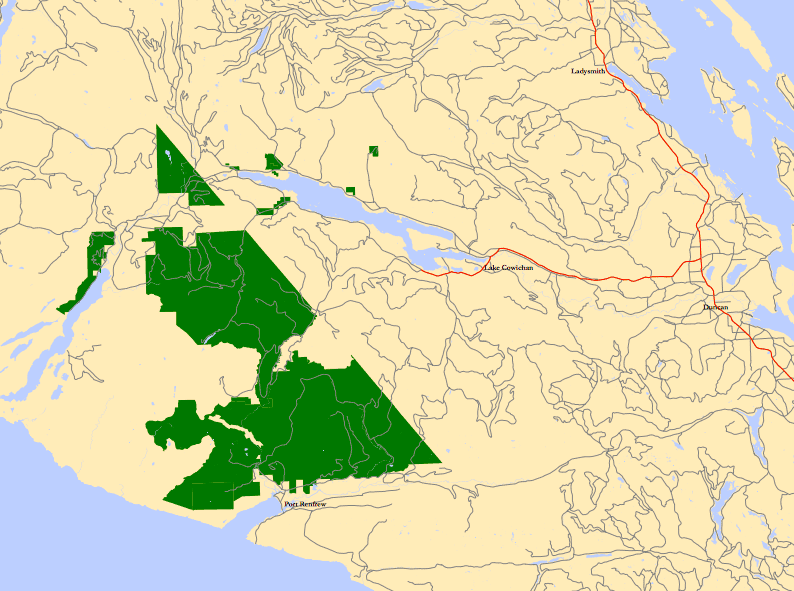
The area where the protests are taking place is Crown land. While “Fairy Creek” has become a shorthand for the conflict’s location, the blockades and camps span a large area, both in the vicinity of the Fairy Creek watershed and in the Caycuse area, which is a significant distance away.
The actual title holders of Crown land are the First Nations on whose unceded traditional territory it sits, in this case Pacheedaht First Nation and Ditidaht First Nation. Recently, the Pacheedaht, Ditidaht and Huu-ay-aht asserted their intention to make their own decisions around what activities will be permitted on their lands.
Meanwhile, the forestry company Teal-Jones has a 25-year licence to harvest timber from a large swath of these territories, including the areas at issue in the protests.
The licence is a deal between the company and the province where the company agrees to harvest timber and pay taxes in return. There’s no precedent or process for conservation groups to buy timber harvesting rights as a measure of protection.
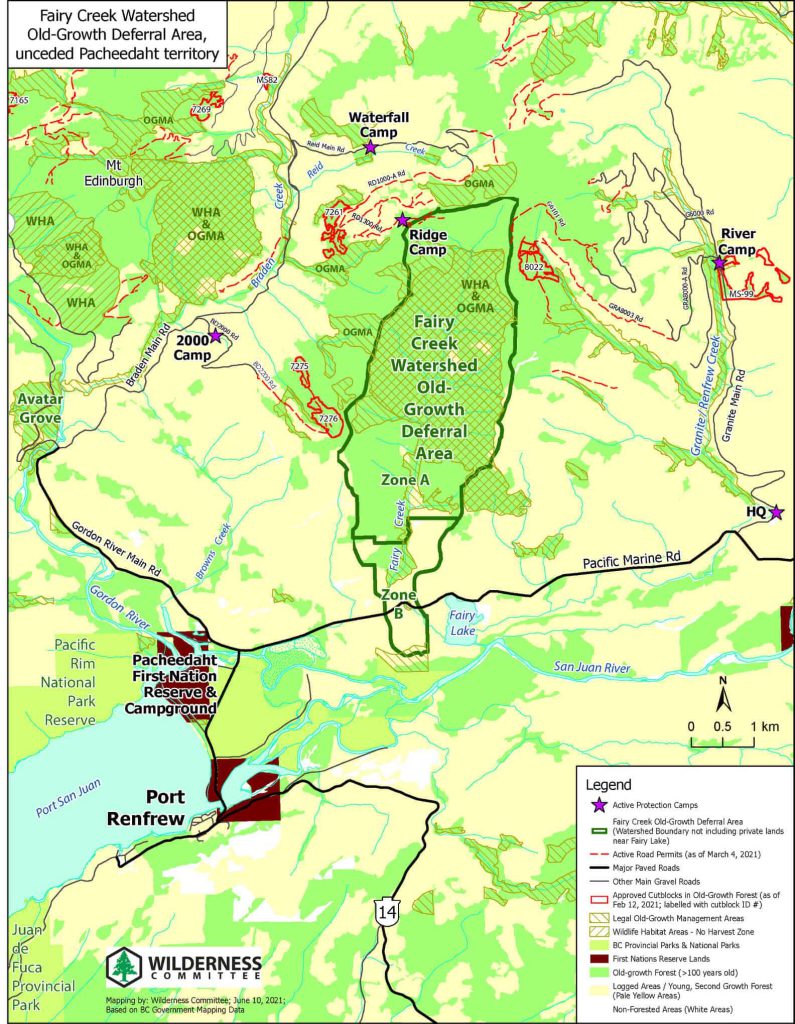
Some level of protection already applies to some, but not all, of the old-growth stands in those areas. Old Growth Management Areas (OGMAs) and wildlife habitat areas cover certain patches, including most of the Fairy Creek watershed. Deferrals announced in recent weeks extend temporary protection further, but cover only a small portion of the old growth that Teal-Jones has harvesting rights to.
According to a 2009 management plan report for this particular licence, the company expected half of its total harvest to be from old-growth forests (where most of the trees are 250 years old or older) between 2009 and 2019.
If the government extends further protections or makes the deferrals permanent, it may be required to compensate Teal-Jones for its losses.
Author
We live in a media ecosystem that thrives on misinformation. Big Tech and AI companies are consuming the work of real human beings and Canadian news has been banned on Facebook and Instagram.

And yet, I have hope for journalism because of the work we’re doing at IndigiNews.
At IndigiNews, we embody tâpwêwin — the Cree value of integrity and responsibility in truth-telling. We are committed to our independent, Indigenous-led newsroom rooted in community, accountability, and relationality. We believe storytelling is a sacred fire that connects our pasts, presents, and futures through the storytellers in our Storytelling Lodge. IndigiNews creates space for Indigenous journalists, storytellers, Knowledge Keepers, and communities to gather, learn, and share stories that matter.
As a registered charity, we are building a fire that allows our work not just to ignite but to thrive. Rather than relying on advertising or corporate acquisition, IndigiNews is sustained by people like you who believe Indigenous stories are important for the future of our communities.
Your support is making a real difference.
Our community of supporters, our Firekeepers, make it possible to grow our newsroom, publish award-winning journalism, train emerging Indigenous journalists through initiatives like the ReFocus Photojournalism Fellowship, and publish trustworthy stories that serve our communities across the country. Every story we publish helps fill in gaps left by mainstream media and ensures Indigenous perspectives are represented with care, accuracy and respect.
But there is still more work to do.
As the media landscape becomes more and more uncertain, community support is as necessary and essential as it’s ever been. Every new Firekeeper helps protect the independence of our newsroom and strengthens journalism that is accountable to our many and varied communities over corporations.
That’s why we’re inviting you to become a Firekeeper.
Firekeepers tend to and protect the sacred fire. Your monthly contributions directly support IndigiNews’s Storytelling Lodge, helps sustain our independent, Indigenous-led newsroom, and ensures future generations of Indigenous storytellers have the resources they need to do the work.
As a registered Canadian charity, all eligible donations receive a charitable tax receipt.
If you believe Indigenous stories matter, if you value independent journalism, and if you want to help build a strong future for Indigenous media, we invite you to join our circle of Firekeepers today.
Together, we can keep the fire burning.
— Eden Fineday, Publisher, IndigiNews
Support us nowLatest Stories
-

Olympic bobsledder Eden Wilson aims to ‘help open doors’ for aspiring Indigenous athletes
Recently inducted into the North American Indigenous Athletics Hall of Fame, the ‘Calgary’-based Métis athlete is working to break barriers for the next generation
-
In Simpcw First Nation, Secwe̓pemc women are revitalizing hide tanning
Working with animal pelts is a lengthy, labour-intensive process — but teachers in the ‘B.C.’ community are ensuring the tradition is passed on