Amid a climate crisis, ‘Vital Signs’ documents the ‘relentless force’ of changing landscapes
The new exhibition at the Bill Reid Gallery features multimedia work from six First Nations artists touching on the personal and collective impacts of climate change


Tucked into a quiet corner of the Bill Reid Gallery is a nine-minute film by Nlaka’pamux artist Jade Baxter about the wildfire that devastated her homelands.
Through a series of raw, handheld clips, Why Would I Leave? documents the months leading up to the June 2021 blaze that tore through “Lytton.”
Baxter’s footage captures not only the fire itself, but the simmering tension of a community living under intensifying climate pressure.
After weeks of record-breaking temperatures during the western “North America” Heat Dome, the fast-moving flames caused two fatalities and destroyed most of the Nlaka’pamux village.
The piece is part of the new exhibition Vital Signs, which features work by six First Nations artists who explore the personal and collective impacts of climate-related catastrophes on their communities.
The six artists — Jade Baxter (Nlaka’pamux), Jasper Berehulke (Syilx/Okanagan), Kali Spitzer (Kaska Dena), Kwiis Hamilton (Hupačasath/Leq’a:mel), Rebecca Baker-Grenier (Kwakiuł, Dzawada’enuwx and Sḵwx̱wú7mesh), and Sage Nowak (Tahltan) — were in attendance. For several of them, Vital Signs marks the first time they’ve shared their work at the downtown “Vancouver” gallery.
On May 13, Matriarch Mary Point welcomed more than one hundred guests to the the opening of the exhibition on the lands of the xʷməθkʷəy̓əm, Sḵwx̱wú7mesh and səl̓ilwətaɬ Peoples.
“This place has many names,” Point said as she stood among guests in the grand hall of the gallery, with its soaring ceilings and mezzanine-level balcony that wraps around the room.
“Whether we think of this place as the Bill Reid Gallery, as ‘Hornby Street,’ as ‘Vancouver,’ I think we can collectively think of this place as — leləm̓ — as home.”

Point, who is from the xʷməθkʷəy̓əm Nation, says she saw “not only a crisis,” depicted in the exhibition works, but “messages of caution.”
“In our language, there is no word for art,” she said. “It’s just part of who you are. I really see that upstairs — it’s part of who you are.”
Across the mezzanine, works by the six artists span painting, cedar sculptures, textiles, photography, film, poetry, jewelry, and drawing — showcasing a wide range of artistic expression.
The exhibition’s title, Vital Signs, refers not only to the measurements of the body’s essential functions, but also to the idea that the land is vital to our existence — a living entity in its own right, say curators Aliya Boubard and Amelia Rea.

In Baxter’s film, scenes of intense orange skies, billowing smoke, and smoldering flames reminiscent of an atomic blast are intercut with quiet hand-held clips of the village, a “Canada” flag hanging from a window, and Baxter’s black cat Mitchuk slipping through the frame. These ordinary moments take on profound weight when followed with the sound of howling wind and the surreal, otherworldly light.
Overlaying the juxtaposed clips is a poem, written by Baxter before the fire, in 2019.
“If you crawled up from the river you would see there are worn metal tracks” she reads. “Pounded so deep into rock it could start a blaze to burn this heart out.”

The poem references Pasco v. Canadian National Railway, a landmark 1985 B.C. Supreme Court decision. On August 19 of that year, the court issued an injunction preventing CN Rail from constructing a second track along an eight-mile stretch of the Thompson River — a ruling that safeguarded Nlaka’pamux fishing and cultural sites.
Silhouetted against a hillside ablaze, two figures stand watching as thick smoke swallows the night sky. Over the scene, Baxter delivers a stark quote from CN Rail’s legal counsel: “There is god. And next to god is the railway.”
The frame then cuts to an eagle circling high above the smoke. Baxter responds: “To that lawyer I say — I don’t believe in god. And I don’t believe in the railway.”

Jasper Berehulke’s diptich on wood panels continue on the theme of fire, representing “the relentless force of wildfires” he wrote in an artist statement.
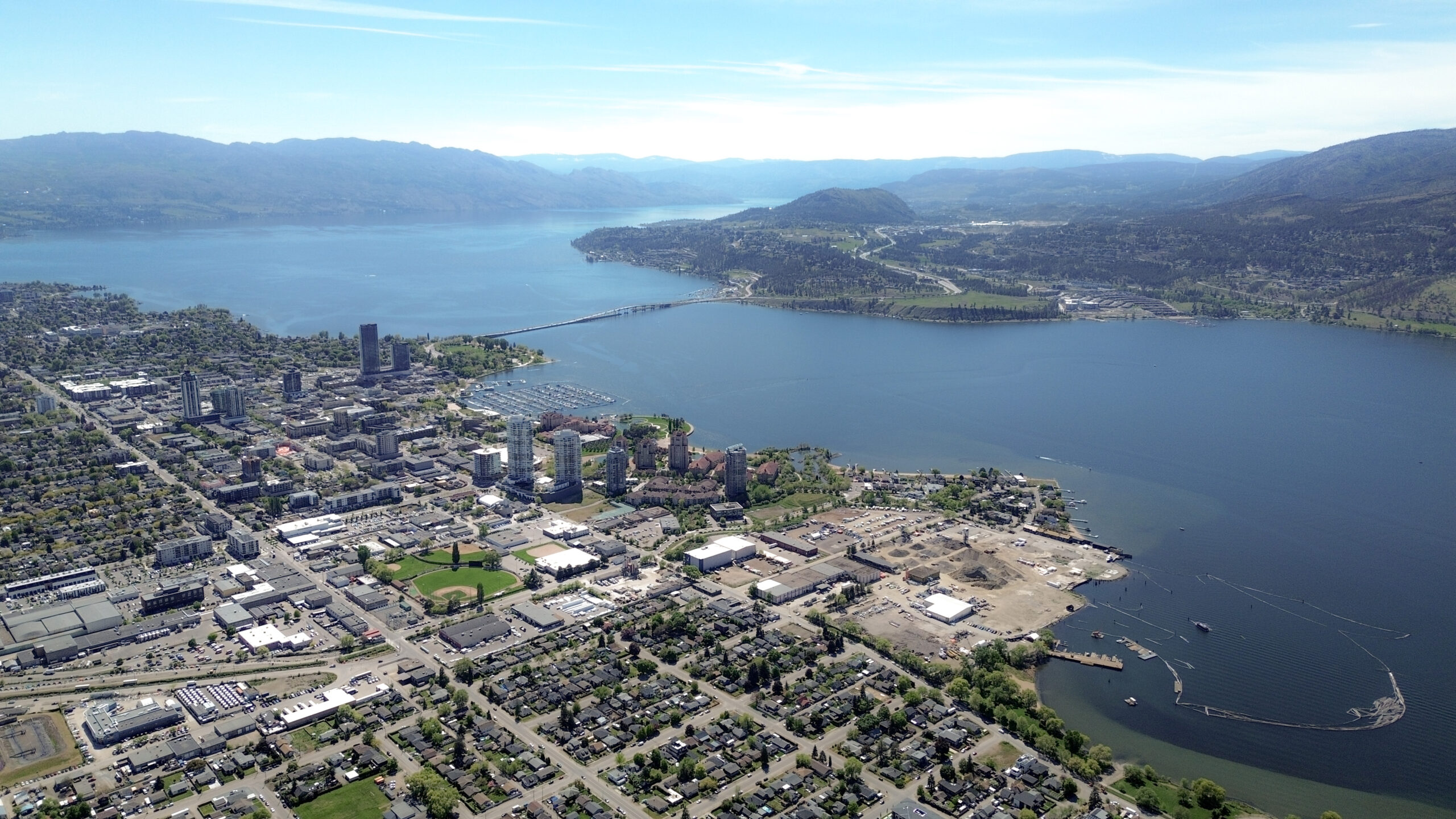
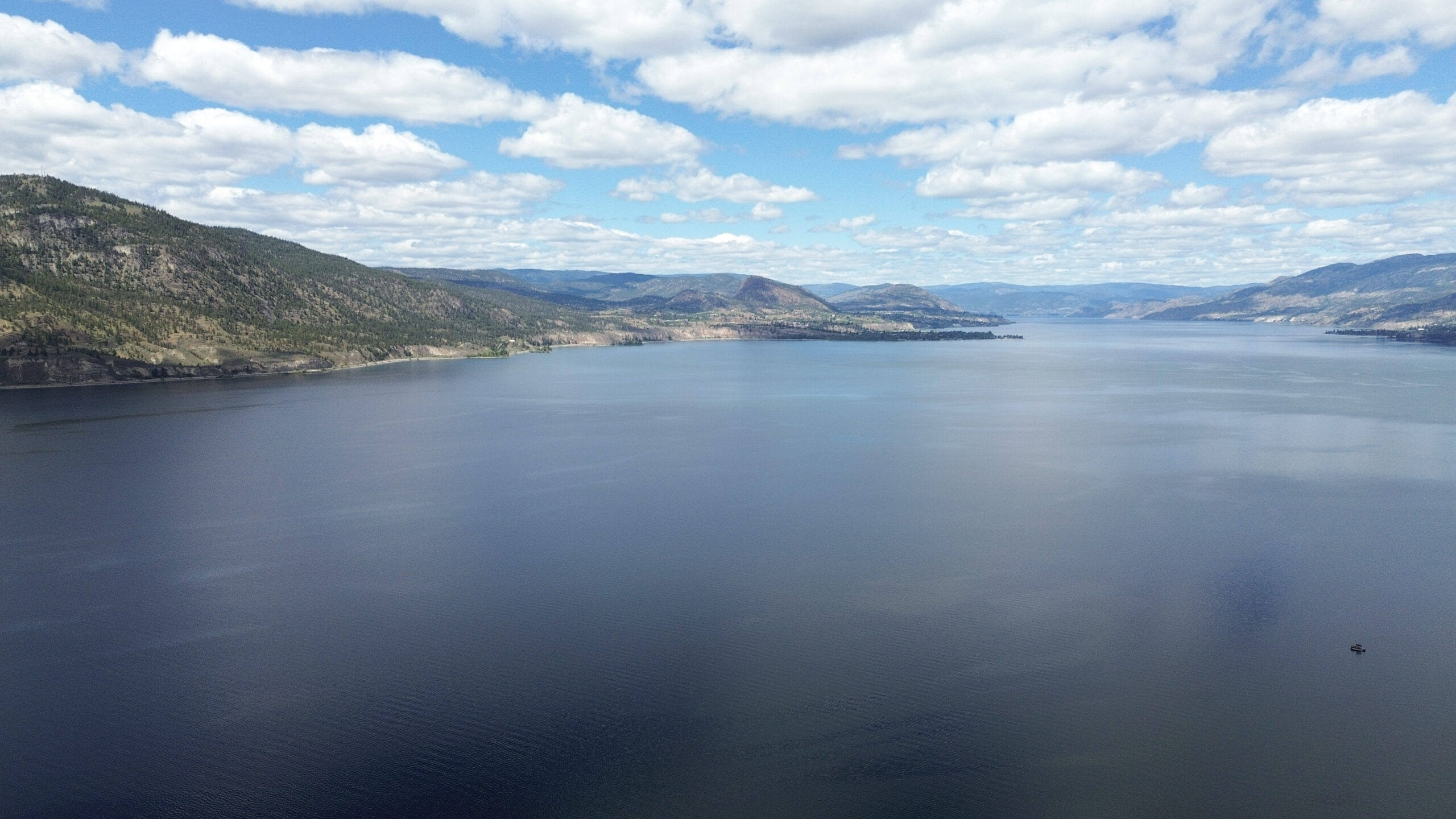
One painting, watching tqłəniw̓ t, depicts the 2023 McDougall Creek wildfire, which blazed through 13,500 hectares of syilx homelands. A silhouette of Berehulke’s brother stands in the foreground, watching as flames consume Westbank First Nation land before jumping the lake towards kiʔláwnaʔ (Kelowna).
His second painting, watching kiʔláwnaʔ, captures a lone ponderosa pine tree “standing as a silent witness,” Berehulke wrote, as fire engulfed the other side of the lake.

Healing is a central theme in the work of Hupačasath/Leq’a:mel artist Kwiis Hamilton, whose diverse practice spans graffiti-style painting, jewelry, and drawing. His large-scale painting explores the cycles we move through — life and death, pain and healing, growth and transformation among both human and non-human relatives.
Black squiggles ripple across the edges of the canvas, symbolizing a time of upheaval and physical change brought on by an earthquake. “This time of change,” Hamilton says, “is an opportunity to learn, grow, and ʔuʔaałukst̓ał (take care of one another).

Engraved silver and hand-cut abalone shell jewelry and ink drawings accompany the painting, which Hamilton says explores the reciprocal relationship humans share with the land.
Also on display is a poem originally written by Hamilton in the Nuu-chah-nulth language. Sayaasim min Nismaqkin (In the future we belong to the land), shares the same name as the series of artworks on display.
“Even on the darkest days,” Hamilton writes, “Your ancestors are with you, Remember them, Acknowledge them, Sing for them, Make an offering.”

A featured piece by fashion designer Rebecca Baker, Our Roots Run Deep, is a corset crafted from old-growth cedar shavings.
“For those who know carving, it’s so special to be surrounded by those remnants,” said Baker, who arrived straight from Native Fashion Week in Santa Fe with her family.
Inspired by her poem Yesterday: A Love Letter to Cedar, Baker said she wanted the piece to reflect “the importance of using every part of our natural resources.”
The exhibition is on view upstairs in the Bill Reid Gallery and will be on view daily until September 7. Admission is free for Indigenous Peoples.
Author
We live in a media ecosystem that thrives on misinformation. Big Tech and AI companies are consuming the work of real human beings and Canadian news has been banned on Facebook and Instagram.
And yet, I have hope for journalism because of the work we’re doing at IndigiNews.
At IndigiNews, we embody tâpwêwin — the Cree value of integrity and responsibility in truth-telling. We are committed to our independent, Indigenous-led newsroom rooted in community, accountability, and relationality. We believe storytelling is a sacred fire that connects our pasts, presents, and futures through the storytellers in our Storytelling Lodge. IndigiNews creates space for Indigenous journalists, storytellers, Knowledge Keepers, and communities to gather, learn, and share stories that matter.
As a registered charity, we are building a fire that allows our work not just to ignite but to thrive. Rather than relying on advertising or corporate acquisition, IndigiNews is sustained by people like you who believe Indigenous stories are important for the future of our communities.
Your support is making a real difference.
Our community of supporters, our Firekeepers, make it possible to grow our newsroom, publish award-winning journalism, train emerging Indigenous journalists through initiatives like the ReFocus Photojournalism Fellowship, and publish trustworthy stories that serve our communities across the country. Every story we publish helps fill in gaps left by mainstream media and ensures Indigenous perspectives are represented with care, accuracy and respect.
But there is still more work to do.
As the media landscape becomes more and more uncertain, community support is as necessary and essential as it’s ever been. Every new Firekeeper helps protect the independence of our newsroom and strengthens journalism that is accountable to our many and varied communities over corporations.
That’s why we’re inviting you to become a Firekeeper.
Firekeepers tend to and protect the sacred fire. Your monthly contributions directly support IndigiNews’s Storytelling Lodge, helps sustain our independent, Indigenous-led newsroom, and ensures future generations of Indigenous storytellers have the resources they need to do the work.
As a registered Canadian charity, all eligible donations receive a charitable tax receipt.
If you believe Indigenous stories matter, if you value independent journalism, and if you want to help build a strong future for Indigenous media, we invite you to join our circle of Firekeepers today.
Together, we can keep the fire burning.
— Eden Fineday, Publisher, IndigiNews
Support us nowLatest Stories
-
Indigenous leaders confront overlapping crises at UN, as climate and conflict collide
IndigiNews is in Geneva for the UN’s Expert Mechanism on the Rights of Indigenous Peoples, which will focus on violence, disaster relief, artificial intelligence, and more.
-
‘Newfoundland’ claims Europeans arrived before the Innu. ‘People don’t disappear,’ counters archeologist
Smithsonian archeologist Stephen Loring’s research is being disputed by the province’s own Archeology Office. He fears the government’s censorship of Innu history is being used ‘to promote a political agenda like land claims’