Gitxsan leaders rally against industry injunctions, calling the orders ‘a license to kill’
Hereditary chiefs say the injunctions, granted by the B.C. Supreme Court and enforced by RCMP C-IRG unit, break their Indigenous law

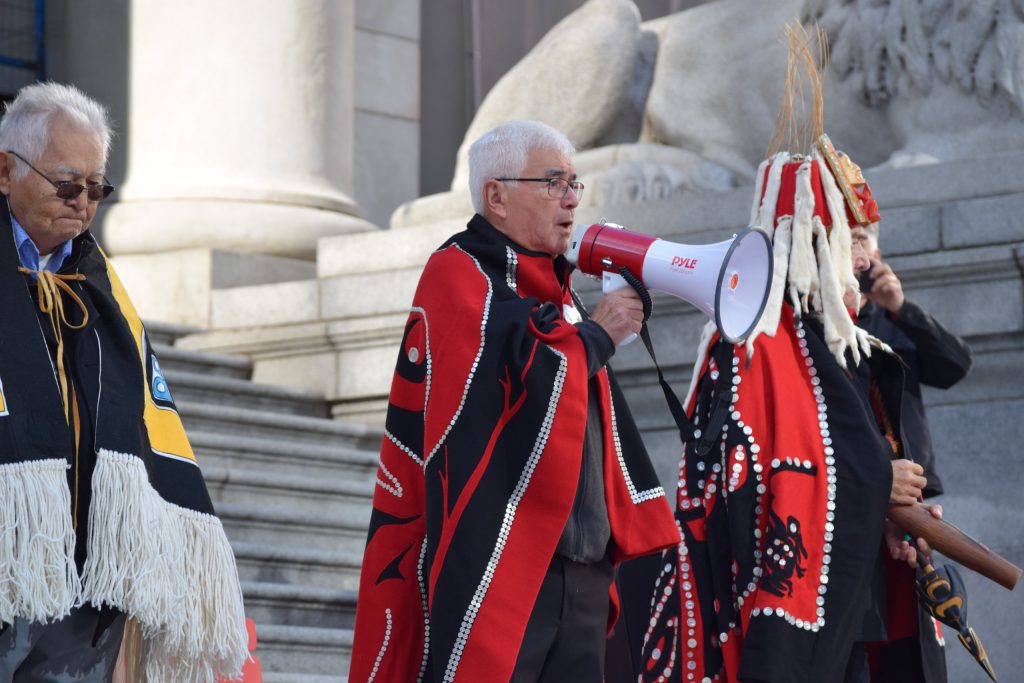
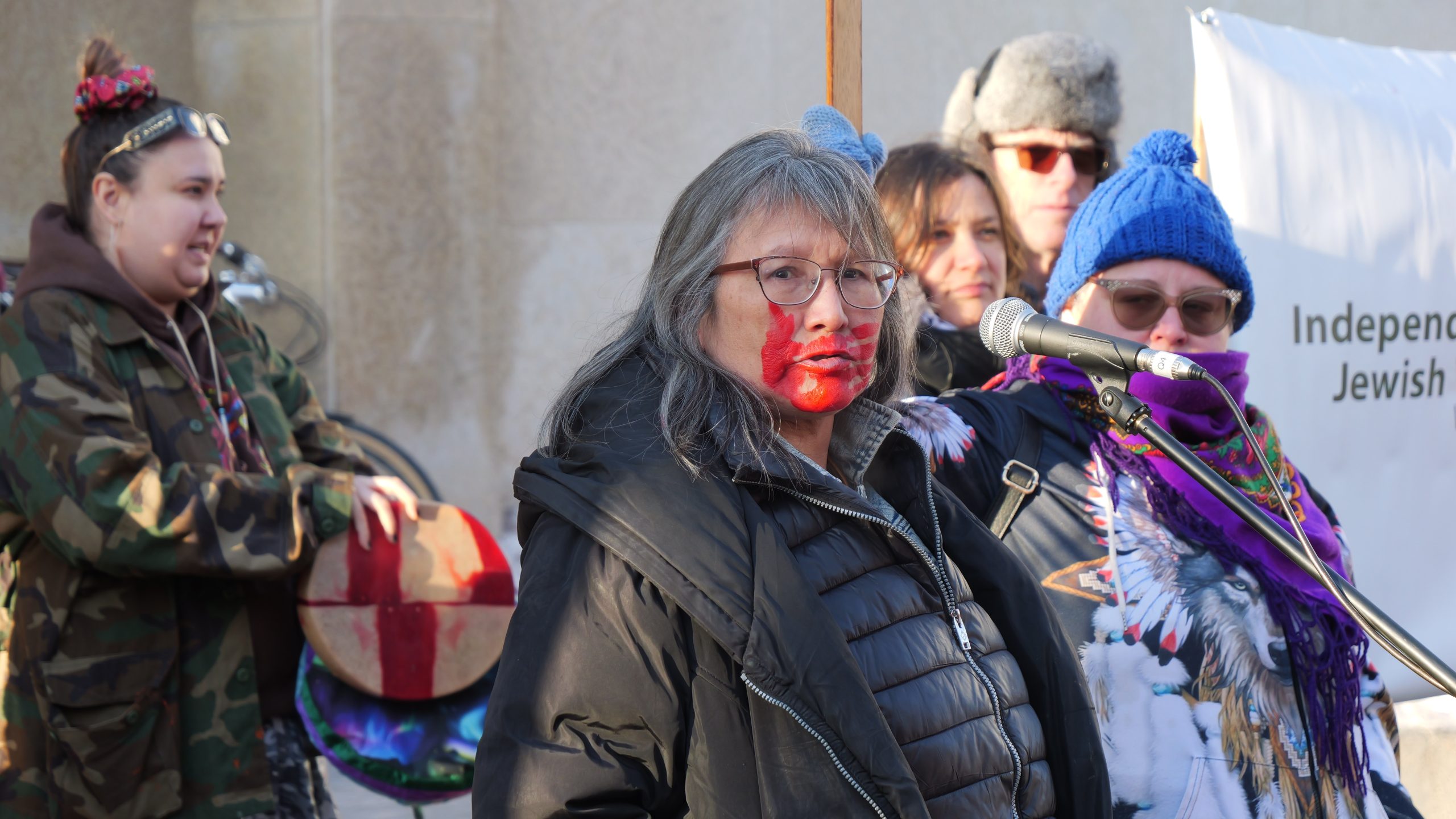
Eight Gitxsan hereditary chiefs led a rally at the B.C. Supreme Court in “Vancouver” this week — speaking out against the use of injunction orders and how they break Indigenous law.
The chiefs say the injunctions — which are requested by industry corporations, granted by the court and enforced by the RCMP’s Community-Industry Response Group (C-IRG) — are in direct opposition to their protocols and a threat to people’s safety.
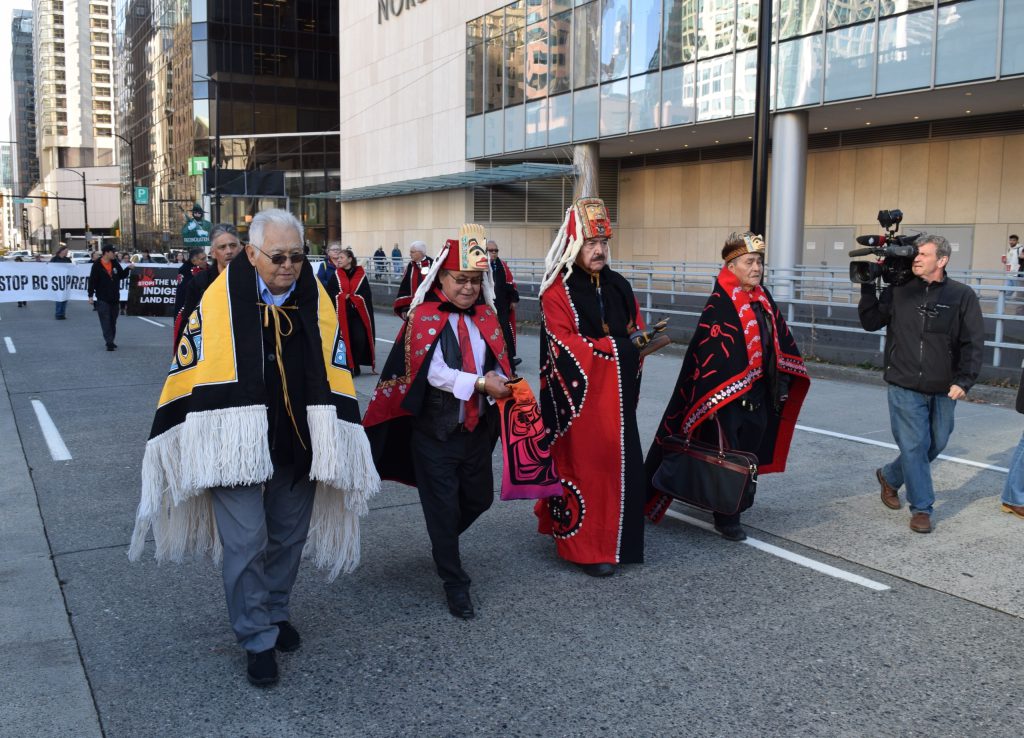
To bring renewed attention to the issue, a group from Gitxsan marched from the steps of the Vancouver Art Gallery, briefly blocking traffic, to the court downtown on Oct. 11.
With each wearing regalia to represent their individual house groups — walking to the soft heartbeat of drums — the chiefs marched in front of a banner that said, “Stop B.C. Supreme Court interference on Gitxsan land issues.”
Luutkudziiwus (Gordon Sebastian), the event’s MC, said the Gitxsan Huwilp Government sent a letter earlier this year to Supreme Court Chief Justice Christopher Hinkson requesting a meeting on the issue, but there has not been any progress.
“The Supreme Court Justice is right here. We’re on his step,” he said in an interview with IndigiNews.
“Because his orders are a license to kill, and we want to deal with him regarding that. These chiefs want to meet with the Supreme Court Justice, and he’s ignoring us.”
Gitxsan laws rooted in respect
The C-IRG unit was first formed in 2017 to quell dissent against energy industry developments, including the Trans Mountain and Coastal GasLink pipelines. There have since been calls to abolish the group because of controversy around their use of force, harassment of Indigenous land defenders and other issues.
The Gitxsan’s neighbouring Wet’suwet’en Nation has been fighting against the Coastal GasLink project, which was granted an injunction by the B.C. Supreme Court in 2018.
Though the project opposes Wet’suwet’en law and rights, there have been dozens of arrests and RCMP raids as the nation tries to protect its land and waters from industry extraction.
Meanwhile, three Gitxsan hereditary chiefs were arrested in 2020 for blocking a railway in “New Hazelton” during a nationwide protest in solidarity with Wet’suwet’en and against the Coastal GasLink injunction.
The Gitxsan Huwilp Government signed a community safety plan with the RCMP in December 2022, but the chiefs expressed that the relationship has since eroded.
In January, the Gitxsan hereditary chiefs issued an order banning the C-IRG from their lands, but the RCMP wouldn’t agree, citing their “lawful obligations” under the B.C. Supreme Court.
Luutkudziiwus and the other leaders said there’s been ongoing industry activity on their lands — from pipeline proposals to mining — and there are concerns for the safety of members.
“We have 35,000 square kilometres of territory divided by about 108 tracts of land. And each tract of land belongs to different chiefs,” Luutkudziiwus said.
“And the respect is that we don’t go into anyone’s land without permission. If you go on there, you’re trespassing. We have our laws to deal with that, and it’s basically respect. We don’t use enforcement.”
After the Gitxsan Huwilp Government requested a meeting with Chief Justice Hinkson regarding their concerns, they received a letter from the B.C. Supreme Court’s legal counsel this spring.
“Your letter raises concerns about actions taken by the RCMP C-IRG to enforce injunctions issued by the court and seeks a meeting with Chief Justice Hinkson to address this issue,” states the letter dated April 28.
“Judges cannot enter into private correspondence or attend private meetings with persons regarding matters that have been, are currently, or may be before the courts … Therefore, your correspondence will not be considered by the court.”
The Gitxsan Huwilp Government wrote back on May 18, clarifying that it was still waiting to meet with a B.C. Supreme Court representative and, in the meantime, would be approaching the situation with a no-trespass ban and a proposed peacekeeping agreement.
“GHG is also discussing these legal issues of the B.C. Supreme Court at our Tripartite Treaty Negotiations Table,” the letter reads, in part.
“Our Gitxsan Nation is in immediate and dire exceptional circumstances due to the militarized deployment of RCMP C-IRG onto our lands and the lands of our First Nations neighbours.”
‘Is that reconciliation?’
The rally calling for an end to RCMP-enforced industry injunctions ties into a larger fight for title and rights that has been ongoing for the Gitxsan chiefs since the start of colonization.
At one point, this fight went all the way to the Supreme Court of Canada in the historic Delgumuukw case, which affirmed ancestral title.
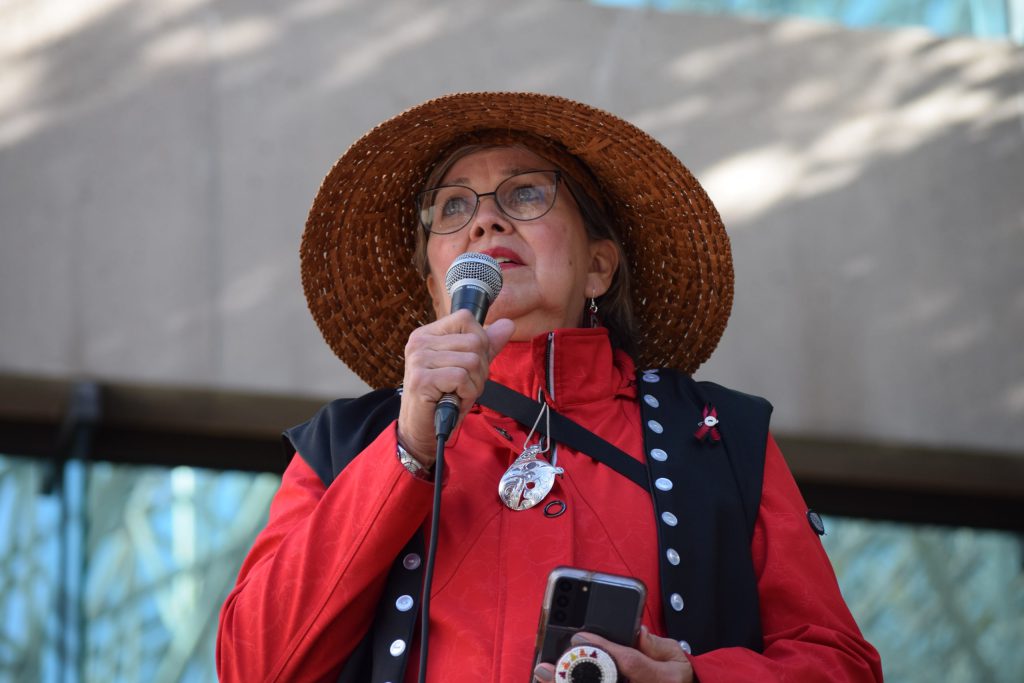
However, Simoogit Geel (Catherine Blackstock) pointed out it has been more than 25 years since that ruling was handed down, but “the governments of Canada and B.C. have not been willing to accept our authority and responsibility.”
Simoogit Geel also referenced the United Nations Declaration on the Rights of Indigenous People (UNDRIP), which specifies free, prior and informed consent must be given by Indigenous communities when it comes to any decisions involving their lands.
“It starts out with the government giving approval to the industry. People coming on our land, and they’re doing that without our prior, informed consent,” she said.
“An injunction is made [as a] full stop, there’s no dialogue … they can bring in the armed martial law with guns and dogs meant to threaten and intimidate. Is that reconciliation?”
Author
We live in a media ecosystem that thrives on misinformation. Big Tech and AI companies are consuming the work of real human beings and Canadian news has been banned on Facebook and Instagram.

And yet, I have hope for journalism because of the work we’re doing at IndigiNews.
At IndigiNews, we embody tâpwêwin — the Cree value of integrity and responsibility in truth-telling. We are committed to our independent, Indigenous-led newsroom rooted in community, accountability, and relationality. We believe storytelling is a sacred fire that connects our pasts, presents, and futures through the storytellers in our Storytelling Lodge. IndigiNews creates space for Indigenous journalists, storytellers, Knowledge Keepers, and communities to gather, learn, and share stories that matter.
As a registered charity, we are building a fire that allows our work not just to ignite but to thrive. Rather than relying on advertising or corporate acquisition, IndigiNews is sustained by people like you who believe Indigenous stories are important for the future of our communities.
Your support is making a real difference.
Our community of supporters, our Firekeepers, make it possible to grow our newsroom, publish award-winning journalism, train emerging Indigenous journalists through initiatives like the ReFocus Photojournalism Fellowship, and publish trustworthy stories that serve our communities across the country. Every story we publish helps fill in gaps left by mainstream media and ensures Indigenous perspectives are represented with care, accuracy and respect.
But there is still more work to do.
As the media landscape becomes more and more uncertain, community support is as necessary and essential as it’s ever been. Every new Firekeeper helps protect the independence of our newsroom and strengthens journalism that is accountable to our many and varied communities over corporations.
That’s why we’re inviting you to become a Firekeeper.
Firekeepers tend to and protect the sacred fire. Your monthly contributions directly support IndigiNews’s Storytelling Lodge, helps sustain our independent, Indigenous-led newsroom, and ensures future generations of Indigenous storytellers have the resources they need to do the work.
As a registered Canadian charity, all eligible donations receive a charitable tax receipt.
If you believe Indigenous stories matter, if you value independent journalism, and if you want to help build a strong future for Indigenous media, we invite you to join our circle of Firekeepers today.
Together, we can keep the fire burning.
— Eden Fineday, Publisher, IndigiNews
Support us nowLatest Stories
-
Indigenous leaders give the UN a roadmap for protecting their peoples
Amidst prayers and vows of solidarity, UN Expert Mechanism on the Rights of Indigenous Peoples ends annual meetings with demands for ‘action we’re not seeing globally’
-
Indigenous people demand more say at the UN, as new crises hit their homelands
Indigenous nations live ‘on the frontlines’ of climate, conflict and new tech. But their voices remain sidelined in the global halls of power.