Indigenous parent points to ‘pattern of systemic racism’ after suggested cuts to music programming
Carey Newman, Hayalthkin’geme, has resigned from a school board Indigenous committee after an official suggested Indigenous students may not benefit from music classes
A parent and prominent artist says he is “deeply offended” after a Victoria school board official suggested that Indigenous students may not benefit from music classes.
Carey Newman, Hayalthkin’geme, penned an open letter in response to a recent Greater Victoria School District (SD61) committee meeting that has since been co-signed by hundreds of supporters.
Newman — a former SD61 Indigenous Ad Hoc Committee member — wrote the letter after SD61 secretary treasurer Kim Morris suggested cutting music programs, to focus on literary initiatives for Indigenous students instead.
In the May 10 meeting during budget talks, Morris spoke about Indigenous graduation rates being below the provincial average in SD61.
“Will core band, strings or choir improve the Indigenous completion rates? Do Indigenous students participate in band?” she asked.
“The biggest impact we can make on Indigenous student success is literacy.”
Now, Newman and others are demanding a public apology from the school district. Newman also announced his resignation from SD61’s Indigenous Ad Hoc Committee, saying this is only the latest development in a long-deteriorating relationship between the district and Indigenous community.
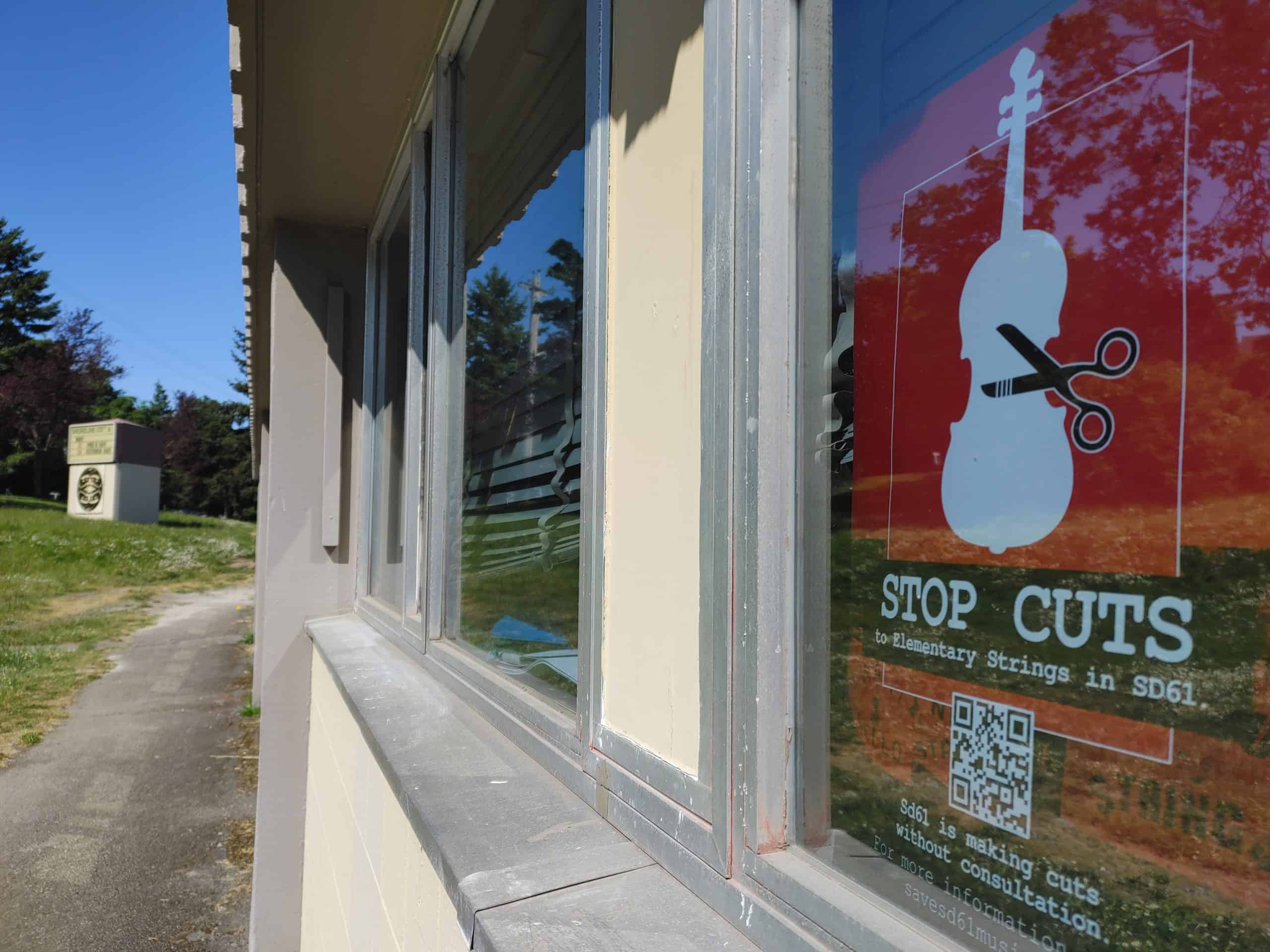
“As an Indigenous musician and father of a child who recently developed a love for violin while taking elementary strings, I am deeply offended by the suggestion that Indigenous students don’t participate in music programming,” his letter states, in part.
“Implying that music cuts are needed to support Indigenous students is false, divisive, undermines the safety of all Indigenous students who attend school in SD61, and is the exact opposite of reconciliation.”
Newman is known as the creator of the Witness Blanket, a national monument to recognize the atrocities of residential schools.
He is Kwakwak’awakw through his father from the Kukwekum, Giiksam, and WaWalaby’ie clans of northern Vancouver Island, and Coast Salish from Cheam of the Sto:lo Nation along the upper Fraser Valley.
Newman says his concerns about SD61 began during a “debacle” in 2017, when he says Indigenous stakeholders’ recommendations went unheard, and the district hired a non-Indigenous District Principal of Indigenous Education.
His letter further points to a March 1 Education Policy and Directions Committee Meeting, where meeting chair and board trustee Ryan Painter noted that too many Songhees and Esquimalt Nations members were present — citing board bylaws.
Newman’s letter goes on to address a survey seeking public input to their budgeting process that posed questions that ranked basic human rights.
But it was the May 10 meeting that pushed Newman to speak out — calling it a particularly egregious example that highlights a profound lack of understanding about what reconciliation means. The budget still has cuts earmarked within Indigenous education.
“Taken together, this sequence of events reveals a pattern of systemic racism that can no longer be seen as a collection of unfortunate missteps, but rather as proof of deeply entrenched paternalistic attitudes towards Indigenous people and our education that continue to this day,” he writes.
Winona Waldron, the president of the Greater Victoria Teachers’ Association, shares Newman’s concerns, and wrote her own scathing letter on behalf of district teachers.
Waldron says concerns began on April 13, when SD61 announced a $7-million deficit — meaning cuts were on the way.
She says now, cutting the music program “under the guise of reconciliation” pits people against each other.
“The story we are being told is that the district needs to reinvent in Indigenous literacy and in that way will see better graduation rates for Indigenous students,” she tells IndigiNews in an interview.
“Somehow because we have music programs, that’s why our Indigenous youth are graduating at lower rates than their non-Indigenous peers and just that argument itself is a complete fallacy. There’s no evidence that one is connected to the other.”
The May 10 presentation did not provide data on the numbers of Indigenous students who do or do not participate in music, because the board said they do not keep track of that type of data after one of the board members requested it.
IndigiNews reached out to the school district but has not received a response.
Waldron says it’s problematic to “paint music as something that is for the elite.”
“There’s a lot of work to be done at the board office,” she says.
Author
We live in a media ecosystem that thrives on misinformation. Big Tech and AI companies are consuming the work of real human beings and Canadian news has been banned on Facebook and Instagram.
And yet, I have hope for journalism because of the work we’re doing at IndigiNews.
At IndigiNews, we embody tâpwêwin — the Cree value of integrity and responsibility in truth-telling. We are committed to our independent, Indigenous-led newsroom rooted in community, accountability, and relationality. We believe storytelling is a sacred fire that connects our pasts, presents, and futures through the storytellers in our Storytelling Lodge. IndigiNews creates space for Indigenous journalists, storytellers, Knowledge Keepers, and communities to gather, learn, and share stories that matter.
As a registered charity, we are building a fire that allows our work not just to ignite but to thrive. Rather than relying on advertising or corporate acquisition, IndigiNews is sustained by people like you who believe Indigenous stories are important for the future of our communities.
Your support is making a real difference.
Our community of supporters, our Firekeepers, make it possible to grow our newsroom, publish award-winning journalism, train emerging Indigenous journalists through initiatives like the ReFocus Photojournalism Fellowship, and publish trustworthy stories that serve our communities across the country. Every story we publish helps fill in gaps left by mainstream media and ensures Indigenous perspectives are represented with care, accuracy and respect.
But there is still more work to do.
As the media landscape becomes more and more uncertain, community support is as necessary and essential as it’s ever been. Every new Firekeeper helps protect the independence of our newsroom and strengthens journalism that is accountable to our many and varied communities over corporations.
That’s why we’re inviting you to become a Firekeeper.
Firekeepers tend to and protect the sacred fire. Your monthly contributions directly support IndigiNews’s Storytelling Lodge, helps sustain our independent, Indigenous-led newsroom, and ensures future generations of Indigenous storytellers have the resources they need to do the work.
As a registered Canadian charity, all eligible donations receive a charitable tax receipt.
If you believe Indigenous stories matter, if you value independent journalism, and if you want to help build a strong future for Indigenous media, we invite you to join our circle of Firekeepers today.
Together, we can keep the fire burning.
— Eden Fineday, Publisher, IndigiNews
Support us nowLatest Stories
-
Indigenous leaders give the UN a roadmap for protecting their peoples
Amidst prayers and vows of solidarity, UN Expert Mechanism on the Rights of Indigenous Peoples ends annual meetings with demands for ‘action we’re not seeing globally’
-
Indigenous people demand more say at the UN, as new crises hit their homelands
Indigenous nations live ‘on the frontlines’ of climate, conflict and new tech. But their voices remain sidelined in the global halls of power.