‘The islands are our homelands, too,’ says W̱SÁNEĆ youth
“The islands are our relatives, the relatives of the deep,” says Peter Underwood of the W̱SÁNEĆ Nation.
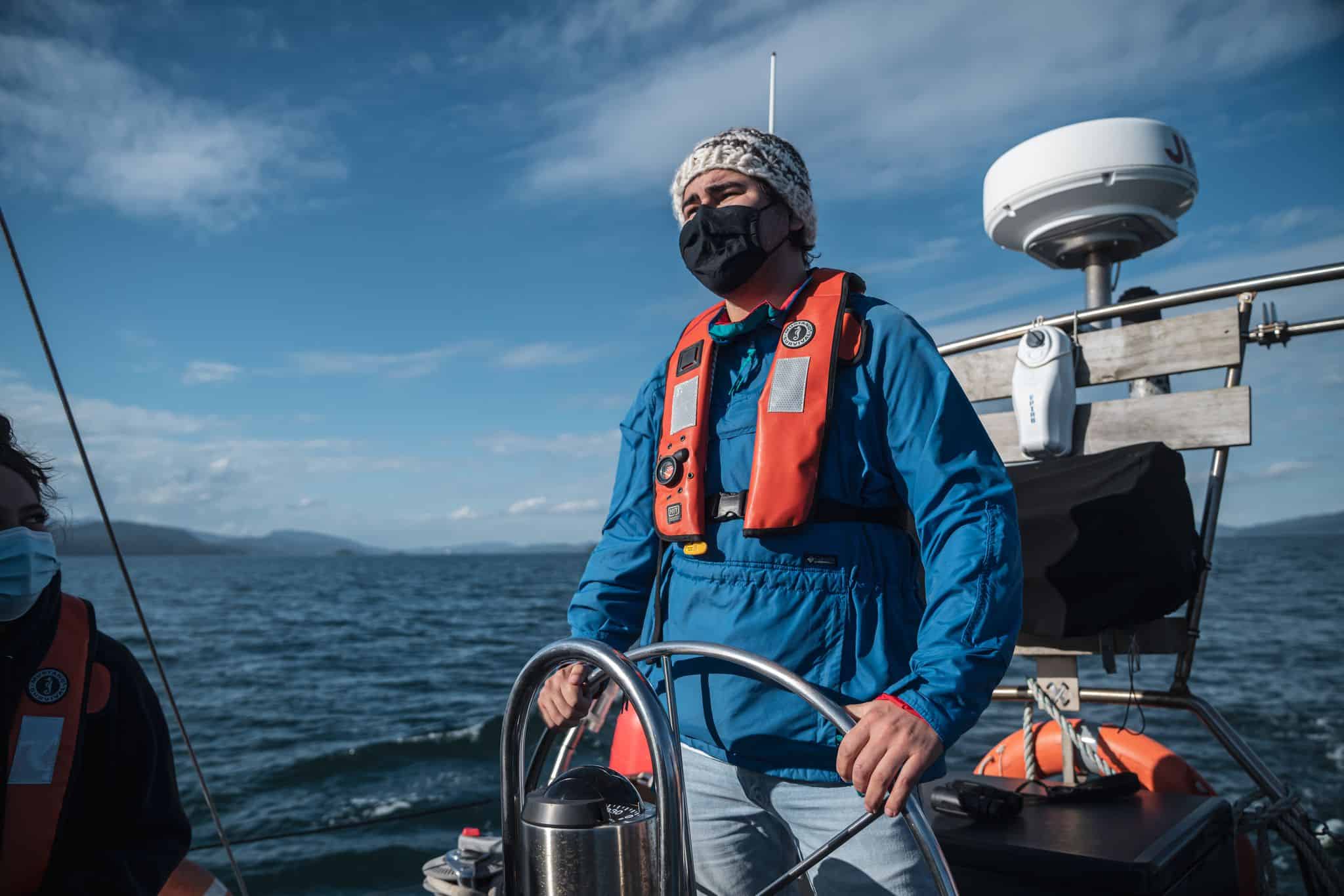
A new cultural revitalization project aims to reconnect W̱SÁNEĆ people to their larger island territories — beyond so-called Vancouver Island.
“It’s all about reconnecting,” says Peter Underwood, a youth from the W̱SÁNEĆ Nation who has been working with the Raincoast Conservation Foundation and the W̱SÁNEĆ leadership council to connect people back to their islands.
“It’s really important that we know that those islands are our homelands, too, and that we are all islanders, more than just on Vancouver Island,” Underwood tells IndigiNews.
W̱SÁNEĆ territory includes several so-called Southern Gulf Islands in the Salish Sea, including S,DÁYES (Pender), S,ḴŦAḴ (Mayne) and ṮEḴTEḴSEN (Saturna).
The ṮEṮÁĆES Revitalization Project, a partnership between the Southern Gulf Islands Community Resources Centre (CRC) and the W̱SÁNEĆ School Board (WSB), aims to share traditional knowledge about W̱SÁNEĆ homelands, for youth, community members, and visitors.
Through a series of five educational videos — to be owned and used by the WSB — the project will incorporate W̱SÁNEĆ traditional knowledge and the role ṮEṮÁĆES (islands) play as a part of ÁLEṈENEȻ (the larger W̱SÁNEĆ homeland).
Central to the educational project is the question ‘Whose land is it?,’ states a CRC press release published in July.
“The W̱SÁNEĆ people have been too long separated from the Islands as a result of the oppressive impacts of colonization and the failure of the settler population to recognize our unceded inherent rights,” says W̱SÁNEĆ Leadership Council director of operations Gord Elliott in the release. “This project supports the resurgence of the W̱SÁNEĆ people in our traditional Homeland.”
The videos will also be used in community forums for the Southern Gulf Islands to “enhance the developing community to community relationship necessary for progressive reconcili-action in building more resilient and sustainable communities,” the release states.
The name ṮEṮÁĆES (pronounced “tlu-tla-chus” — “u” as in fun, “a” as in ape) means ‘islands,’ Underwood explains, which comes from an oral story.
“The meaning of the word is that the islands are our relatives, the relatives of the deep. To reconnect with our islands is to reconnect with our relatives there,” he explains.
Underwood says islands within W̱SÁNEĆ territory would have felt “a little separate from the W̱SÁNEĆ people, because we don’t have active reserves out there.”
“A lot of people don’t even know that we have reserves out there and if they do they don’t know where they are because they are very small and uninhabited,” he says.
At one point, there were year-round villages on the islands, but when people were placed on reservations, they were taken from the islands and the land was sold off, he explains.
Whose land is it?
The ṮEṮÁĆES Steering Committee received matched funding from the Real Estate Foundation of BC in the amount of $75,000 as a follow-up to the successful ṮEṮÁĆES Climate Action Project that took place in 2019-2020, according to the release.
Additional funding is provided by a number of community partners including the W̱SÁNEĆ Leadership Council, Raincoast Conservation Foundation, UVIC Living Lab Project, and the South Pender Historical Society with the Capital Regional District.
One of the videos will feature a presentation by Nick Claxton and John Price on the key findings in their paper: “Whose Land Is It?: Rethinking Sovereignty in British Columbia.” Another will feature an animated version of the ṮEṮÁĆES creation story, and the three others will share W̱SÁNEĆ perspectives on each of the three Southern Gulf Islands”: S,DÁYES (Pender); S,ḴŦAḴ (Mayne) and ṮEḴTEḴSEN (Saturna).
Underwood says there’s a growing number of non-Indigenous people who are starting to make space for Indigenous histories and stories. For example, South Pender Island now has a display of the 13 moons of the W̱SÁNEĆ calender by artist MENEŦIYE, he says.
Some people believe that the history of a place starts when the island is named with an English name, for example, but as Underwood explains, “There’s so much more to it.” Pender Island was originally one island before it was colonized, he says.
The San Juan Islands are also part of the W̱SÁNEĆ homelands, but when the colonial continental borders were implemented, the W̱SÁNEĆ people become separated, he says. It’s this kind of valuable insight, rooted in traditional knowledge, that will be provided by Elders through the ṮEṮÁĆES project, he adds.
“It’s really important that we know the history of those lands because the W̱SÁNEĆ peninsula is only a small part of our territory. We include the waters and islands, too.”
“The Islands, our relatives, have provided a way of life for our people for thousands of years and W̱SÁNEĆ law creates a reciprocal relationship of care and stewardship between W̱SÁNEĆ and ṮEṮÁCÉS,” Underwood says.
This responsibility is absolute; we are obligated to care for these islands, not only through our own actions but by protecting the islands against harmful actions by others. This project supports our exercise of this deep responsibility.”
Author
We live in a media ecosystem that thrives on misinformation. Big Tech and AI companies are consuming the work of real human beings and Canadian news has been banned on Facebook and Instagram.
And yet, I have hope for journalism because of the work we’re doing at IndigiNews.
At IndigiNews, we embody tâpwêwin — the Cree value of integrity and responsibility in truth-telling. We are committed to our independent, Indigenous-led newsroom rooted in community, accountability, and relationality. We believe storytelling is a sacred fire that connects our pasts, presents, and futures through the storytellers in our Storytelling Lodge. IndigiNews creates space for Indigenous journalists, storytellers, Knowledge Keepers, and communities to gather, learn, and share stories that matter.
As a registered charity, we are building a fire that allows our work not just to ignite but to thrive. Rather than relying on advertising or corporate acquisition, IndigiNews is sustained by people like you who believe Indigenous stories are important for the future of our communities.
Your support is making a real difference.
Our community of supporters, our Firekeepers, make it possible to grow our newsroom, publish award-winning journalism, train emerging Indigenous journalists through initiatives like the ReFocus Photojournalism Fellowship, and publish trustworthy stories that serve our communities across the country. Every story we publish helps fill in gaps left by mainstream media and ensures Indigenous perspectives are represented with care, accuracy and respect.
But there is still more work to do.
As the media landscape becomes more and more uncertain, community support is as necessary and essential as it’s ever been. Every new Firekeeper helps protect the independence of our newsroom and strengthens journalism that is accountable to our many and varied communities over corporations.
That’s why we’re inviting you to become a Firekeeper.
Firekeepers tend to and protect the sacred fire. Your monthly contributions directly support IndigiNews’s Storytelling Lodge, helps sustain our independent, Indigenous-led newsroom, and ensures future generations of Indigenous storytellers have the resources they need to do the work.
As a registered Canadian charity, all eligible donations receive a charitable tax receipt.
If you believe Indigenous stories matter, if you value independent journalism, and if you want to help build a strong future for Indigenous media, we invite you to join our circle of Firekeepers today.
Together, we can keep the fire burning.
— Eden Fineday, Publisher, IndigiNews
Support us nowLatest Stories
-
In the Okanagan desert, snakes offer lessons on protecting a fragile ecosystem
For two decades, researchers at the Nk’Mip Desert Cultural Centre have tracked snakes across syilx homelands — while helping people appreciate the often-feared creatures
-
Beloved on the powwow circuit, young boy’s connection to the drum inspires
Now four, Waseskwan Redcrow was dancing ‘before he could even fully walk’ — his family says participating in powwows has brought them joy and belonging