Community rallies around Skwxwú7mesh mother after viral TikTok video
Celina Sinisalo set out to help others cope with record-high food inflation — and ended up receiving an outpouring of support and love

Before getting ready for the day, Celina Sinisalo looks into the camera and addresses her TikTok following — sharing how her family is dealing with record-high grocery inflation.
“OK, so me and my daughter are really trying to stretch our food because it’s the last week until child tax day which is always the hardest for us,” she says.
“So we are going to show you one of the resources we use to survive.”
Appearing in the next clip with a flawless face of makeup, Sinisalo goes on to document a visit to a community service-provider called Ma Mawi where she and her daughter accessed a food hamper.
The Skwxwú7mesh Úxwumixw mother, who now lives in “Winnipeg,” decided to share information about how she keeps food on the table during difficult times, in hopes that it might help somebody else.
The video went viral on the app and is now at almost half a million views, with hundreds of grateful comments — showcasing a need for support and community as many people in “Canada” have also been struggling to afford basic groceries.
“I learned when I moved from a different province, trying to access resources, it’s sometimes hard if you don’t know where to begin,” says Sinisalo in an interview.
“So the whole point of that video was to spread awareness on what it’s like to be a single mother and spread awareness on resources within the City of Winnipeg for those who need it.”
In the comments of the video, people expressed gratitude and also shared their personal experiences with rising food prices. Many expressed similar struggles or offered to help out with groceries.
“Love the realness in this, not a lot of people show this side of real life. It can be a struggle for all, I had to use a foodbank yesterday,” reads one comment.
“I’m married, we both have full time jobs and we still struggle,” says another.
Sinisalo says that she and her daughter have needed to rely more on public supports since food inflation has been so extreme.
“With the rise in food costs, it just went up so drastically I was surprised because I could go to Walmart or No Frills and easily fill up a cart and go home, and it would last two and a half weeks, and I’d be okay,” she says.
“But now with the rise in food costs, I go to Walmart or whatever and it only lasts a week, I was mind boggled. And I have to access resources more now, often I wait until it gets to the bare minimum and then I have to start calling around again for resources just to survive.”
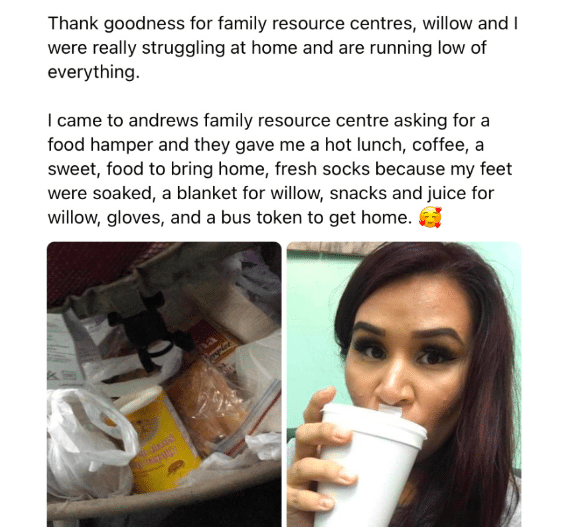
While issues including COVID-19, the climate crisis, and the Russian invasion of Ukraine are all said to have driven inflation and access to foods according to Statistics Canada — grocery giants have also gained record-high profits.
In March, top grocery industry executives were called to Parliament, where they were questioned about rising food prices in their stores. Grocery prices went up 9.70 per cent in February, according to StatCan. That’s almost double the current 5.2 per cent inflation rate.
“We have families going into your stores, looking at the price of items, and putting them back because they can’t afford them,” said NDP Leader Jagmeet Singh to Loblaw billionaire Galen Weston.
“We have families that are struggling to buy food for their kids in this country […] and they look at you and see you making record profits.”
Weston maintained that the company has made their record-high profit from financial services, apparel, and pharmaceutical sales — not groceries.
“Grocery chain profits are not the reason for food inflation,” Weston replied to Singh.
Meanwhile, Second Harvest — an organization which redistributes perishable food that might otherwise be sent to landfills — released an alarming report showing that things are likely to not get better in 2023 for folks experiencing food insecurity.
The organization’s research said the number of people accessing free food from nonprofits is expected to increase another 60 per cent this year, on top of a 134 per cent growth in 2022.
Food Banks Canada shares much of the same sentiment in their 2022 Annual Report.
“We will be blunt: There has likely never been a more difficult time for food banks in Canada. Across the country, more people are turning to food banks than ever before in our history,” the report reads. “Many people are visiting for the first time, making the difficult choice to ask for help because their money simply isn’t stretching far enough to cover their expenses.”
For Sinisalo, she will continue to do her part in uplifting those who are on the ground actually experiencing the day-to-day inequities of food insecurity.
“I feel like people who work don’t reach out to those resources because they feel like they don’t need to, or they don’t deserve to, when in reality everybody needs help,” she says.
“And we need to normalize that just because someone has a job, it doesn’t mean that they don’t deserve help.”
After receiving an outpouring of love and support that included gifts, and financial support, Sinisalo redistributed the wealth among other single parents in her community. An Indigenous teaching of love and equity is for a person not to allow kin to live in poverty while they live in abundance — and Celina walks the talk.
“The main reason why I would love to help others is because growing up I always seen my mooshum selflessly give to the community out of the kindness of his heart,” she says.
“I’ve always admired and looked up to my mooshum and truly aspire to be him one day. Always so brave and kind, just wanting to help families to make them feel loved.”
Author
We live in a media ecosystem that thrives on misinformation. Big Tech and AI companies are consuming the work of real human beings and Canadian news has been banned on Facebook and Instagram.

And yet, I have hope for journalism because of the work we’re doing at IndigiNews.
At IndigiNews, we embody tâpwêwin — the Cree value of integrity and responsibility in truth-telling. We are committed to our independent, Indigenous-led newsroom rooted in community, accountability, and relationality. We believe storytelling is a sacred fire that connects our pasts, presents, and futures through the storytellers in our Storytelling Lodge. IndigiNews creates space for Indigenous journalists, storytellers, Knowledge Keepers, and communities to gather, learn, and share stories that matter.
As a registered charity, we are building a fire that allows our work not just to ignite but to thrive. Rather than relying on advertising or corporate acquisition, IndigiNews is sustained by people like you who believe Indigenous stories are important for the future of our communities.
Your support is making a real difference.
Our community of supporters, our Firekeepers, make it possible to grow our newsroom, publish award-winning journalism, train emerging Indigenous journalists through initiatives like the ReFocus Photojournalism Fellowship, and publish trustworthy stories that serve our communities across the country. Every story we publish helps fill in gaps left by mainstream media and ensures Indigenous perspectives are represented with care, accuracy and respect.
But there is still more work to do.
As the media landscape becomes more and more uncertain, community support is as necessary and essential as it’s ever been. Every new Firekeeper helps protect the independence of our newsroom and strengthens journalism that is accountable to our many and varied communities over corporations.
That’s why we’re inviting you to become a Firekeeper.
Firekeepers tend to and protect the sacred fire. Your monthly contributions directly support IndigiNews’s Storytelling Lodge, helps sustain our independent, Indigenous-led newsroom, and ensures future generations of Indigenous storytellers have the resources they need to do the work.
As a registered Canadian charity, all eligible donations receive a charitable tax receipt.
If you believe Indigenous stories matter, if you value independent journalism, and if you want to help build a strong future for Indigenous media, we invite you to join our circle of Firekeepers today.
Together, we can keep the fire burning.
— Eden Fineday, Publisher, IndigiNews
Support us nowLatest Stories
-

AI data centers are booming. Indigenous People want help protecting their lands and knowledge
Indigenous leaders warn the UN that the rapid growth of artificial intelligence facilities threatens their rights
-
For Indigenous peoples worldwide, conflict means much more than war
From Guatemala to Ethiopia, Aotearoa (New Zealand) to Kanaky (New Caledonia) —Indigenous leaders at UN meetings this week say true peace requires self-determination and respect for their rights