Awakening a Haida clan that slept for 150 years
Siblings Kalga Jaad Erin Brillon and Skil Xaaw Jesse Brillon worked together to host the return of their Haida clan of Laana Tsaadas with first feast in more than a century

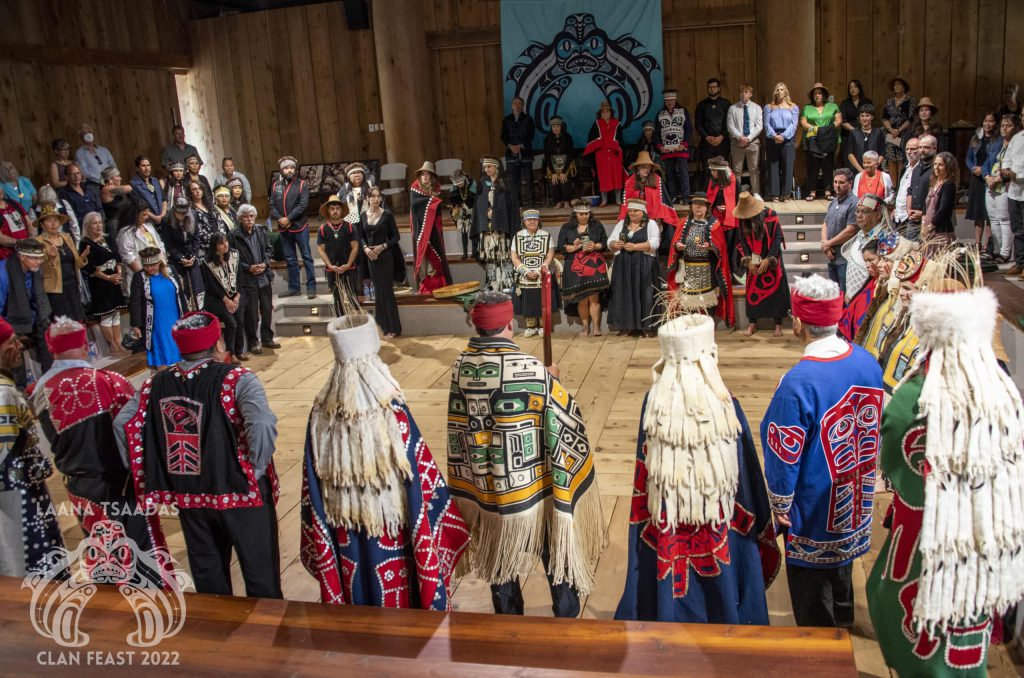
After sleeping for 150 years, the Haida clan of Laana Tsaadas is awakening. Building on careful research and closely-kept teachings, Laana Tsaadas is celebrating the first mask dance in five generations — marking the return of ceremonies that had been stifled under colonial policies that once made them illegal.
Kalga Jaad, Erin Brillon, has carried the duties of her clan like a seed inside her. In Haida culture, key positions like chiefs and matriarchs pass down through the mother’s line — and holding those positions are typically a responsibility of the eldest child of the lineage.
As the eldest daughter of her generation, Kalga Jaad always felt a sense of responsibility, but had to search for what that meant. She and her brother Skil Xaaw, Jesse Brillon grew up “obsessed with culture,” she says, driven by a deep sense of knowing.
“Everytime we were around it, we’d wonder: why don’t we know more?” Kalga Jaad explains.
“My clan was essentially dormant for over five generations because we were by law not allowed to practice our culture.”

Unsung songs and buried dances
The clan’s dormancy is connected to the “Canadian” government’s Potlatch Ban, which was in place between 1885 and 1951. It criminalized all Indigenous ceremonies as part of a colonial effort to erase Indigenous cultures, economies and people.
Kalga Jaad has a historic photo of Haidas from her home village of HlG̲aagilda (Skidegate), taken in the late 1800s by a reverend who was missionizing the area. In the photo, the women are wearing ceremonial regalia — the last capture before the items were confiscated, and later sold to collectors and museums, she says.
“That was basically the last time they were allowed to wear any of their cultural regalia,” Kalga Jaad says.
Two of Kalga Jaad’s matrilineal relations are among those women. Not only was their regalia taken, but totem poles were cut down, stripped from the villages, and sold.
“There’s this massive loss of culture because [the ban] was imposed by the Canadian government and enforced by the churches. And soon after, children were being taken away to residential schools,” shares Kalga Jaad.

Although the effects of colonization are devastating, the culture was never erased. Kalga Jaad and her brother Skil Xaaw, grew up in “Vancouver,” attending urban Haida feasts, allowing them to learn songs and dances revived by Robert and Reg Davidson.
“And so through them and other culture keepers, we were able to start re-engaging with the culture from a fairly young age,” she says.
“This is not something that we’ve consciously done, but unconsciously, I feel like we have understood the responsibility that lies on the eldest,” Kalga Jaad says. Her brother Skil Xaaw is also the eldest son.
“As I understood more about our culture, I recognized that we were doing what would’ve been expected of us traditionally.”

An act of love, family and community
The mask dance and feast is now an historic event that took place in Haida Gwaii on June 25 — marking the return of Laana Tsaadas. Working together, artists, dancers, and singers carefully crafting new masks and regalia.
Skil Xaaw designed the dance screen, which is now among other cultural objects made for their Clan feast, at his exhibit at The Haida Museum running June 24 to December 24. Kalga Jaad worked at timing the feast to match his opening.
The need for healing within communities was expressed at the feast by Chief Wigaanad, whose father David Crosby was of Laana Tsaadas clan.
Kalga Jaad shares that he stood up at the feast and said, “We have to stand together because we’re stronger together.”
“It opened everyone’s hearts and the trueness of the words that we have to put the negativity aside. If we just put those things aside and step forward and step into our hearts, it really does start to transform the community,” she says.
All gathered witnessed the power these words held, and “there was not a dry eye in the house,” says Kalga Jaad.
Chief Wigaanad gifted the clan a copper, a form of currency in potlatches.
“Coppers are still used in potlatches nowadays, in a different capacity than what they traditionally were used for,” explains Kalga Jaad.
Careful reconstruction
Thirty years of careful research by Kalga Jaad’s uncle, Ken Brillon, built the foundation of this revitalization — one he sadly did not get to witness because he recently passed away. Ken started with the oral histories and then tried to substantiate that with any written record, explains Kalga Jaad.
“He had a massive library, the most extensive library of Haida cultural books,” she says. Helpingwith Brillon’s research, Everson brings his academic background in anthropology.
Everson explains it wasn’t easy, as Laana Tsaadas clan is a smaller clan, and didn’t capture the attention of western anthropologists.
“Anytime there’s ethnographic work, it’s always slanted towards whoever the informants are, and it’s always biased,” Everson says. “And because their clan was so small, it was relegated to literally a handful of passages, almost footnotes.”
He speaks from the experience of his own family, with an abundance of documentation and archival material. His great, great-grandfather worked with Franz Boas for thirty years, and his family benefits to this day from the results.
“Being able to scour volumes of information,” he explains, “and then going and looking at Erin’s clan where it’s just kind of pushed to the periphery of the historical records. It’s like a night and day contrast.”
Now the clan is officially revived through the ceremony, the people gathered did the work that a clan typically would: officiating a traditional marriage.
Kalga Jaad’s husband Andy Everson, who is Kwakwaka’wakw, visited his bride’s village as a step in the traditional marriage process — bringing four of his chiefs to meet with her family.
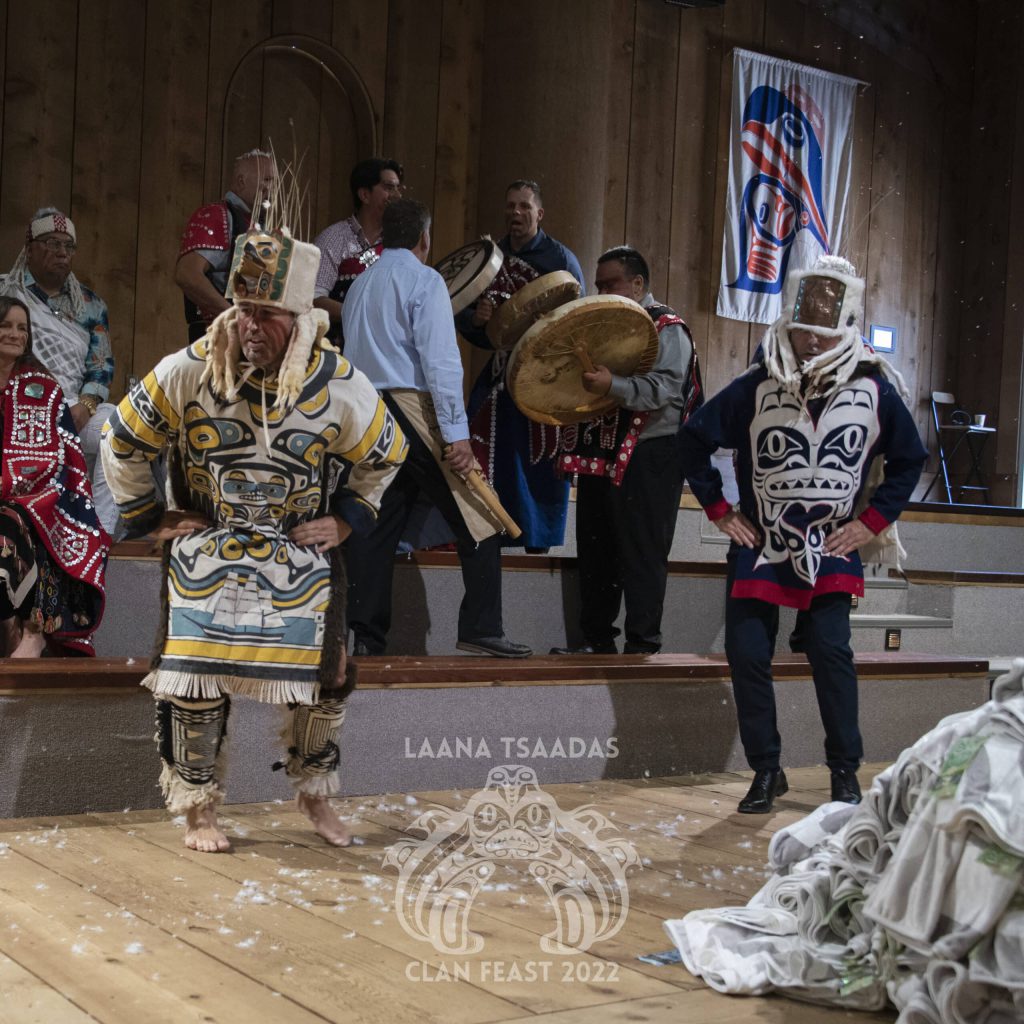
Skil Xaaw created a copper that was gifted to the groom’s family during the wedding ceremony. He also made a chief’s frontlet of copper and inlaid abalone, which was added to a headdress Kalga Jaad made of ermine, abalone, and sea lion whiskers. Wearing this regalia, he danced with the groom to show unity.

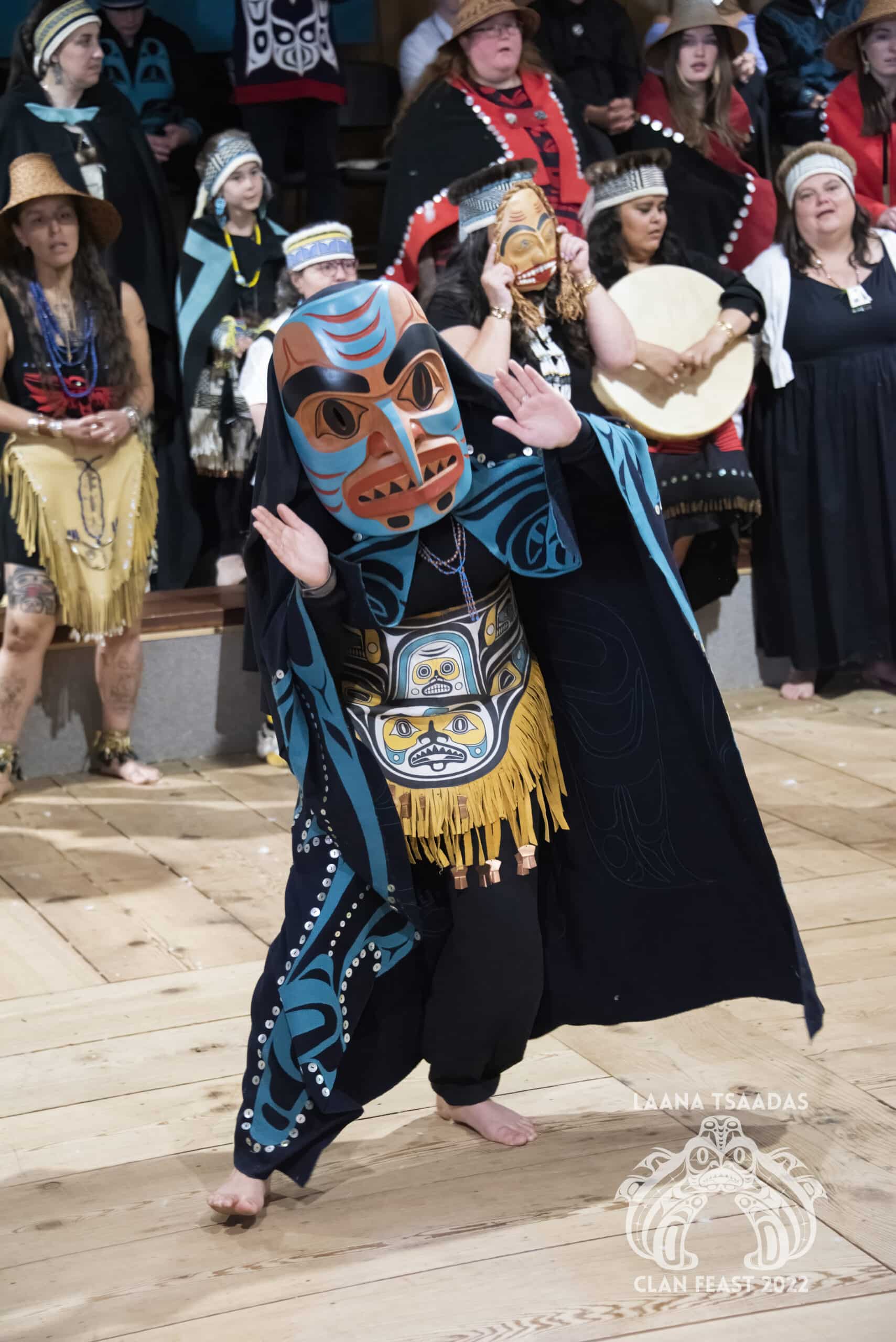
Kalga Jaad’s eldest daughter, Marlo Brillon, was mentored by her artist uncle Skil Xaaw, and carved and painted a dogfish mask.
Dogfish is one of the primary crests of their clan, also shared among other Haida clans. Marlo received her Haida name at the same feast — Xaayling’tso means “bright sunbeam that breaks through storm clouds.”
Dancing with her mask, Xaayling’tso was a bright sunbeam, breaking through 150 years of oppression — Laana Tsaadas has returned.
Editor’s note: IndigiNews has purposefully used watermarked versions of photos submitted for this story — Kalga Jaad and her family added the marks indicating the clan feast to ensure the context behind the images remained intact.
Author
We live in a media ecosystem that thrives on misinformation. Big Tech and AI companies are consuming the work of real human beings and Canadian news has been banned on Facebook and Instagram.
And yet, I have hope for journalism because of the work we’re doing at IndigiNews.
At IndigiNews, we embody tâpwêwin — the Cree value of integrity and responsibility in truth-telling. We are committed to our independent, Indigenous-led newsroom rooted in community, accountability, and relationality. We believe storytelling is a sacred fire that connects our pasts, presents, and futures through the storytellers in our Storytelling Lodge. IndigiNews creates space for Indigenous journalists, storytellers, Knowledge Keepers, and communities to gather, learn, and share stories that matter.
As a registered charity, we are building a fire that allows our work not just to ignite but to thrive. Rather than relying on advertising or corporate acquisition, IndigiNews is sustained by people like you who believe Indigenous stories are important for the future of our communities.
Your support is making a real difference.
Our community of supporters, our Firekeepers, make it possible to grow our newsroom, publish award-winning journalism, train emerging Indigenous journalists through initiatives like the ReFocus Photojournalism Fellowship, and publish trustworthy stories that serve our communities across the country. Every story we publish helps fill in gaps left by mainstream media and ensures Indigenous perspectives are represented with care, accuracy and respect.
But there is still more work to do.
As the media landscape becomes more and more uncertain, community support is as necessary and essential as it’s ever been. Every new Firekeeper helps protect the independence of our newsroom and strengthens journalism that is accountable to our many and varied communities over corporations.
That’s why we’re inviting you to become a Firekeeper.
Firekeepers tend to and protect the sacred fire. Your monthly contributions directly support IndigiNews’s Storytelling Lodge, helps sustain our independent, Indigenous-led newsroom, and ensures future generations of Indigenous storytellers have the resources they need to do the work.
As a registered Canadian charity, all eligible donations receive a charitable tax receipt.
If you believe Indigenous stories matter, if you value independent journalism, and if you want to help build a strong future for Indigenous media, we invite you to join our circle of Firekeepers today.
Together, we can keep the fire burning.
— Eden Fineday, Publisher, IndigiNews
Support us nowLatest Stories
-
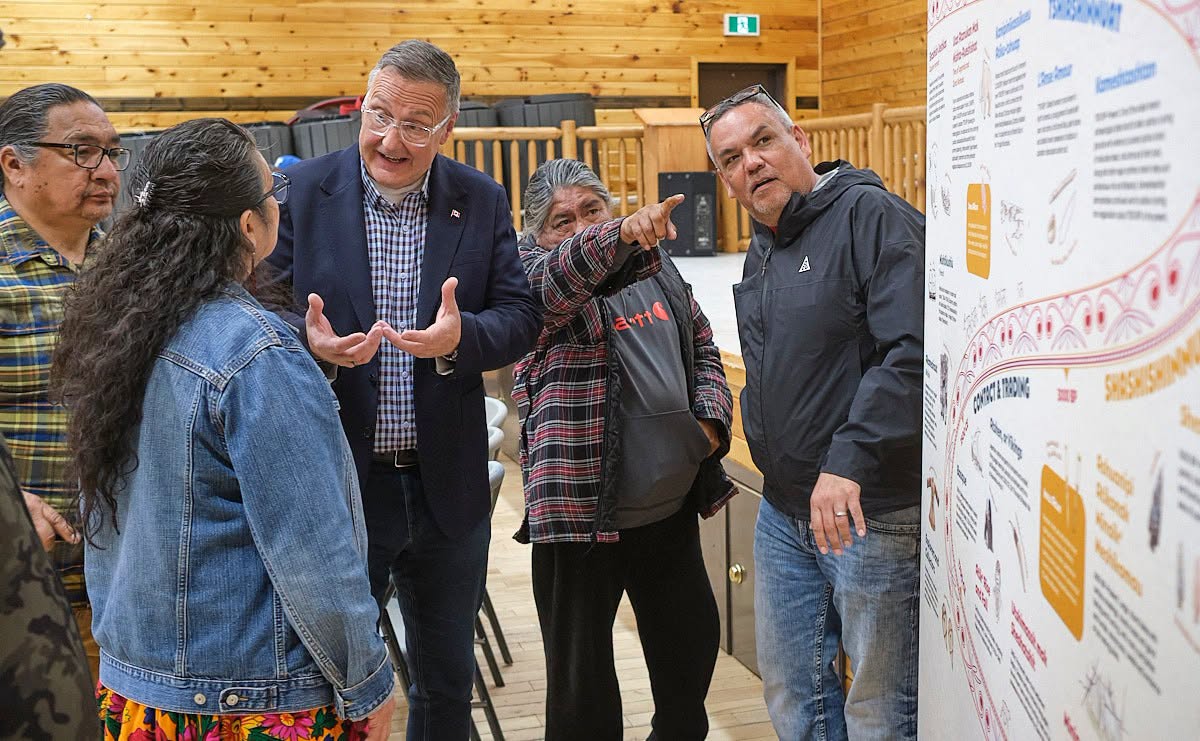
Innu Nation ‘moved to anger, to strength’ after accusing province of censoring history
Solidarity pours in after ‘Labrador’ history exhibition abruptly cancelled after province ordered removal of cultural items and timelines older than 300 years
-
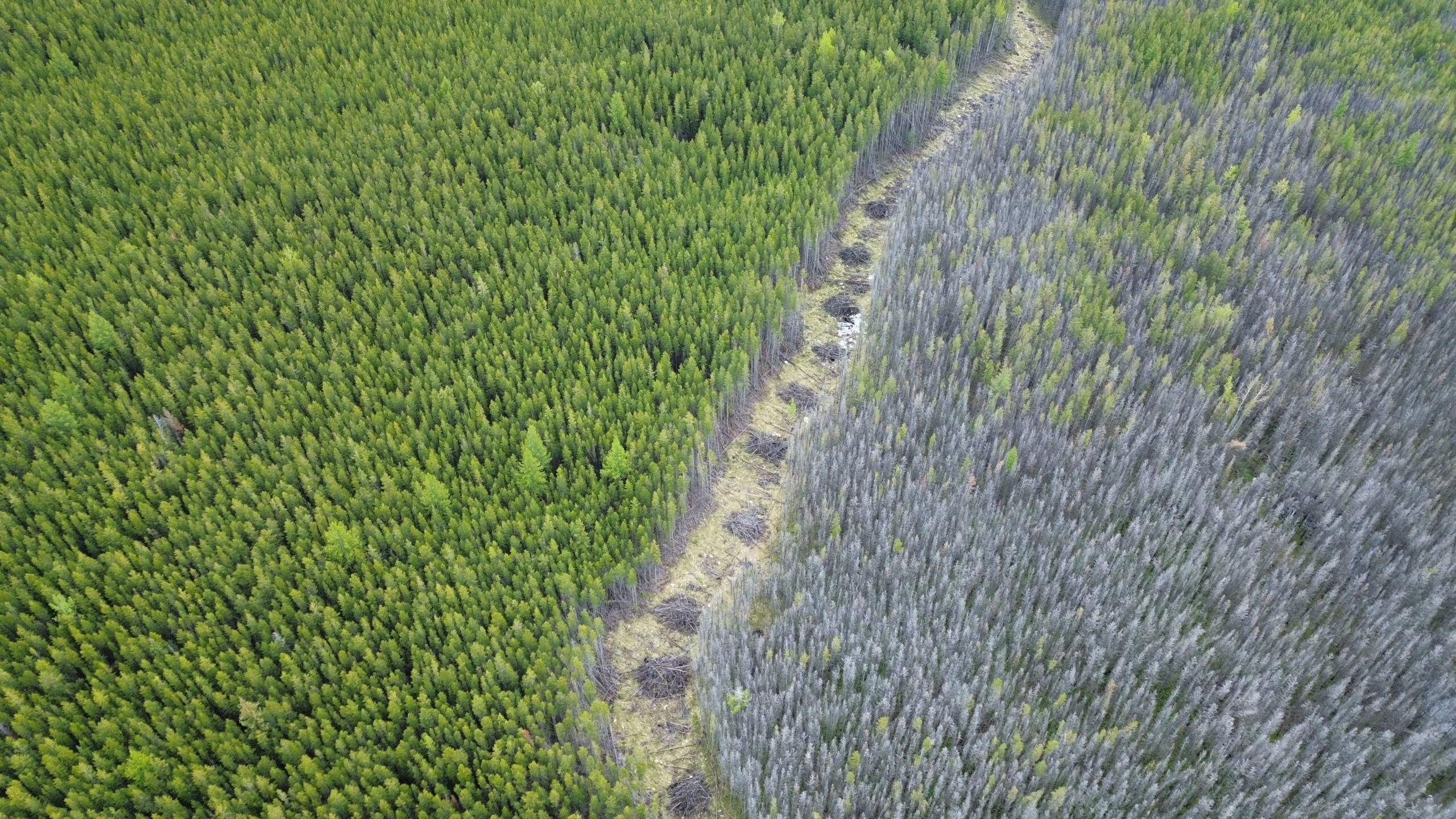
Osoyoos Indian Band set to restore native plants, species in wildfire-ravaged forests
The First Nation plans to clear out burned spaces and restore trees, berries and medicinal plants to the area, encouraging biodiversity and wildlife to return