Innu Nation ‘moved to anger, to strength’ after accusing province of censoring history
Solidarity pours in after ‘Labrador’ history exhibition abruptly cancelled after province ordered removal of cultural items and timelines older than 300 years
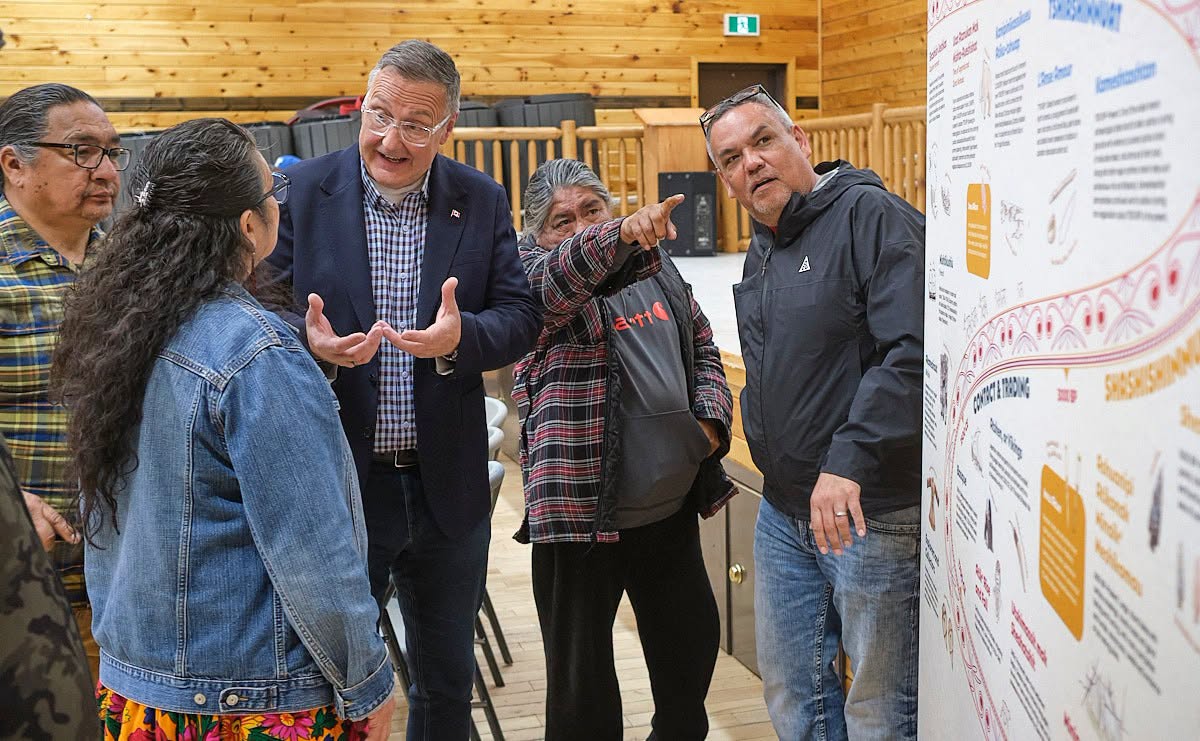
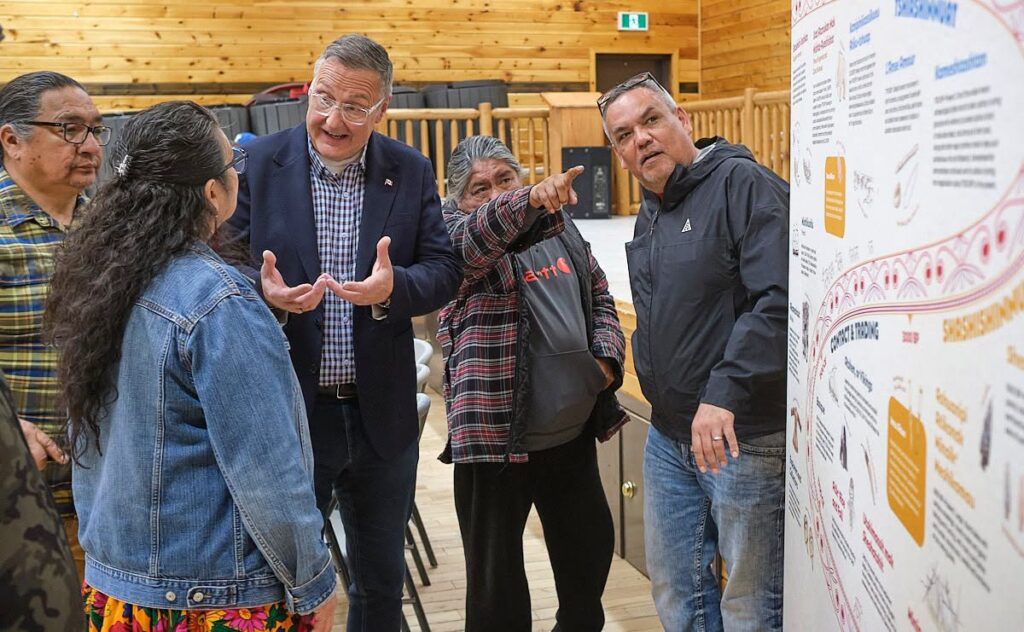
Fallout continues from the last-minute cancellation of an exhibition of Innu culture and history in “Newfoundland and Labrador” — after its organizers said the province tried to censor it.
After two years of planning, “Innu Pakassiun (“Innu tools for survival”) was set to open on Sunday at the Labrador Interpretation Centre, on National Indigenous Peoples Day.
The centre is run by The Rooms, the province’s official archives, museum and gallery — a Crown corporation overseen by provincial appointees, including the deputy minister of Tourism, Culture, Arts and Recreation.
But instead, the Innu Nation abruptly scrapped the long-awaited display.
It accused the province of ordering the removal of all cultural items and timelines older than 300 years, contradicting the government’s preferred version of history.
The exhibition’s planner, Innu Nation Cultural Guardian Jodie Ashini, said she was “heartbroken” when a representative of The Rooms called her as she was setting up the exhibition on June 17.
“The truck had arrived, and that morning I had videos of it unpacking — live videos of our exhibit pieces being brought in,” Ashini told IndigiNews.
“I’d been helping dress mannequins, and it was just excitement … you could feel the buzz in the air, the energy.”
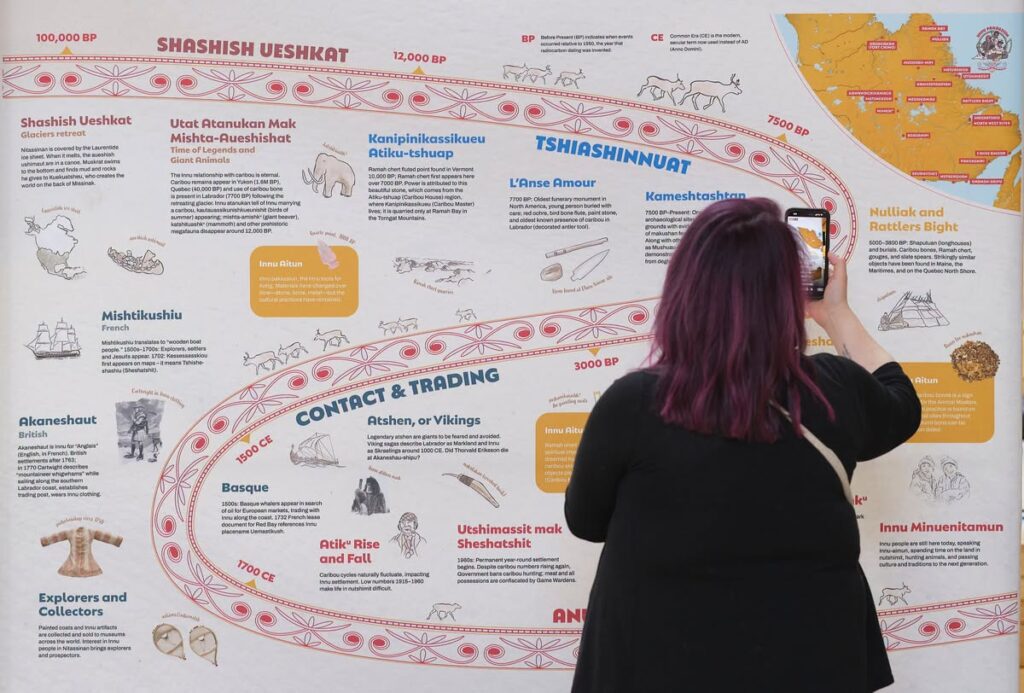
According to Ashini, The Rooms’ representative told her the exhibition could not include its timeline of Innu existence and history, along with extensive archeological evidence that supported it, because it would go against the government’s acceptable timeline of Innu history — which dates back just three centuries.
“At that point, I felt like they had backed us into a corner,” she said, “because they had delivered everything, and I guess maybe was hoping that because it was here, that we wouldn’t say no.”
Controversy escalates — along with solidarity
The display of ancestral Innu items held at two museums — including the Canadian Museum of History and The Rooms itself — had been billed as a “milestone on the path to repatriation and … bringing our belongings home.”
The Innu Nation explained the decision to cancel “Innu Pakassiun,” saying The Rooms’ demands contradicted “the accepted academic consensus timeline of Innu history in Labrador,” according to a statement.
“Instead the Innu would be required to support the province’s own controversial theory of Innu history.”
Innu Nation’s Grand Chief Simon Pokue added that “attempts to restrict or redefine Innu history to suit the province’s legal objectives are unacceptable.”
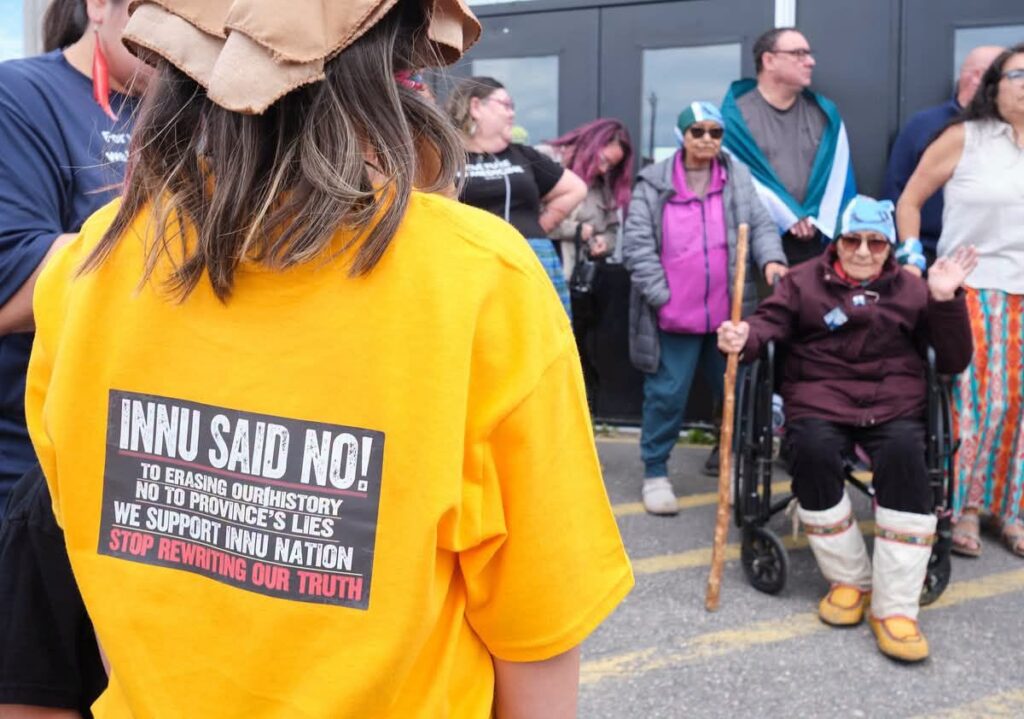
The cancellation led to a swift outcry over the coming week. The next day, the Labrador Friendship Centre decried what it called the “alteration of Indigenous histories to fit colonial narratives.”
It called the allegations a “continuation of systems that erase Indigenous voices and control Indigenous stories,” the centre stated on Facebook.
“The stories of the Innu people belong solely to them. Their history should not be subject to political approval, revision, or erasure.”
Later that day, the Innu Development Limited Partnership withdrew in protest from Expo Labrador, an major annual economic development and business conference opening the next morning.
The nation also postponed its planned community consultations about an out-of-court settlement agreement with Hydro-Quebec, citing “the insult from the Government of Newfoundland and Labrador,” and “the province’s position on our Innu timeline,” according to a statement posted to Facebook.
The next day, members of Innu Nation protested outside the Expo Labrador event in Happy Valley-Goose Bay, where Premier Tony Wakeham was the planned keynote speaker.
But then the organizer, the Labrador North Chamber of Commerce, cancelled the entire trade show, pending “a resolution between the Government of Newfoundland and Labrador and the Innu of Labrador,” according to a statement.
“We are disappointed the government did not address the outstanding concerns of the Labrador Innu this week,” the organization said on Tuesday, “and we will be cancelling the remainder of the conference.”

Representatives of the province’s other Indigenous groups have rallied behind Innu Nation.
On Saturday, the Assembly of First Nations Quebec-Labrador (AFNQL) stated it “denounces the Government of Newfoundland and Labrador’s interference in historical facts,” and that “any attempt to revise, question, or diminish the history of the First Peoples of these lands is appalling.”
On Wednesday, the Nunatsiavut Government — elected by Inuit in “Labrador” — expressed its solidarity.
“As Inuit, we know what it means to have our story challenged or misrepresented,” said President Johannes Lampe in a statement.
“The Innu Nation has shown tremendous leadership and patience, and they deserve a provincial partner that listens, understands, and acts in good faith.”
A day later, the Mi’kmaq community of Miawpukek First Nation issued its own statement, declaring it “stands behind the Innu Nation and their denouncing of Newfoundland and Labrador’s cancel-culture approach to Innu history and presence on their homeland.”
Ashini said the outpouring of solidarity has strengthened the community’s resolve to fight for their history.
“Now it’s moved to anger, to strength even,” Ashini said.
“Everyone is coming together, all the different organizations, people are working together … We will fight what the province is trying to do.”
Premier and minister apologize
The Rooms did not respond to questions about the exhibition, but referred IndigiNews to the province.
In a letter sent Tuesday to Innu Nation, Premier Wakeham said he and the Indigenous relations and reconciliation minister had met with leaders and apologized.
“I deeply regret the events that produced the controversy over the Innu exhibit and I apologize for those events,” Wakeham wrote.
“The provincial government will not require statutory institutions publicly displaying Indigenous culture to establish a timeline of the occupancy of land in Labrador.”
Meanwhile, the minister of Labrador Affairs and Indigenous Relations and Reconciliation said she’d hoped to find a “solution that respects all points of view” and “a compromise to allow the exhibit to proceed.”
“I understand that much time, care, and effort has gone into its preparation,” Lela Evans stated, “and I recognize the importance of the Innu sharing their history and story so that all Newfoundlanders and Labradorians may better understand their culture.”
Neither Wakeham nor Evans addressed the allegations that the government had interfered in the exhibition’s Innu history timeline, or imposed its own 300-year interpretation on Innu history.
But while much of the furor and media attention has focused on the exhibition’s cancellation — and province’s apology for it — leaders of the Innu Nation said on Wednesday officials had failed to address “the central issue … the province’s continued promotion of a narrative that questions thousands of years of Innu presence in Nitassinan.”
The archeology department at the Memorial University of Newfoundland called the province’s historical stance “flawed,” backing up Innu knowledge about their long history in the region.
The faculty’s anthropologists and archeologists — including former Canadian Archaeological Association president Lisa Rankin — said there is “a substantial body of archaeological and ethnohistorical scholarship” confirming Innu presence “extending well beyond 300 years,” on top of Innu knowledge.
‘Knowledge passed down from thousands of years’
Ashini sits on the board of the Indigenous Heritage Circle, and was appointed to Parks Canada’s Indigenous Cultural Heritage Advisory Council.
“We have oral stories; we have knowledge passed down from thousands of years,” said the former archeology field technician and archeology student at Memorial University of Newfoundland.
She accused the province of “erasing who we are as a people,” alleging its archeologists “totally disregard any of our oral history or because it’s not [in] written form.”
Non-Innu researchers — including those insisting Innu didn’t exist in “Labrador” prior to the 18th century — do not know Innu history or tools as Innu do, she said.
Ashini, who is from Sheshatshiu Innu First Nation — one of two Innu settlements in “Labrador” — gave an example of an instance where outside archeologists found an Innu tool, and then debated whether it was a toy plane propeller or a hand off a clock.
But she and her father — former Innu Nation Grand Chief and land claim negotiator Daniel Ashini — identified the object as in fact a traditional tool.
“’No, guys, this is a needle for weaving snowshoes,’” she recalled informing the researchers.
“And that’s how my story would have been interpreted if it wasn’t for my father and myself on that archeology site. That one example is proof of how sites can be interpreted so wrong without Innu knowledge and perspective.”

An exhibit of pride in heritage
“Innu Pakassiun” was created to display Innu belongings taken and stored in Canadian Museum of History and The Rooms collections.
Ashini said it included cultural items such as snowshoes, moccasins, caribou-painted coats, beadwork, red ochre pigment for painting.
“There’s just a lot of different things … taken away,” Ashini said, “and now were able to come home after over 100 years sitting in drawers and museums.”
For her, the hardest part of cancelling the long-planned exhibition was “feeling like I was letting my people down.”
She said many fellow Innu told her “Innu Pakassiun” felt like “pieces of their mother and father and grandparents” coming home.
“It was really a place to bring children and let them discover who our ancestors were,” she explained.
“There’s a lot of times now they’re not represented in Newfoundland and Labrador curriculum in school, and they don’t see themselves getting recognized.”
Having kids see their long history reflected in a provincial museum, she added, “I thought would be really beneficial to them.”
But Ashini said “Innu Pakassiun” cannot be shown to the public outside of The Rooms, because only the museum provides the needed climate-controlled rooms, security and pest control for safely storing of cultural items and belongings.
“They need to have security in order for the insurance, and they can’t be just put into any building,” she said.
“So, they have dictated all of the power, even when our items are to come home they come with clauses about how we protect them.”
She believes the government is dragging its feet on a four-decade old land claim by Innu, and that the latest scandal occurred “because Newfoundland and Labrador is trying to not recognize us.”
“Just saying something and not following through won’t fix it,” she said. “There has to be a big acknowledgement from the government now that they messed up.
“The exhibit is set up, it’s ready to go, but the door’s locked.”
But she is still hopeful, she told IndigiNews, because “our ancestors came home and that their strength is here with us — the Innu people — and this is really come to bring us their strength, maybe unite us.”
Author
We live in a media ecosystem that thrives on misinformation. Big Tech and AI companies are consuming the work of real human beings and Canadian news has been banned on Facebook and Instagram.
And yet, I have hope for journalism because of the work we’re doing at IndigiNews.
At IndigiNews, we embody tâpwêwin — the Cree value of integrity and responsibility in truth-telling. We are committed to our independent, Indigenous-led newsroom rooted in community, accountability, and relationality. We believe storytelling is a sacred fire that connects our pasts, presents, and futures through the storytellers in our Storytelling Lodge. IndigiNews creates space for Indigenous journalists, storytellers, Knowledge Keepers, and communities to gather, learn, and share stories that matter.
As a registered charity, we are building a fire that allows our work not just to ignite but to thrive. Rather than relying on advertising or corporate acquisition, IndigiNews is sustained by people like you who believe Indigenous stories are important for the future of our communities.
Your support is making a real difference.
Our community of supporters, our Firekeepers, make it possible to grow our newsroom, publish award-winning journalism, train emerging Indigenous journalists through initiatives like the ReFocus Photojournalism Fellowship, and publish trustworthy stories that serve our communities across the country. Every story we publish helps fill in gaps left by mainstream media and ensures Indigenous perspectives are represented with care, accuracy and respect.
But there is still more work to do.
As the media landscape becomes more and more uncertain, community support is as necessary and essential as it’s ever been. Every new Firekeeper helps protect the independence of our newsroom and strengthens journalism that is accountable to our many and varied communities over corporations.
That’s why we’re inviting you to become a Firekeeper.
Firekeepers tend to and protect the sacred fire. Your monthly contributions directly support IndigiNews’s Storytelling Lodge, helps sustain our independent, Indigenous-led newsroom, and ensures future generations of Indigenous storytellers have the resources they need to do the work.
As a registered Canadian charity, all eligible donations receive a charitable tax receipt.
If you believe Indigenous stories matter, if you value independent journalism, and if you want to help build a strong future for Indigenous media, we invite you to join our circle of Firekeepers today.
Together, we can keep the fire burning.
— Eden Fineday, Publisher, IndigiNews
Support us nowLatest Stories
-
In the Okanagan desert, snakes offer lessons on protecting a fragile ecosystem
For two decades, researchers at the Nk’Mip Desert Cultural Centre have tracked snakes across syilx homelands — while helping people appreciate the often-feared creatures
-
Beloved on the powwow circuit, young boy’s connection to the drum inspires
Now four, Waseskwan Redcrow was dancing ‘before he could even fully walk’ — his family says participating in powwows has brought them joy and belonging