A new GyaaG̲ang (totem pole) is raised in Haida ceremony, celebrating a ‘small act of reconciliation’
Carving by Haida artist Ḵuuya Micheal Moody depicts ‘WaasG̲uu the Sea Wolf carrying a deep-sea frog — a symbol of luck, wealth and prosperity
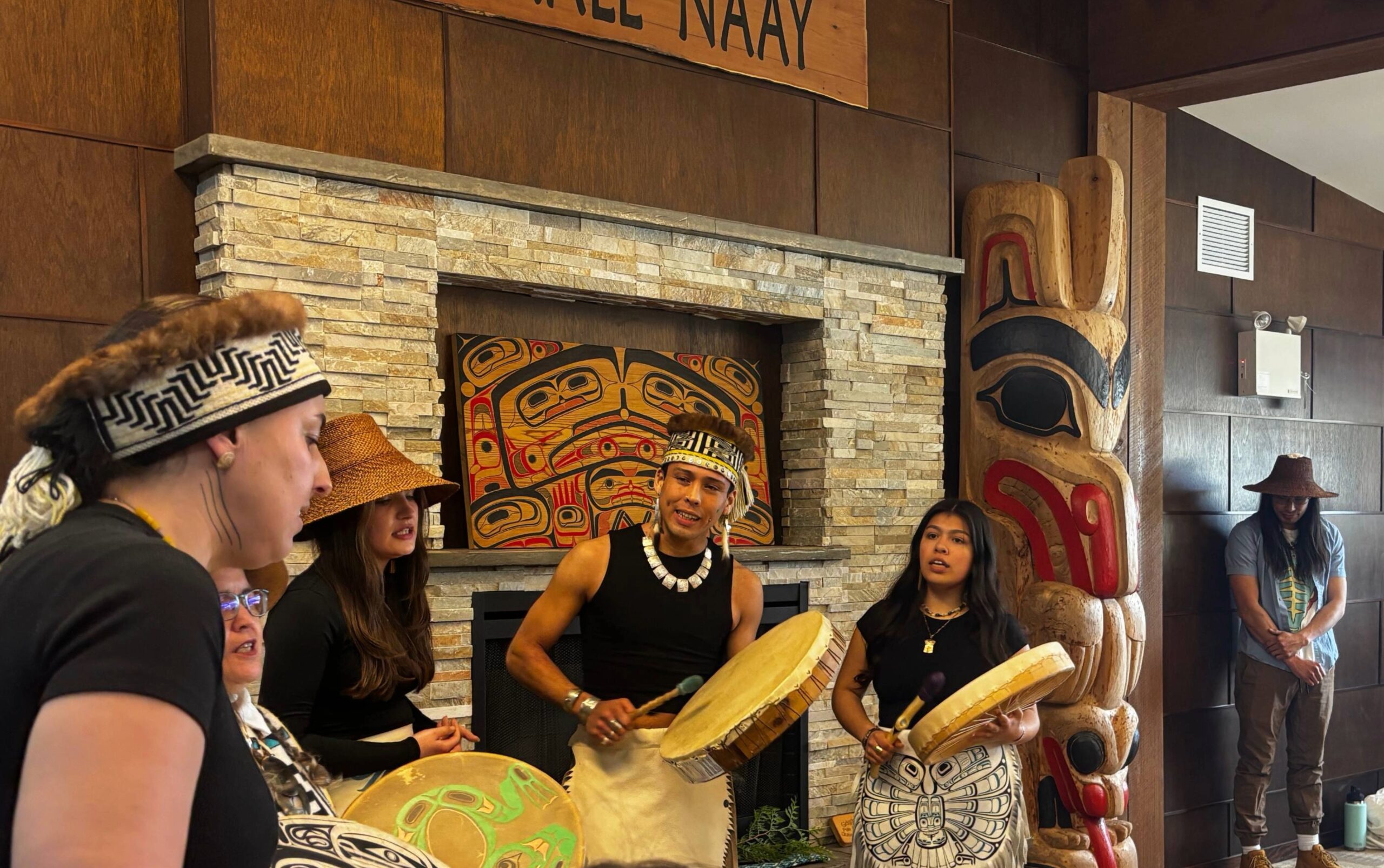
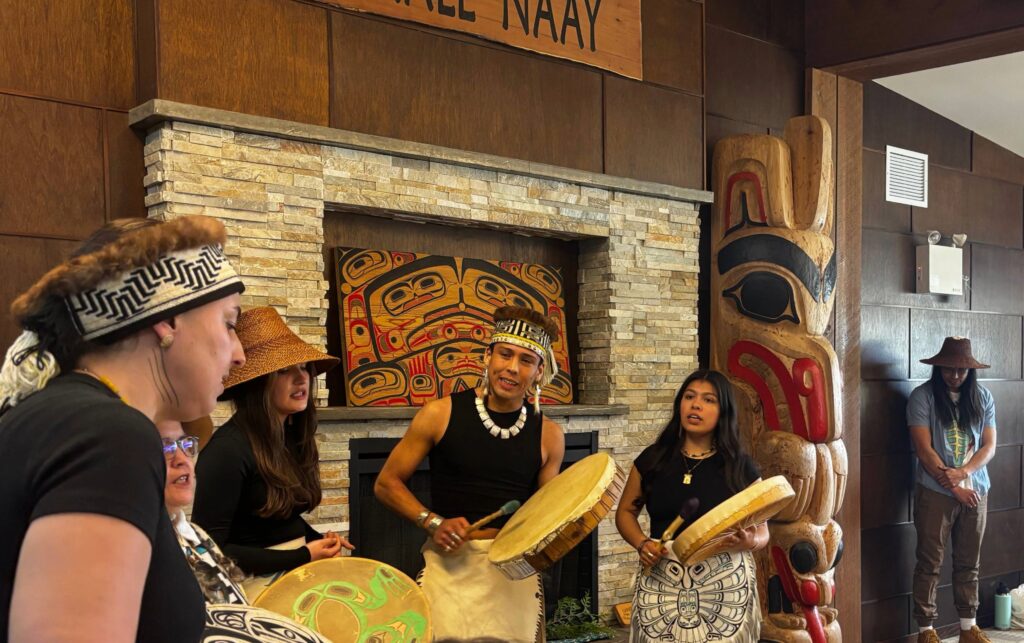
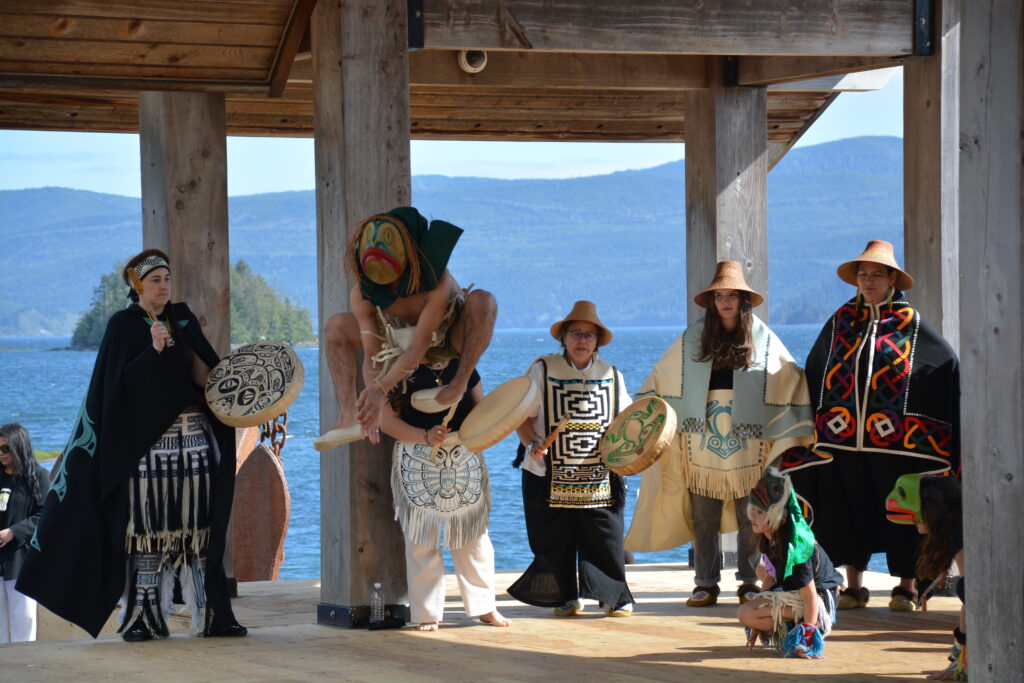
The sound of songs and drumming carry across Skidegate Inlet, as dancers in woven regalia move through Spirit Square, beneath a blue sky with clouds low on the horizon.
The May 1 gathering of chiefs, matriarchs, dancers, witnesses and other community members watch as a newly carved Haida GyaaG̲ang (totem pole) by artist Ḵuuya Micheal Moody is lifted into its home inside the Northern Savings Credit Union branch in Daajing Giids.
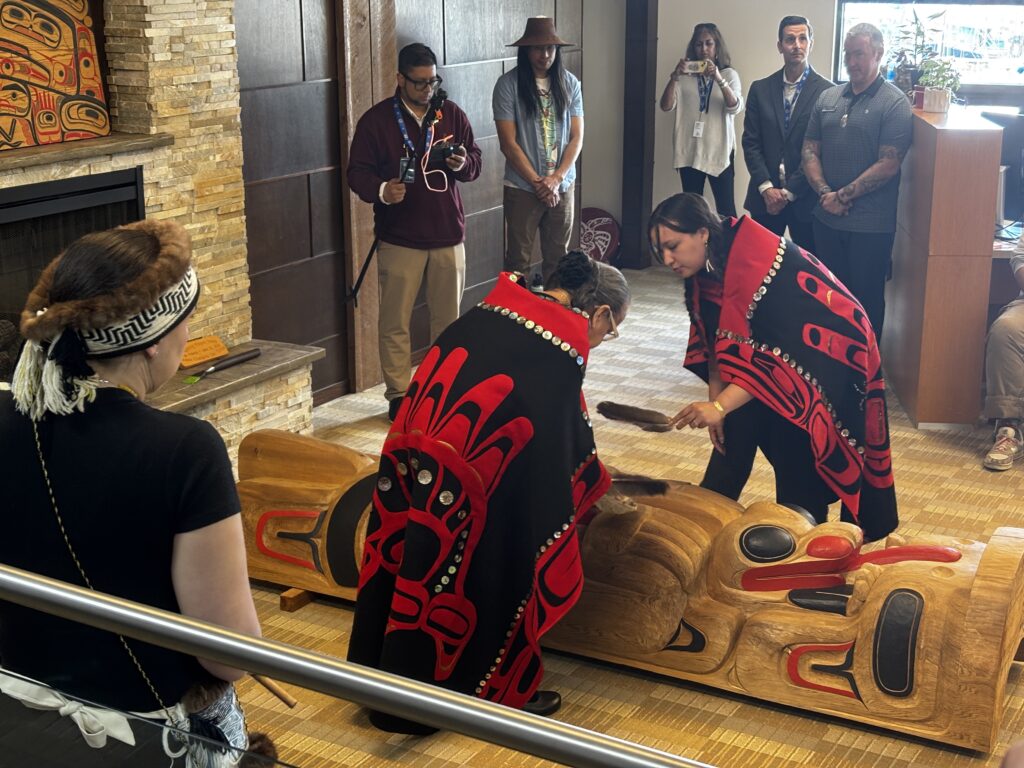
The day begins outside with a food burning — a ceremonial offering to the ancestors — before guests move indoors for the pole-raising ceremony, during which Haida matriarchs bless the carving by smudging and brushing it with cedar.
Hltaaxuulang Gud ad K’aaju (Friends Singing Together), a dance group representing members of different Haida clans, share songs.
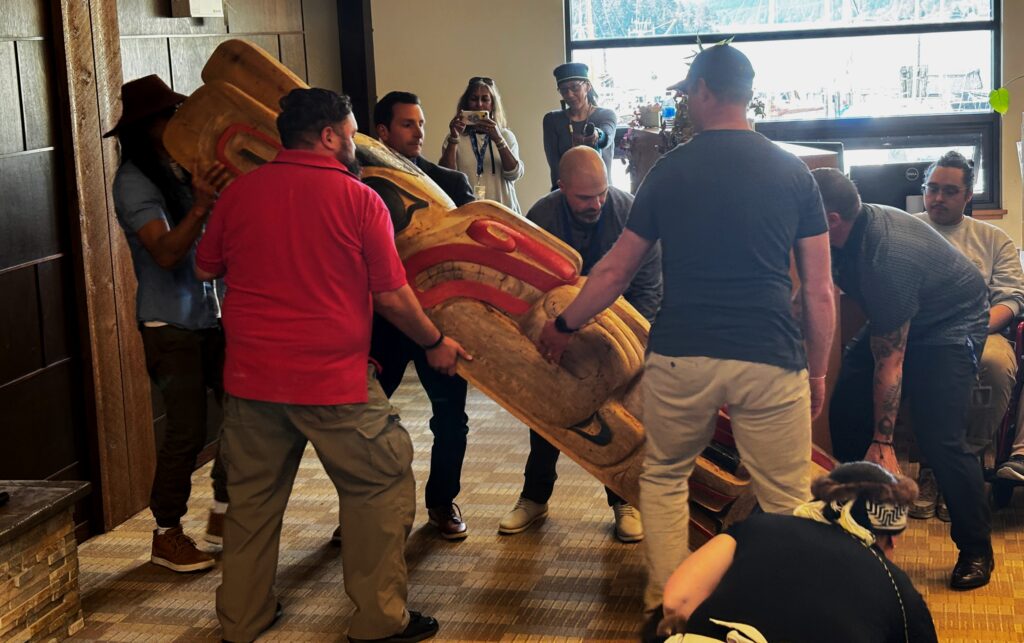
Once it’s blessed, several men help Ḵuuya lift his carving upright as the crowd watches in silence.
With the pole secured, applause fills the room as fresh cedar branches from the blessing ceremony are placed at its base.
‘Good fortune in all forms’
The pole is named Gina ‘Láa SG̲un (Good Fortune Pole). Ḵuuya, from HlG̲aagilda (Skidegate) and a member of the Raven Clan of Naay Ḵun KiiG̲awaay, carved two figures on it: a sea wolf at the top, and a deep-sea frog below.
‘WasG̲uu, the Haida Sea Wolf, is a supernatural being who ferries the deep-sea frog — “the embodiment of luck, wealth and prosperity,” Ḵuuya explains in a statement.
“Anyone who sees the deep-sea frog is said to receive good fortune in all forms.”
The two-figure pole was carved from cedar, with sweeping black formline designs, deep-set eyes, and red accents running across the face and tongue of the lower figure.
Gidin Jaad (Erica Reid), a Haida and Tsimshian educator and former Northern Savings employee for 10 years, is the event’s master of ceremonies.
“It’s a privilege to be here today, to stand with my fellow chiefs — the ones that are here today — and to represent the Haida Nation,” she says.
“I just want to say háawa [thank you], Northern Savings.”
The credit union, which operates two branches on Haida Nation territory, commissioned the carving — part of what it describes as its commitment to the Truth and Reconciliation Commission (TRC)’s calls to action for businesses.
Those calls to action include “building respectful relationships” with Indigenous people, including “education for management and staff” on Indigenous and colonial history, as well as “equitable access to jobs, training, and education opportunities,” the TRC’s recommendation states.
“We thank everyone for coming here today to witness the raising of Gina ‘Láa SG̲un,” says Stefan Delloch, president and CEO of Northern Savings Credit Union.
The Council of the Haida Nation offered guidance on the project, alongside the Hereditary Chiefs Council, and the Hlk’ayk’ii (To Start a Fire) project of the Haida Gwaii Museum and Swiilawiid Sustainability Society.
“Allowing us to raise a GyaaG̲ang provides us with the opportunity to show our respect to the land, culture, language, history, and to honour the Haida people,” Delloch adds.
“Háawa for allowing our partnership to grow. We are forever grateful, and we wish everyone good fortune ahead.”
‘Kindness that’s going to lead to larger feats’
With the Gina ‘Láa SG̲un pole finally in place, Ḵuuya performs a carver’s dance to bring life into it, exclaiming loud “hoo’s” and grunts as he raises a carving tool toward his newly installed work.
The dance symbolizes the completion of his carving, uplifting the ongoing preservation of Haida culture.
The ceremony continues in Spirit Square, where people share speeches, dancing, food, refreshments, and gifts to the ceremony’s witnesses, as well as recognition and thanks to Haida Chiefs and supporting organizations.
Jenny Cross, a Haida Elder from HlG̲aagilda, thanks Ḵuuya “for creating the beautiful totem pole,” and also honours the cedar tree it was carved from.
“At every fire offering, we offer with love and respect,” she says. “We’re all here in a good way.
“Cedar is life — it was our transportation, shelter, clothing, totem poles, masks and utensils.”
Xyallaga Daaguuyah (Desi Collinson), representing Council of the Haida Nation in HlG̲aagilda, calls the pole’s commissioning a “small act of reconciliation” that will serve as a larger symbol of reconciliation.
“Everyone’s always asking what reconciliation is,” he muses.
“I think it’s just a small act of kindness that’s going to lead to larger feats.”
Author
We live in a media ecosystem that thrives on misinformation. Big Tech and AI companies are consuming the work of real human beings and Canadian news has been banned on Facebook and Instagram.
And yet, I have hope for journalism because of the work we’re doing at IndigiNews.
At IndigiNews, we embody tâpwêwin — the Cree value of integrity and responsibility in truth-telling. We are committed to our independent, Indigenous-led newsroom rooted in community, accountability, and relationality. We believe storytelling is a sacred fire that connects our pasts, presents, and futures through the storytellers in our Storytelling Lodge. IndigiNews creates space for Indigenous journalists, storytellers, Knowledge Keepers, and communities to gather, learn, and share stories that matter.
As a registered charity, we are building a fire that allows our work not just to ignite but to thrive. Rather than relying on advertising or corporate acquisition, IndigiNews is sustained by people like you who believe Indigenous stories are important for the future of our communities.
Your support is making a real difference.
Our community of supporters, our Firekeepers, make it possible to grow our newsroom, publish award-winning journalism, train emerging Indigenous journalists through initiatives like the ReFocus Photojournalism Fellowship, and publish trustworthy stories that serve our communities across the country. Every story we publish helps fill in gaps left by mainstream media and ensures Indigenous perspectives are represented with care, accuracy and respect.
But there is still more work to do.
As the media landscape becomes more and more uncertain, community support is as necessary and essential as it’s ever been. Every new Firekeeper helps protect the independence of our newsroom and strengthens journalism that is accountable to our many and varied communities over corporations.
That’s why we’re inviting you to become a Firekeeper.
Firekeepers tend to and protect the sacred fire. Your monthly contributions directly support IndigiNews’s Storytelling Lodge, helps sustain our independent, Indigenous-led newsroom, and ensures future generations of Indigenous storytellers have the resources they need to do the work.
As a registered Canadian charity, all eligible donations receive a charitable tax receipt.
If you believe Indigenous stories matter, if you value independent journalism, and if you want to help build a strong future for Indigenous media, we invite you to join our circle of Firekeepers today.
Together, we can keep the fire burning.
— Eden Fineday, Publisher, IndigiNews
Support us nowLatest Stories
-
In the Okanagan desert, snakes offer lessons on protecting a fragile ecosystem
For two decades, researchers at the Nk’Mip Desert Cultural Centre have tracked snakes across syilx homelands — while helping people appreciate the often-feared creatures
-
Beloved on the powwow circuit, young boy’s connection to the drum inspires
Now four, Waseskwan Redcrow was dancing ‘before he could even fully walk’ — his family says participating in powwows has brought them joy and belonging