Beyond language learning, weekly Cree classes taught me about kinship
‘Spirit never excludes anyone, but sometimes people exclude themselves’ has been a key teaching on my education journey


What is kinship, and how do we express it? Who are our people? Who are we responsible for and to?
These are some of the questions I have been asking myself as I study nêhiyawêwin, the Cree language.
I’ve been taking Cree classes with the same group of people online for the past four or five years. Our teacher is an incredible Elder named Dorothy Visser. She grew up speaking only nêhiyawêwin in Saddle Lake, “Alberta.” She has an incredible store of knowledge and experiences, and our class has the honour of learning from her. At 83, she is truly a treasure.
There are about 15 of us who show up regularly to the weekly classes and occasional in-person gatherings. Sometimes, the numbers swell to 20 or 30, but they don’t usually stay that high. People come, and people go, but after four or five years, there is a very sweet, tight-knit bunch that I can generally count on seeing when I attend.
Last year, in ceremony, an Elder said something that I think about often: “Spirit never excludes anyone, but sometimes people exclude themselves.”
That hit home for me. There are many people I know who I feel would thrive at Kokum Dorothy’s Cree lessons or who I believe would find healing at ceremony or language retreats. But a lot of folks don’t feel comfortable showing up to a space where they don’t know anyone. For those who were separated from their culture at birth, they may suffer from imposter syndrome and not feel “native enough” to attend. Or folks attend class a few times but for whatever reason, find it difficult to make attending into a habit.
I was like that myself when I first joined Cree classes.
The mind can be a funny thing: sometimes mine told me that I deserved a “break,” as though studying my language were some sort of punishment. It seemed like a daunting task when I thought about it — but it never felt like one when the class started.
Seeing everybody’s face, laughing at all the jokes, taking turns singing songs — class was actually a pleasure. A joy, even.
Even so, I started to doubt the efficacy of my online classes, as though that were the only reason to attend. A few years ago, I read a paper on language transmission that evaluated different teaching methods and learning environments for Indigenous language acquisition. I discovered that weekly adult language classes have a very low rate of success, if success is measured by creating fluent speakers.
This put me off my classes for a while. What’s the point, I thought, if I’m not going to become fluent this way? What are we even doing this for?
Then, last fall, I decided to force myself to learn faster by attending more classes. After years of studying my language, I could barely string together a basic sentence. As someone who once mastered French and could get by in Spanish if necessary, I was frustrated with my lack of progress in learning Cree.
So I signed up for two different online Cree classes on top of my weekly class with Elder Dorothy, one of which was an intensive class focusing on culture that met three evenings a week.
But after studying Cree four nights a week for a few months, I felt burnt out. When the other two classes ended, even though Elder Dorothy’s classes are year-round, I decided to take a break. I stopped attending the class led by my beloved Elder and friend. A few months went by, and I just didn’t tune in on Mondays. I went to the gym instead, or played video games. I watched shows with my family. I let it slip my mind.
I excluded myself from my community.
So when I received an email inviting me to a weekend language retreat this past March, I knew I had to go. I RSVP’d, and my husband and I were able to attend — and am I ever glad that we did. I ended up having the time of my life. The location and lodging was beautiful, and we were served three delicious meals a day. People came from all across the country, some of them with their spouses and children.
Along with Dorothy, there was another Elder who joined us, and when she emerged from her room the first night for dinner, my jaw nearly hit the floor. Her hair was braided beautifully and she was wearing a stunning ribbon skirt. Her ears, neck and arms were all adorned with beaded and silver jewellery. She looked amazing — I hadn’t realized that this gathering was going to be an opportunity to dress up in our finest, but it was a safe space to embrace our culture and let our colours shine.
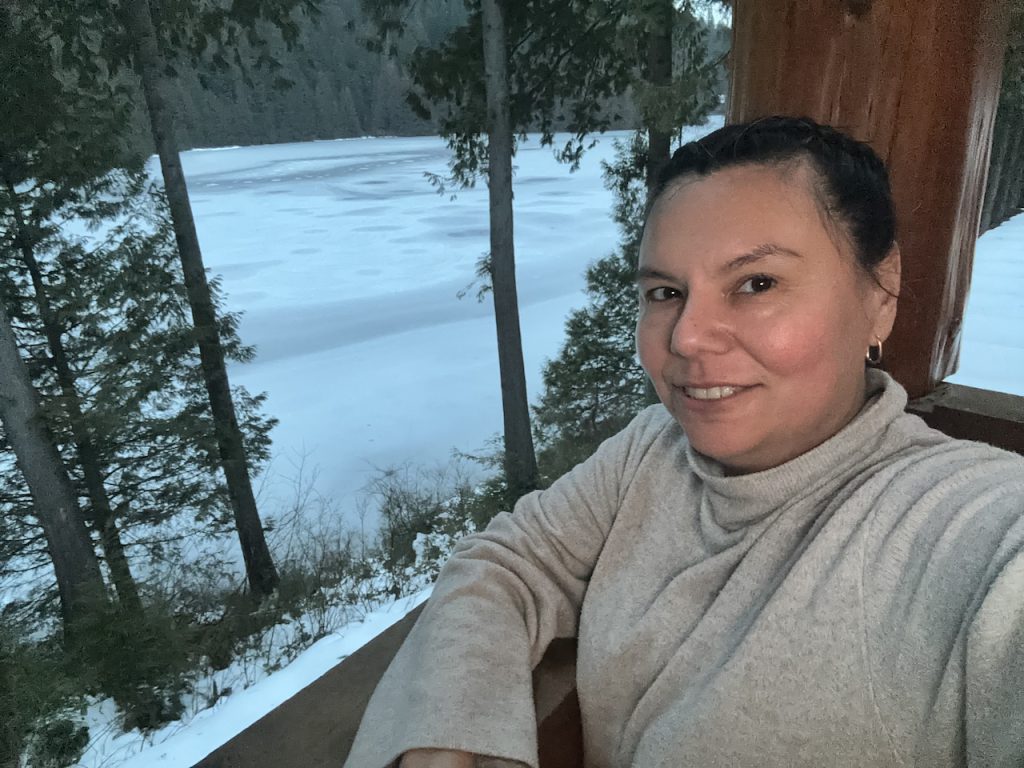
There was still snow on the ground and the lake was frozen over. The land was stunning. We sang songs around the fire, learned vocabulary outside in the snow, made drums and rattles.
All in all, it was an incredible weekend that reminded me of what I already knew: this language class isn’t just about learning Cree words and grammar. It’s about more for me than language acquisition.
It gives me what is, perhaps, the most important thing for any human being: a sense of belonging.
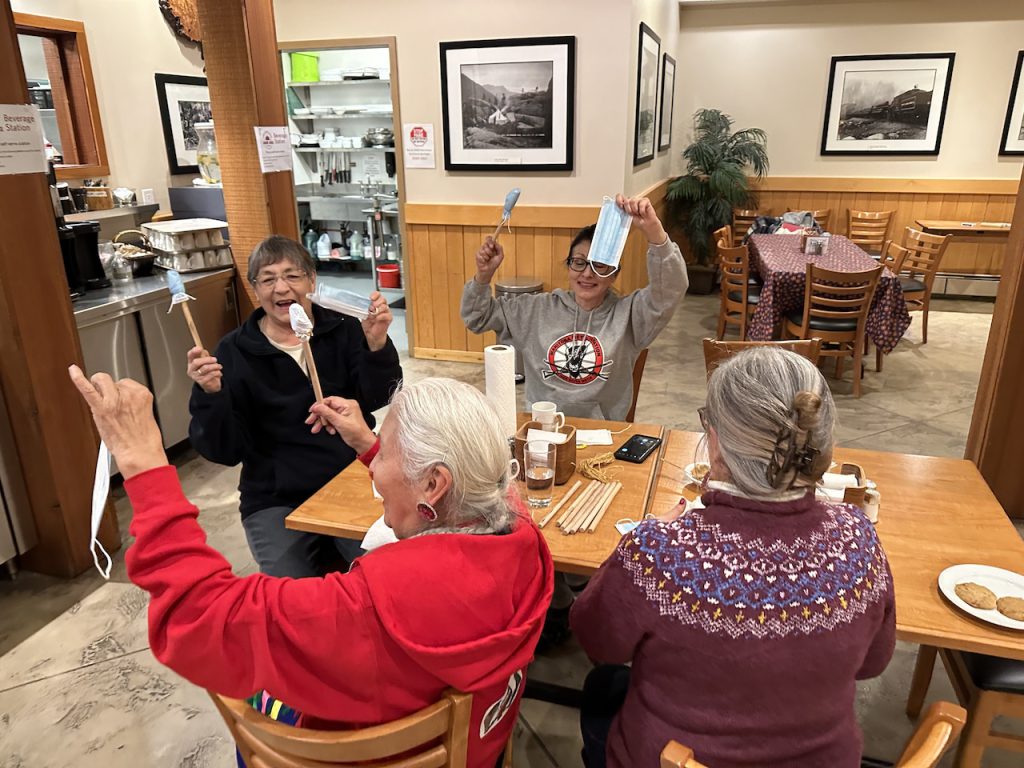
A few months later, in June, I attended a class supper, hosted by Elder Dorothy. As we all sat in a circle listening to obscenely loud fiddle music, playing spoons together and whooping and shrieking with joy while we followed the moves of the amazing Elder Betty Gladue, I felt so much joy. I couldn’t stop myself from getting up and doing a (poor imitation of) a jig. I felt sorry that I had spent those months excluding myself from this group. This — this joy, this kinship — is how humans were meant to live.
I had forgotten how incredible it is to have a community — or perhaps I never knew. Growing up without knowing many of my immediate family members due to the long lasting impacts of the trauma they suffered at residential “school” cut me off from them and deprived me of that sense of belonging. Even the side of the family that raised me didn’t really know how to belong to a community. My non-Indigenous mother left her family and their religion behind as a young adult and never really found anything to replace it. She spent most of her adulthood alone and very lonely. I inherited these traits.
But I’ve found my people now: they are a community who are unwavering in their kindness and acceptance of me, who truly know me. This community is made up of people of all ages, from different walks of life and at different places in their linguistic and cultural journeys, but they all accept me for who I am.
For a while, I had forgotten how much I needed these people. I hadn’t understood how to be in kinship with this group. By not attending class for those few months, I had stopped showing up for myself, and at the same time, I had stopped showing up for them.
I’m nearing 50 — and after many years of walking a healing path, I think I’ve finally figured out how to show up in my social life, to open up to people and let myself be vulnerable. To become emotionally invested. To choose to include myself in a community.
At dinner that night a few months ago, I made a promise to my community to show up online for class the next day. And I did.
I continue to learn so much from Elder Dorothy, and I now realize that I’m incredibly lucky to even know her. It is an honour to be able to spend time with her. If I have a chance to be in the same room with her and I don’t take it, I’m missing out on so much: her stories, humour, wisdom, kindness and strength. She is the living record of who we are as nêhiyawak. She carries the past into the present, and into the future through us and our children.
We learn better when we are in community with one another. I’m learning how to show up for myself and my community. Spirit never excludes anybody, and I think I’m done excluding myself, too.
Author
We live in a media ecosystem that thrives on misinformation. Big Tech and AI companies are consuming the work of real human beings and Canadian news has been banned on Facebook and Instagram.
And yet, I have hope for journalism because of the work we’re doing at IndigiNews.
At IndigiNews, we embody tâpwêwin — the Cree value of integrity and responsibility in truth-telling. We are committed to our independent, Indigenous-led newsroom rooted in community, accountability, and relationality. We believe storytelling is a sacred fire that connects our pasts, presents, and futures through the storytellers in our Storytelling Lodge. IndigiNews creates space for Indigenous journalists, storytellers, Knowledge Keepers, and communities to gather, learn, and share stories that matter.
As a registered charity, we are building a fire that allows our work not just to ignite but to thrive. Rather than relying on advertising or corporate acquisition, IndigiNews is sustained by people like you who believe Indigenous stories are important for the future of our communities.
Your support is making a real difference.
Our community of supporters, our Firekeepers, make it possible to grow our newsroom, publish award-winning journalism, train emerging Indigenous journalists through initiatives like the ReFocus Photojournalism Fellowship, and publish trustworthy stories that serve our communities across the country. Every story we publish helps fill in gaps left by mainstream media and ensures Indigenous perspectives are represented with care, accuracy and respect.
But there is still more work to do.
As the media landscape becomes more and more uncertain, community support is as necessary and essential as it’s ever been. Every new Firekeeper helps protect the independence of our newsroom and strengthens journalism that is accountable to our many and varied communities over corporations.
That’s why we’re inviting you to become a Firekeeper.
Firekeepers tend to and protect the sacred fire. Your monthly contributions directly support IndigiNews’s Storytelling Lodge, helps sustain our independent, Indigenous-led newsroom, and ensures future generations of Indigenous storytellers have the resources they need to do the work.
As a registered Canadian charity, all eligible donations receive a charitable tax receipt.
If you believe Indigenous stories matter, if you value independent journalism, and if you want to help build a strong future for Indigenous media, we invite you to join our circle of Firekeepers today.
Together, we can keep the fire burning.
— Eden Fineday, Publisher, IndigiNews
Support us nowLatest Stories
-
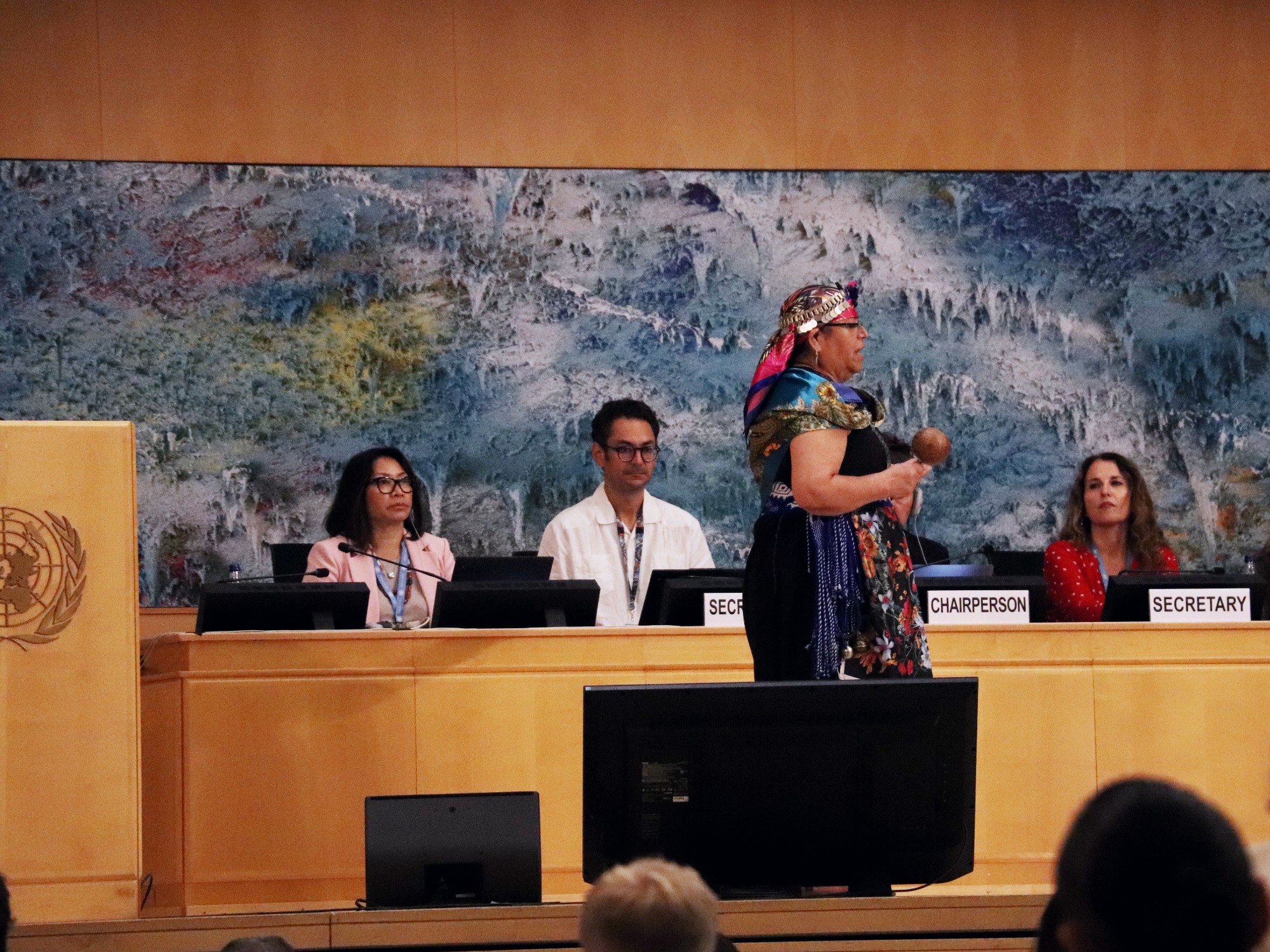
Indigenous people demand more say at the UN, as new crises hit their homelands
Indigenous nations live ‘on the frontlines’ of climate, conflict and new tech. But their voices remain sidelined in the global halls of power.
-
Through their lenses: Showcasing the work of our 2026 ReFocus fellows
Get to know our photojournalism training cohort through a series of portraits shot during a week in Kjipuktuk (Halifax)