With ‘grief and a desire for change,’ community gathers to remember MMIWG2S+ in ‘Winnipeg’
Cities across the continent held similar walks on Valentine’s Day, marking the 35th anniversary of annual memorials for missing and murdered Indigenous women, girls and Two-Spirit people

Content warning: This story contains details about missing and murdered Indigenous women, girls and Two-Spirit people (MMIWG2S+). Please look after your spirit and read with care.
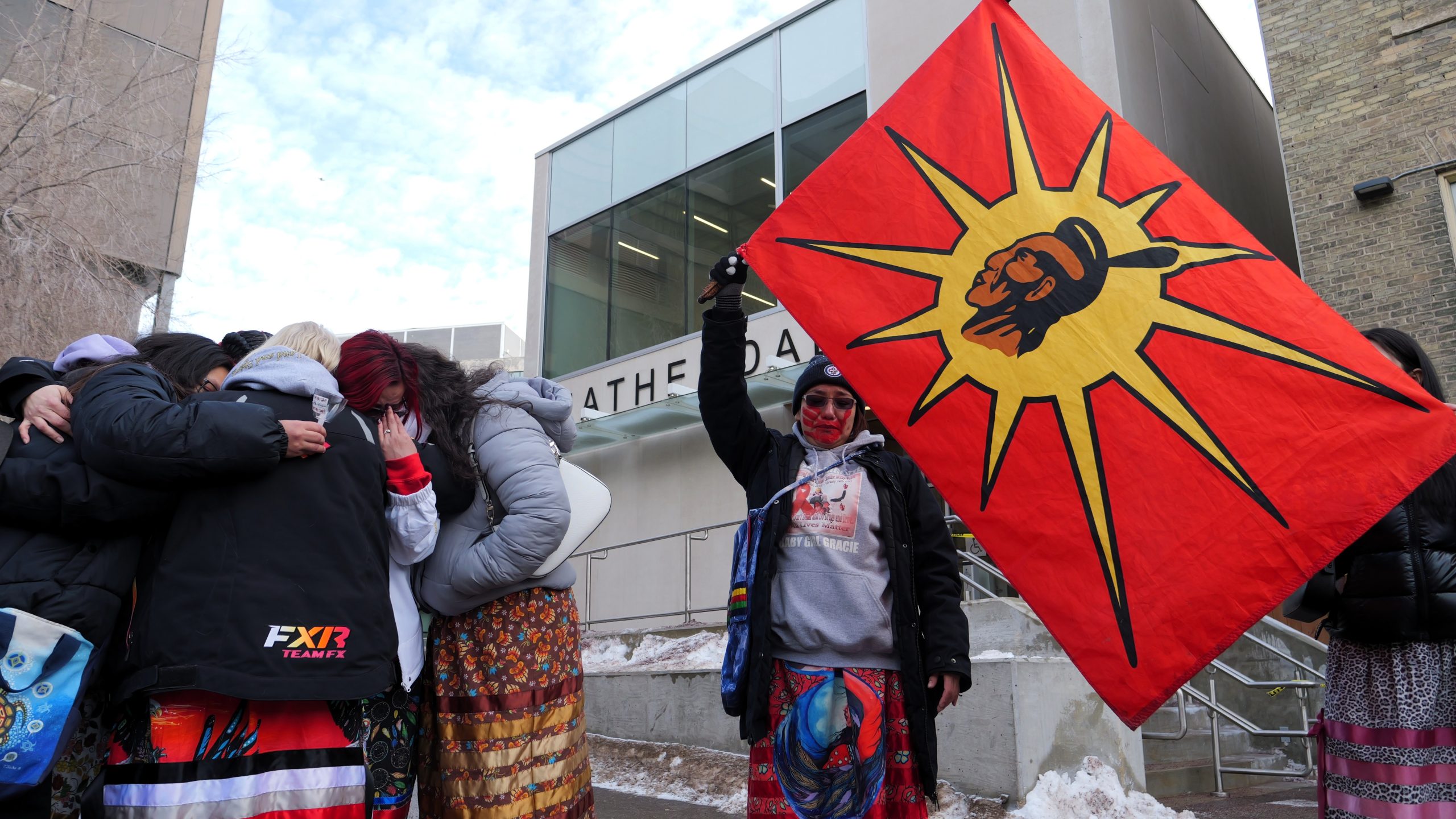
Photographs of loved ones, purple and pink butterfly placards, and a long red scroll of beloved names — all symbols to honour “Manitoba’s” missing and murdered Indigenous women, girls and Two-Spirit people (MMIWG2S+) last weekend.
On Valentine’s Day, more than 200 people circled around a “Winnipeg” city block — gathering in remembrance, and to advocate for justice.
The annual Women’s Memorial March ended with a sacred fire outside the University of Winnipeg.
Leading the event as a marshall was Falon Fritsch, 23, whose Ojibwe family is from Bloodvein First Nation.
“What brings me here today is grief and a desire for change,” they said.

Before and after the walk, people gathered inside the university, where they heard speeches and shared a light meal.
This year, Manitoba Keewatinowi Okimakanak (MKO) hosted the annual event, after longtime march co-ordinator Alaya McIvor passed the torch to the northern chiefs’ advocacy group.
The march took place in the heart of Turtle Island — at the confluence of the Red and Assiniboine Rivers, home to the Anishinaabe, Cree, Dakota and Red River Métis.

Its origins and inspiration lie 35 years ago, when the first march took place in “Vancouver’s” Downtown Eastside, within the territories of the xʷməθkʷəy̓əm (Musqueam), Sḵwx̱wú7mesh (Squamish) and səlilwətaɬ (Tsleil-Waututh) Nations.
That first event in 1992 honoured the memory of Cheryl Ann Joe, a Shíshálh woman who was murdered in the neighbourhood that year.
Decades later, what started then as a small memorial by her mother Linda has grown massively into a multi-city event to honour all MMIWG2S+ across the continent.

After opening prayers, the Binesi Ikwéwag (Thunderbird Women) Singers — an all-women drum group — sounded their buffalo-hide big drum.
Drum-keeper Shyanne Sinclair, from Fisher River Cree Nation and Berens River First Nation, explained the group formed “with gatherings like this” in mind.
“Whenever the community calls upon us,” she said, “we try to honour that as much as possible.”
She said members of the group have been personally affected by friends and family who have gone missing or been murdered.
“Some of us were almost MMIW,” Sinclair added.
“We try to encourage little girls and empower young women to come to the drum and learn the teachings, because it was gifted to women at first.”

‘Until then, I will walk’
This year’s march marshall, Fritsch, is a volunteer member of the Mama Bear Clan street patrol.
Members of the group walk twice a week in the city’s North Point Douglas neighbourhood and on the nearby Main Street strip.
They described the initiative as led by women and supported by men, and its main work “community outreach” — including giving out food, socks, warm clothing and hygiene products to their fellow community members in need.
“If one of our relatives is struggling with using substances,” they added, “we offer harm reduction … safe supplies for them to use.”
Fritsch’s hope is that “one day we can live as we always have lived in time immemorial where our girls are safe, our women are safe, and our Two-Spirit people are safe.”
“And until then, I will walk,” they declared.

Celebrated throat singer Nikki Komaksiutiksak, an Inuk woman from “Chesterfield Inlet” in Nunavut, spoke about her forced relocation to “Winnipeg” after being apprehended by the state as a child.
She and her cousin Jessica Michaels were taken into Child and Family Services (CFS) custody when she was seven years old.
Despite being displaced, the pair held onto their culture through their traditional throat singing.
But that wasn’t enough to keep Michaels, who she calls her sister, safe from the “child welfare” system that made them vulnerable.
Michaels was just 17 years old when she was murdered in a “Winnipeg” rooming house in 2001.

She called CFS a “fragmented system that is monstrous and hard to navigate” for children disconnected from their kin and homelands.
“No one wanted to take accountability for her murder,” she lamented. “Not the justice system, no governments, nobody.”
For Komaksiutiksak, her sister’s killing “sparked something inside.”
She vowed to advocate for the safety of Inuit women, girls and gender-diverse relatives.
It’s something she said she’ll do “for the rest of my life.”

‘Jennifer’s still out there. Somebody knows something’
The family of Jennifer Catcheway also attended the memorial march — a yearly ritual for them.
Jennifer, of Skownan First Nation, was 18 when she disappeared on her birthday in 2008.
“We never had our closure,” said her mother, Bernice Catcheway.
“Jennifer’s still out there somewhere. Somebody knows something. And I always say if you know something, contact RCMP or myself.”
On the day her daughter vanished, she was supposed to arrive at the family home in “Portage La Prairie” for cake and ice cream.
But she never showed up.

A call from the 18-year-old was traced to a location near “Grand Rapids.”
Since that day, her family hasn’t stopped searching for her.
“Whether you think it’s insignificant or not,” Catcheway added, “it’s one piece of the puzzle that we need — just that one missing piece to bring her home.”
The family and Manitoba Métis Federation have offered a $20,000 reward for information leading to Jennifer’s whereabouts.
Her brother Willie Starr said her disappearance continues to haunt the family.
“It hurts every year,” he said.
“My parents, they’re the backbone of all this that keeps us going, pushing for the answers.”

Last year, David Beauchamp’s daughter, Shanastene Irene McLeod, was murdered.
He said this year’s march is especially significant because the one-year anniversary of the 35-year-old’s killing was the day after Valentine’s Day.
McLeod, a member of Muskowekwan First Nation, and another victim — 33-year-old Swan Lake First Nation member Sheldon Catcheway — were found with gunshot wounds in the city’s North End. Both died in a hospital.
“It will be our first Valentine’s without her, ” said Beauchamp, of Ka-ka-kwe-ke-je-ong (Ebb and Flow First Nation).
He told IndigiNews it’s been particularly emotional for the family to mark a year of holidays without her.

‘Strength and love from the community’
Louise Menow, from Norway House Cree Nation, attended the march to remember multiple people she is mourning.
Those include her friend Hillary Wilson, family friend Claudette Osborne, and her nine-year-old niece Gracie McKay Valade.
She wore a hoodie with Gracie’s image on it.
“She was a very happy girl. She was very bright. She loved her family, and I know she loved me … it was really hard when we lost her,” said Menow.
“Her drunk driver walked away with a failure to stay at a crime scene, and that to me is injustice.”
She said she is planning to mark the three-year anniversary of Gracie’s death on Feb. 24 with a feast and fire.

She said the first time she attended one of the memorial marches, she found it “really tough” because she wasn’t yet “ready to deal with my emotions.”
But in the years since, she’s found strength from joining hundreds of others honouring lost loved ones.
“It’s amazing when community comes together,” Menow said.
“I get a lot of my strength from knowing that I’m not the only one out there that is suffering.”
Menow said she met “a lot of amazing people” attending public events who’ve inspired her to use her voice to speak out.
She hopes more and more people are able to experience the support she has.
“Just take those steps, come and feel the presence and strength and love from the community,” she urged.
“That’s what helps me and keeps me going.”

Author

Latest Stories
-
With ‘grief and a desire for change,’ community gathers to remember MMIWG2S+ in ‘Winnipeg’
Cities across the continent held similar walks on Valentine’s Day, marking the 35th anniversary of annual memorials for missing and murdered Indigenous women, girls and Two-Spirit people
-

Exhibition explores ‘total visual languages’ binding Salish peoples together
New feature, ‘Every River Has a Mouth,’ highlights interconnectivity between Coast and Interior Salish artists at the Bill Reid Gallery