After week-long journey, Kwakiutl memorial monument arrives in ‘Vancouver’ via hovercraft
The pole by carver Stan Hunt is now set to travel to Tkʼemlúps te Secwépemc where the former Kamloops Indian Residential School is located
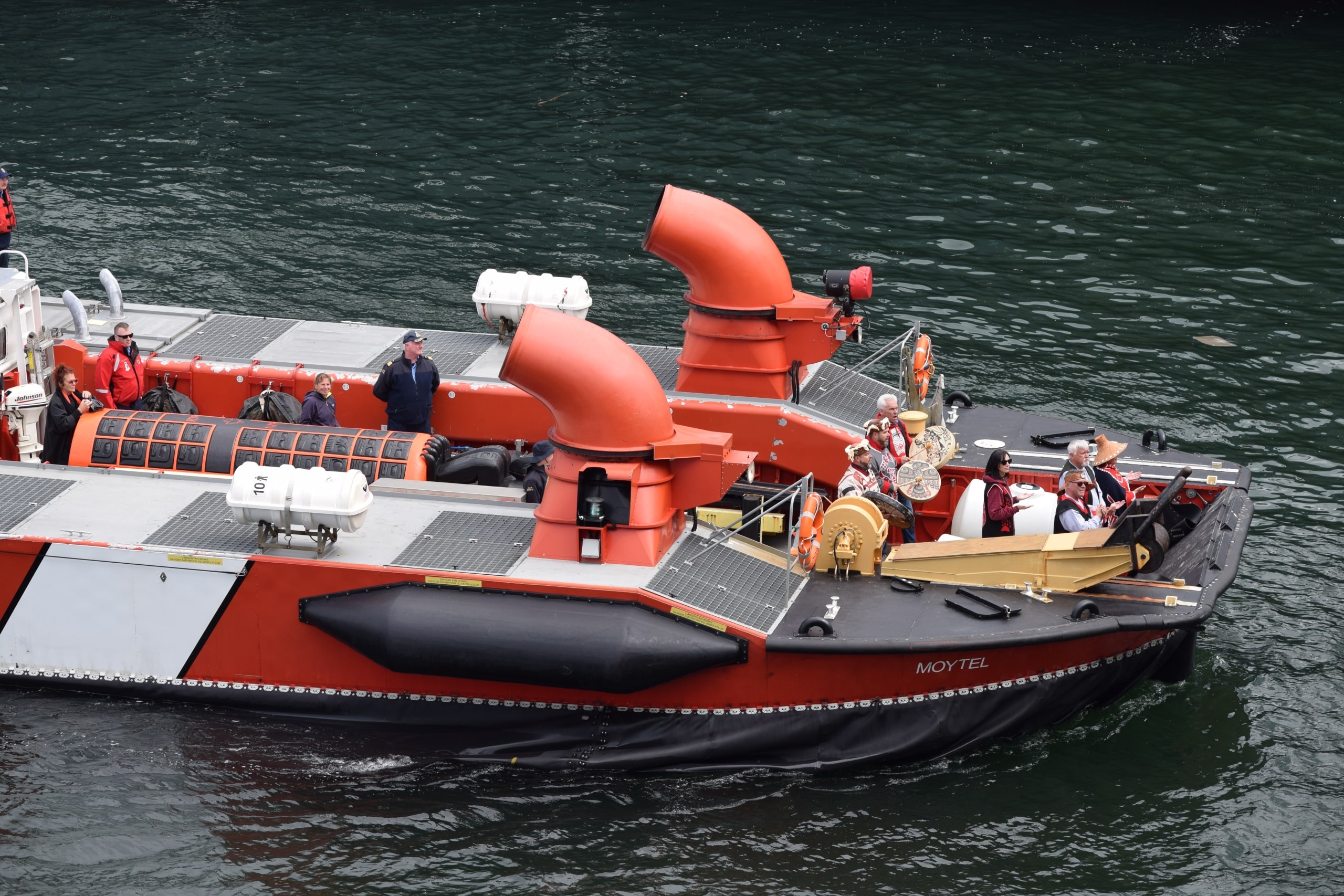
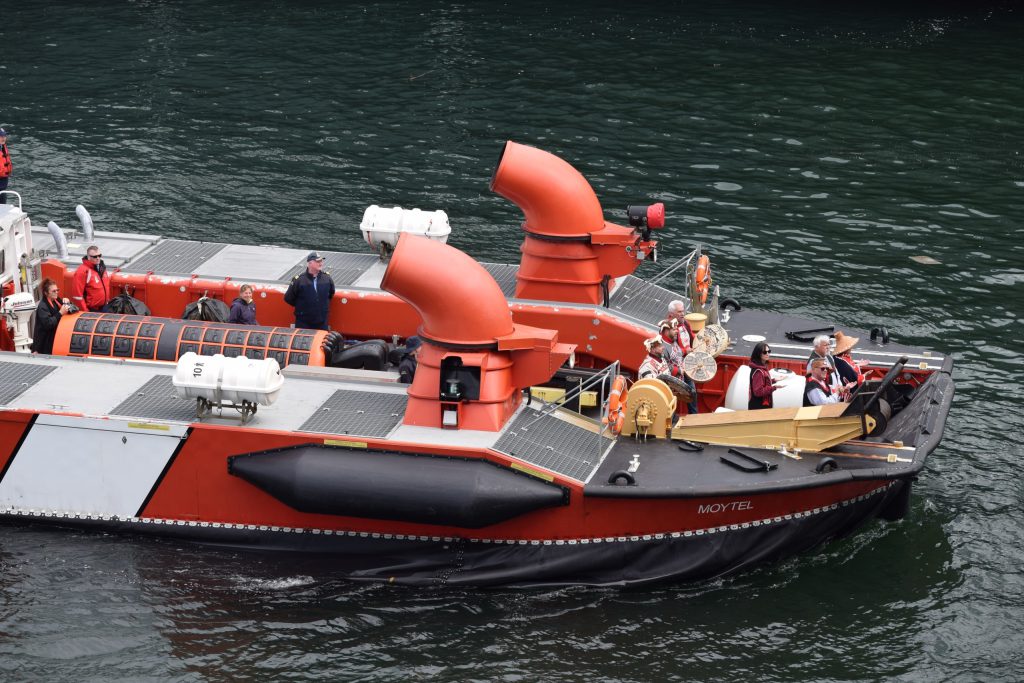
Culminating a week-long journey across “Vancouver Island,” a Kwakiutl monument carved in memory of the children lost to residential schools arrived to the shores of the mainland on Wednesday.
The five-and-a-half-metre pole travelled in a Canadian Coast Guard hovercraft from lək̓ʷəŋən territories to the waters of xʷməθkʷəy̓əm, Sḵwx̱wú7mesh and səlilwətaɬ, where it was welcomed by dozens of people at Canada Place.
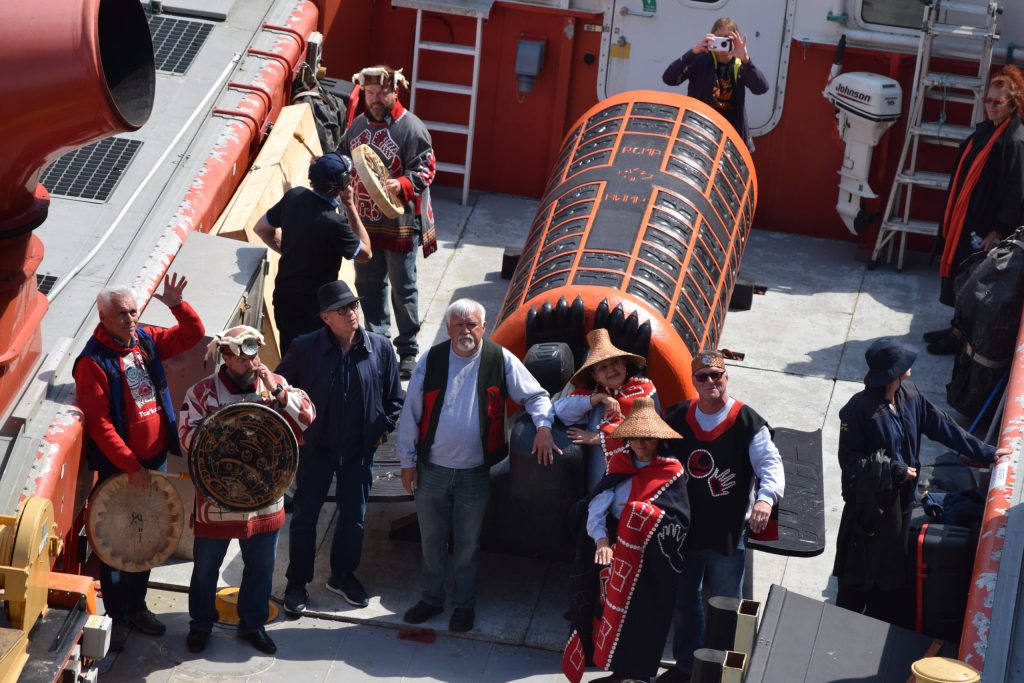
The monument by renowned artist Stan Hunt is made of red cedar that was harvested from his home territories in Fort Rupert. It depicts Raven — the Kwakiutl Creator — watching over 130 children as he calls their spirits home.
‘We’re doing this for the children’
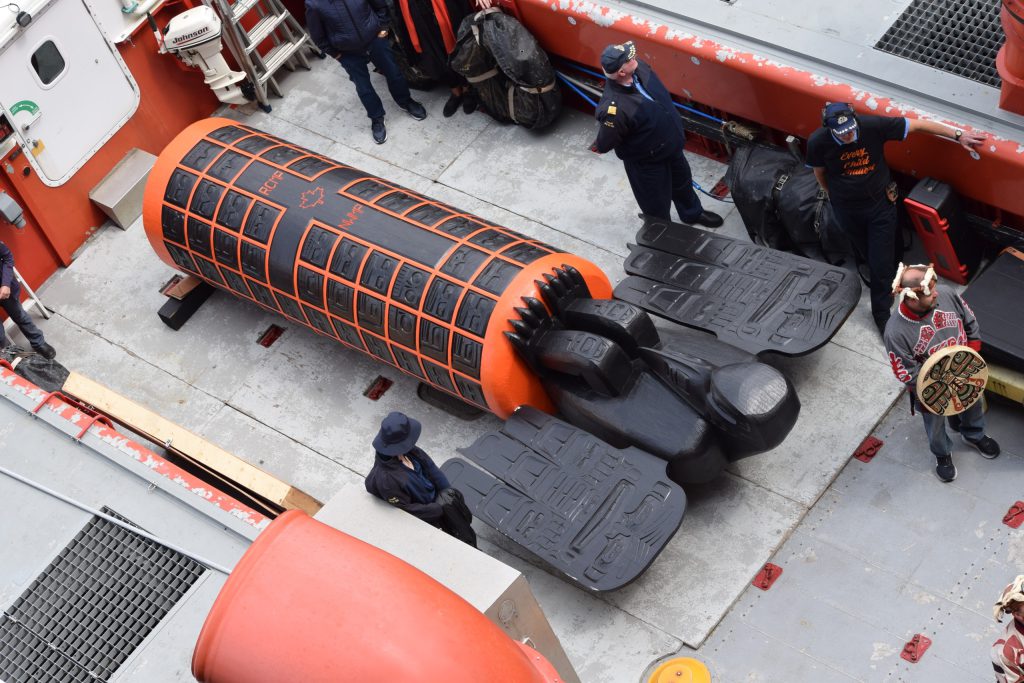
Over the winter, Hunt worked five to seven days each week, along with his nephew Rey Dickie and cousin Mervyn Child, to complete the monument — using chisels and knives to carefully fashion each unique face.
“Sometimes, you know, it was eight or 10 below zero in Port Hardy and we were working in a tent, and sometimes it was pretty hard to get up and do this,” Hunt said in an interview.
“But then you think, ‘we’re doing this for the children.’ So we’d just dress warmer, go out and put a full day in and keep working.”
It took 10 months to complete the monument, which was conceptualized in response to the evidence of children’s remains at the former Kamloops Indian Residential School (KIRS). Hunt wanted to do something in memory of all of the spirits lost at the institution, along with others across the country.
Hunt and his carving assistants worked down to the wire until June 16, when a delegation from Kwakiutl began a journey to bring the pole across the Island — which included stops in Homalco, Snuneymuxw and Cowichan territories.
“I think we did 11 ceremonies in six days,” Hunt said.
“I don’t think that’s ever been done. Just to say that sounds incredible, really.”
The plan is to next bring the pole to Tkʼemlúps te Secwépemc territories, where KIRS is located, and options are being explored to potentially journey it further as well.
Raven, the trickster
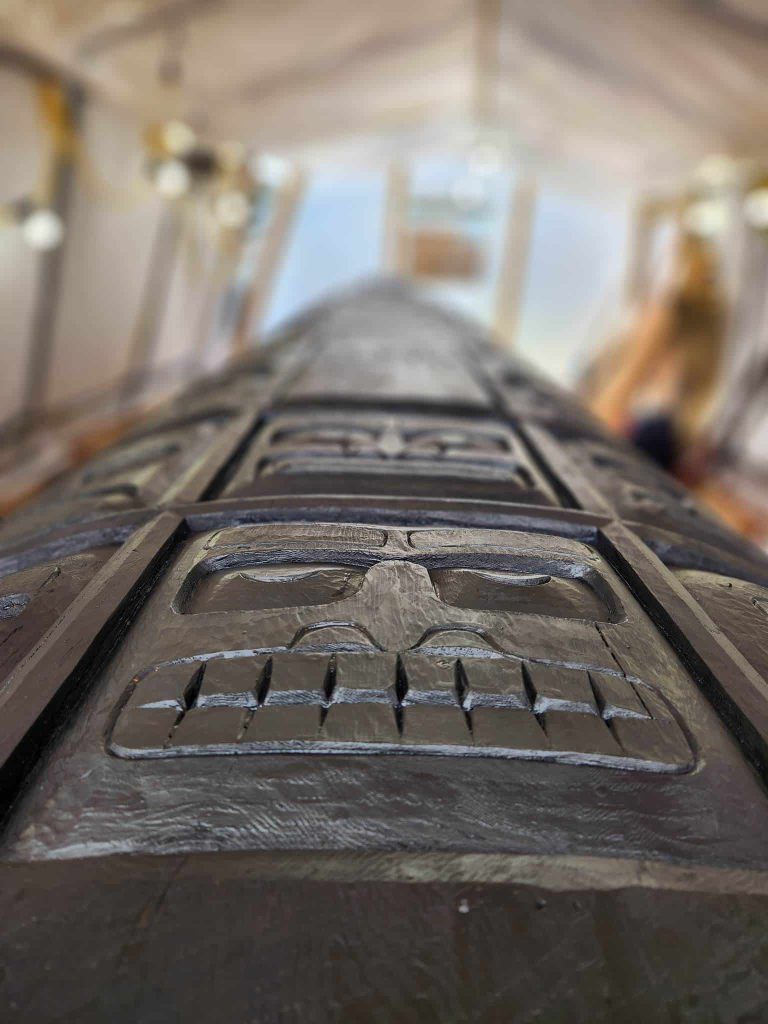
Details of Stan Hunt’s memorial monument. Photo: Canadian Coast Guard
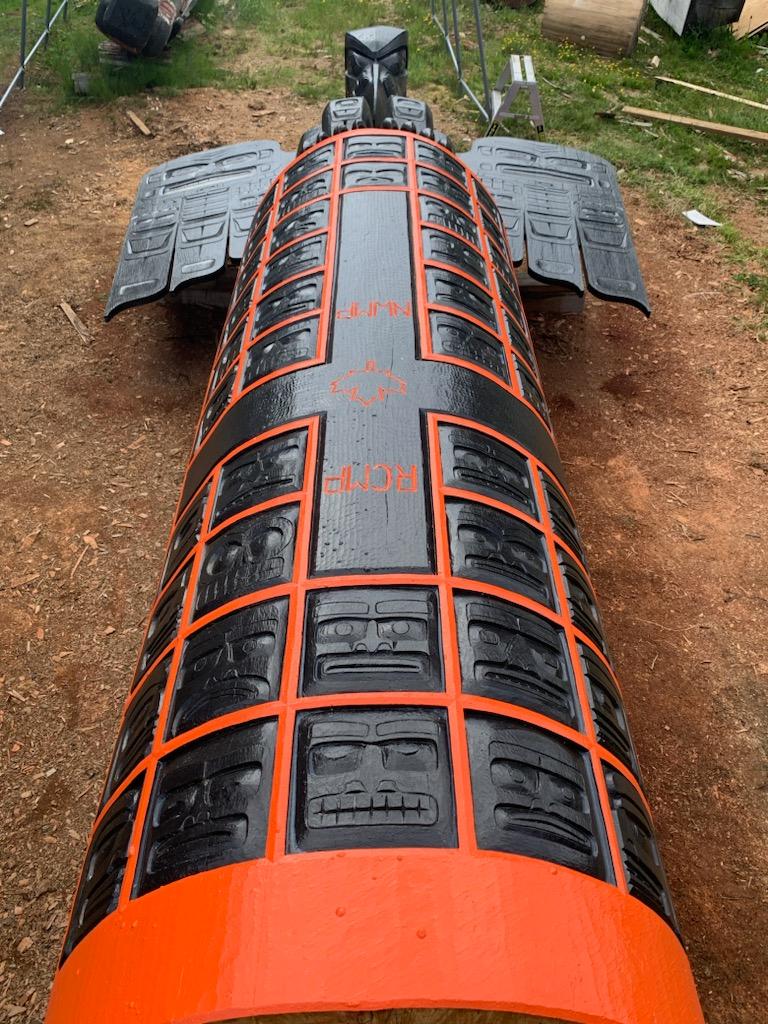
The pole includes an inverted cross, maple leaf and police symbols. Photo: Canadian Coast Guard
The monument is washed in mournful black to represent the dark time in history, with orange details referencing the Every Child Matters movement.
The Catholic church, the police and “Canada” are all also depicted through symbols and text: “All the participants that thought it was OK to murder our children are all represented on the monument,” Hunt said.
The symbols — including a cross and maple leaf — are each inverted for the viewer, but not for Raven, who looks straight down at them while cradling a seed of life in his beak.
“He’s also the trickster, so when he sees that, he sees it right side up,” Hunt said. “And we believe that he’s going to help us find our children and is calling their spirits to come home.”
Through the monument’s journey, Hunt and his delegation have been travelling with police escorts, and also worked with the Canadian Coast Guard and the Navy to bring the pole across to the mainland on National Indigenous Peoples Day.
He said working with those institutions to raise awareness about the harms they’ve caused felt historic because each one of the people he interacted with recognized the hard truths depicted in the pole.
The monument’s journey has also received a lot of public support as both Indigenous and non-Indigenous supporters have gathered at the various stops to view the monument and show solidarity.
‘The monument tells the truth’
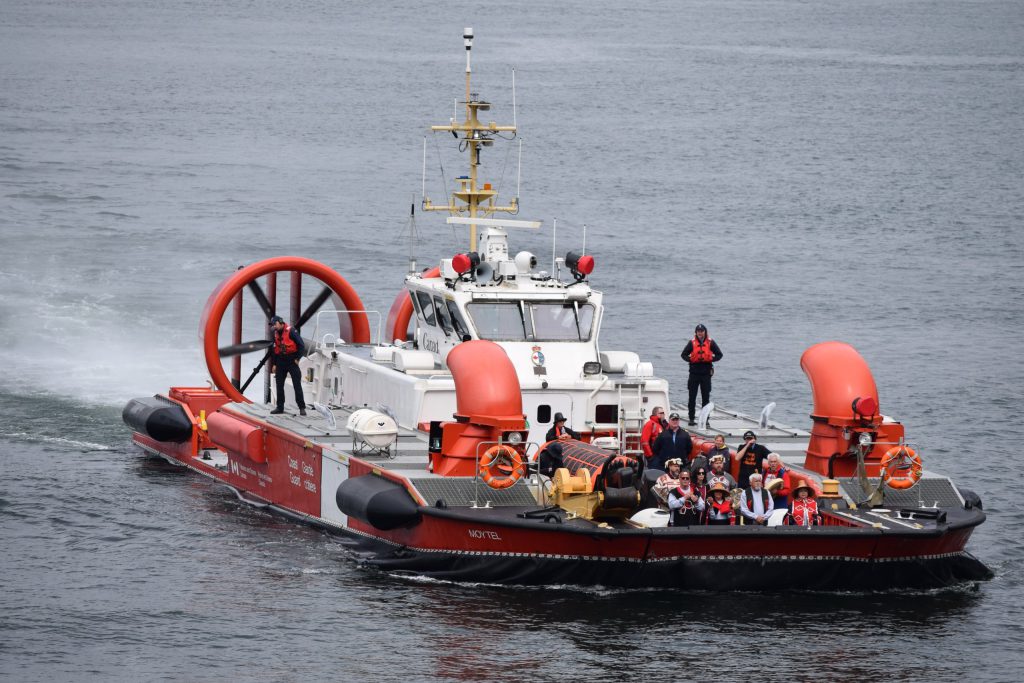
During the journey across the water on the Canadian Coast Guard hovercraft, the delegation briefly rode alongside a BC Ferries vessel, where passengers gathered on the ferry’s deck to applaud and wave.
When the hovercraft eventually pulled into the harbour in “Vancouver,” people lined up along the railings overlooking the harbour to welcome their arrival.
After greeting everyone and acknowledging the host nations, Hunt and his family sang a celebration song as well as their mother and father’s love song.
Now, the pole is in the possession of the Canadian Coast Guard until further notice as Hunt and his family take a rest before they take it on the road again.
“The monument tells the truth. It tells the truth about what happened,” Hunt said.
“It’s deliberately made so when you see it, you automatically know what it’s for. And I think that worked because people, when they see it, they do realize it’s for the children. … It has an effect on people and it brings out a lot of emotions.”
Author
We live in a media ecosystem that thrives on misinformation. Big Tech and AI companies are consuming the work of real human beings and Canadian news has been banned on Facebook and Instagram.
And yet, I have hope for journalism because of the work we’re doing at IndigiNews.
At IndigiNews, we embody tâpwêwin — the Cree value of integrity and responsibility in truth-telling. We are committed to our independent, Indigenous-led newsroom rooted in community, accountability, and relationality. We believe storytelling is a sacred fire that connects our pasts, presents, and futures through the storytellers in our Storytelling Lodge. IndigiNews creates space for Indigenous journalists, storytellers, Knowledge Keepers, and communities to gather, learn, and share stories that matter.
As a registered charity, we are building a fire that allows our work not just to ignite but to thrive. Rather than relying on advertising or corporate acquisition, IndigiNews is sustained by people like you who believe Indigenous stories are important for the future of our communities.
Your support is making a real difference.
Our community of supporters, our Firekeepers, make it possible to grow our newsroom, publish award-winning journalism, train emerging Indigenous journalists through initiatives like the ReFocus Photojournalism Fellowship, and publish trustworthy stories that serve our communities across the country. Every story we publish helps fill in gaps left by mainstream media and ensures Indigenous perspectives are represented with care, accuracy and respect.
But there is still more work to do.
As the media landscape becomes more and more uncertain, community support is as necessary and essential as it’s ever been. Every new Firekeeper helps protect the independence of our newsroom and strengthens journalism that is accountable to our many and varied communities over corporations.
That’s why we’re inviting you to become a Firekeeper.
Firekeepers tend to and protect the sacred fire. Your monthly contributions directly support IndigiNews’s Storytelling Lodge, helps sustain our independent, Indigenous-led newsroom, and ensures future generations of Indigenous storytellers have the resources they need to do the work.
As a registered Canadian charity, all eligible donations receive a charitable tax receipt.
If you believe Indigenous stories matter, if you value independent journalism, and if you want to help build a strong future for Indigenous media, we invite you to join our circle of Firekeepers today.
Together, we can keep the fire burning.
— Eden Fineday, Publisher, IndigiNews
Support us nowLatest Stories
-
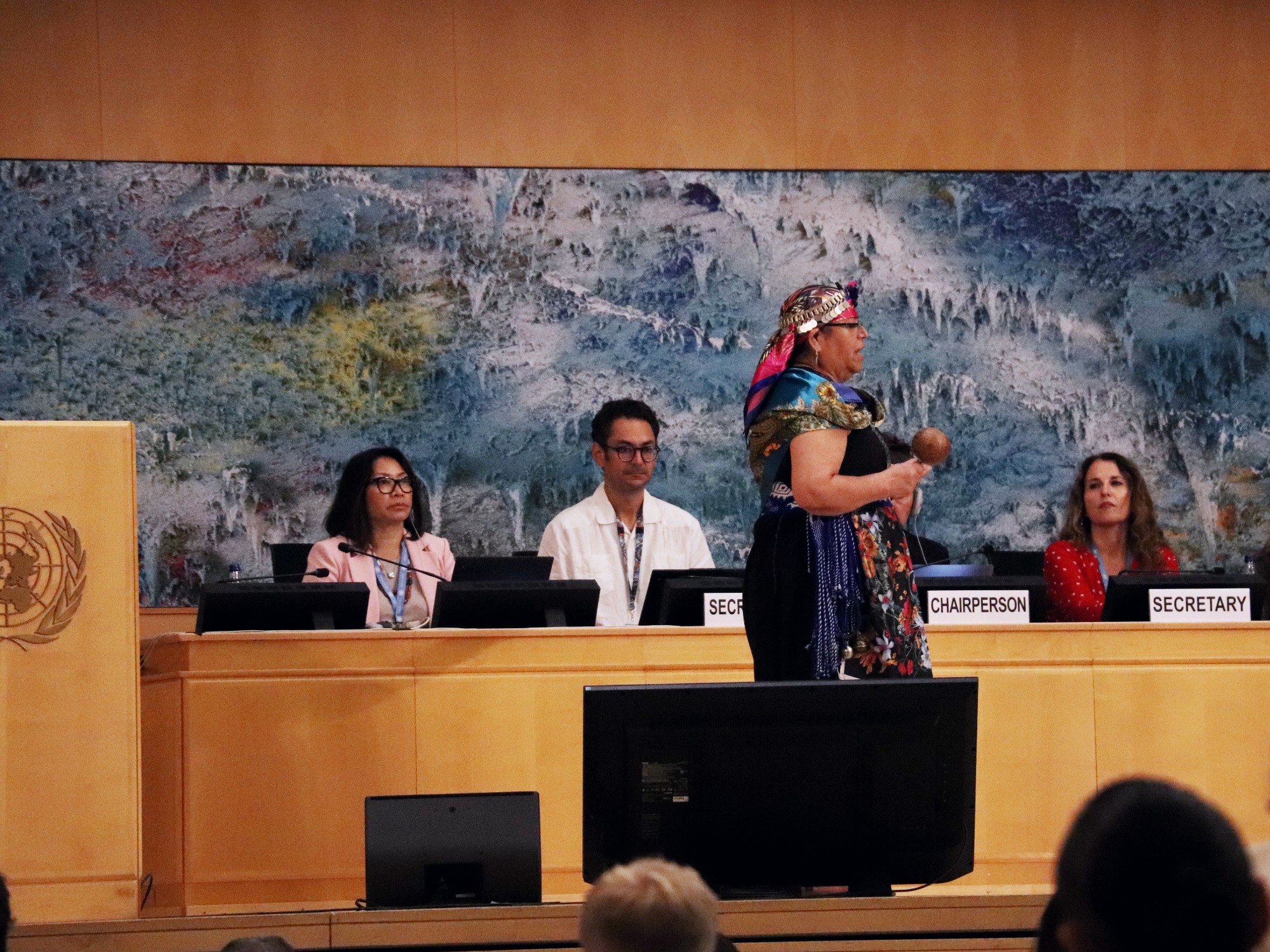
Indigenous people demand more say at the UN, as new crises hit their homelands
Indigenous nations live ‘on the frontlines’ of climate, conflict and new tech. But their voices remain sidelined in the global halls of power.
-
Through their lenses: Showcasing the work of our 2026 ReFocus fellows
Get to know our photojournalism training cohort through a series of portraits shot during a week in Kjipuktuk (Halifax)