Yakama Nation holds naming ceremony for spider previously unknown to scientists
The arachnid species found in the Columbia River Gorge was given the Indigenous name ‘Tulishpun’ alongside its scientific name ‘Trogloraptor’
This story was originally printed in Underscore Native News and appears here with permission and minor style edits.
Greta Binford was hiking one fall day near Wahkeena Falls in “Oregon,” and trying to take it easy after tearing her ACL. She began flipping over small boulders to see what she could find, as she often enjoys seeing what critters she could identify, when a chestnut orange spider with little feet caught her eye.
Binford, an arachnologist and professor at Lewis and Clark College, has taken treks through the forests and valleys around the world as an avid traveler for her work. And on that October day in 2021, Binford stumbled upon a newfound spider species less than 100 miles away from home.
“I roll over enough rocks that I kind of know what to expect, and I was like, ‘Wow, you’re different,’” she said.
Binford’s finding is shaking up the world of arachnologists everywhere. Although she had the scientific honour of naming the spider since she discovered it, she passed that opportunity to Indigenous people of the Columbia River Gorge.
In return, the Yakama Nation, in conjunction with the Columbia River Inter-Tribal Commission, or CRITFC, welcomed Binford and her research team with open arms.
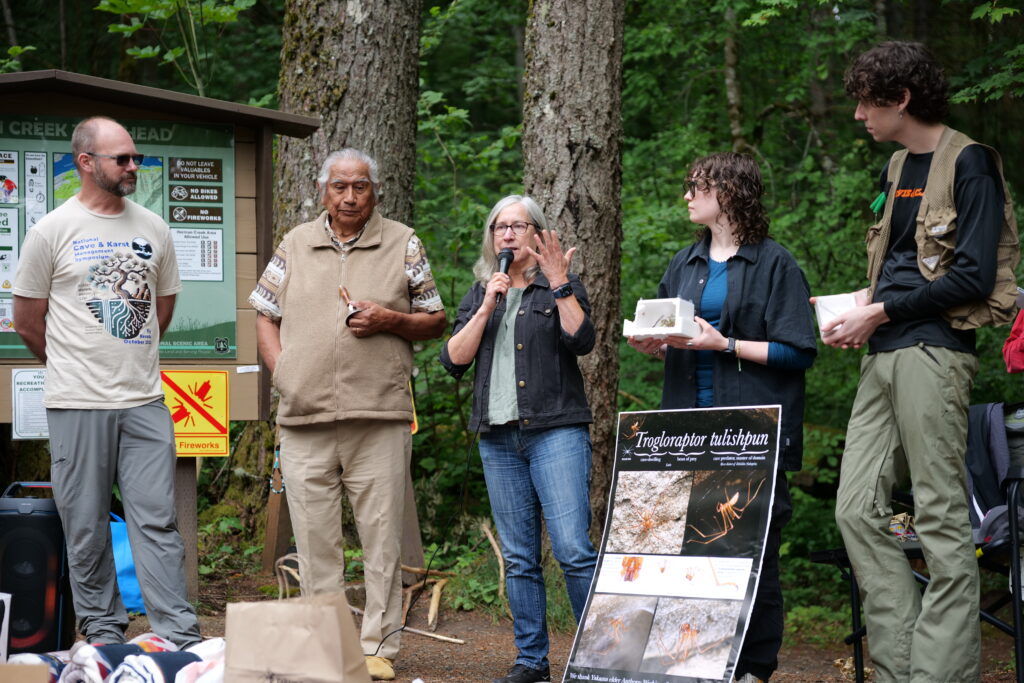
To honour her discovery and the spirit of their relative, the Trogloraptor spider, the Yakama Nation held a traditional naming ceremony for the arachnid on June 10.
‘I just don’t know what this is’
The spider Binford found reminded her of a type of spider called a Trogloraptor, which, until now, was only found in caves of southwestern Oregon.
At first, Binford quickly identified that it was a Trogloraptor, but because her sample was found nearly 500 kilometres away from its endemic region, or specific area where it would be regularly found, self doubt began to creep in.
“I’ve never been just bursting with confidence, where I was like, ‘oh, of course, that’s a Trogloraptor, and I just discovered a new species,” Binford said. “I was like, ‘I just don’t know what this is,’ and so I wanted to rear it up until it was an adult, and then take a closer look.”
It was only 17 years ago that the family of spiders, Trogloraptoridae, which the Trogloraptor genus stems from, was discovered by scientists, making Binford’s new find a truly unique case.
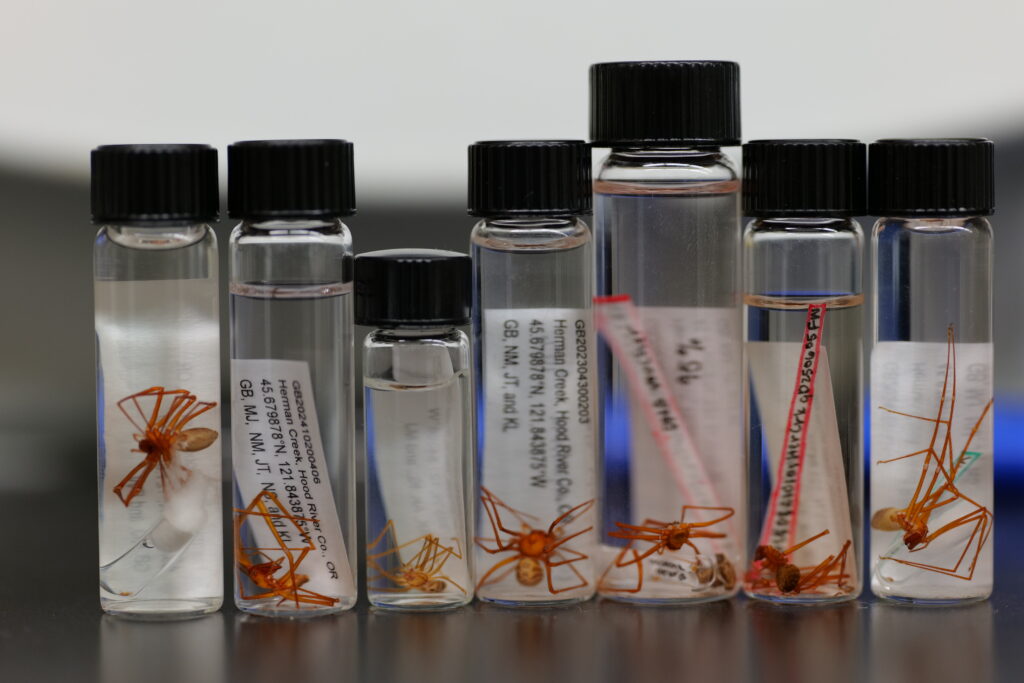
But to prove the spider she found was a new species, she had to have adult samples and the spider she collected was only a juvenile, sparking an intellectual hunt that lasted years.
“I went all the way up to the top of the Columbia River Gorge, and rolled things over, rolled over wood, looked along streams, anywhere I could find an indentation, and I couldn’t find another specimen,” she said.
In August 2023, she had the idea to contact friends of hers who are cavers to see if the spiders she found lived in caves. Within weeks, her team were at Angel’s Landing in the Columbia River Gorge.
They went into talus caves, an area of boulders and rocks that fell onto one another after a rock slide, and climbed their way down. Binford remembers shimmying down on her back and hearing a colleague, Neil Marchington, who worked on the discovery of the Trogloraptoridae family call out: “Here’s one.”
After Binford and her team collected samples she ran into another problem: the spiders she collected were all females. To classify a new species scientists only need to have adult specimens, but Binford was curious as to why she couldn’t find any males.
As she continued her research, she was reaching the point where she was ready to give the spider a name, publish the paper and finish the formal species description. And once again, by chance, she found the missing piece she was seeking.
“We’d given up on finding males until last summer,” she said. “Last August I went out with a friend, and we found mature males, the very first mature males of the species we discovered just last August.”
Trogloraptor tulishpun
When it came to naming the spider species, Binford and her former student, Madeline Jones, brainstormed ways to get local Indigenous communities involved. Jones reached out to CRITFC to see how they could go about naming the spider.
“I was just so excited because it feels so right to partner with the folks that really hold the deep knowledge of this region,” Binford said.
CRITFC reached out to Yakama tribal Elder Tony Washines to name the spider. Washines, a knowledge keeper of the language of the river dialect of Ichiskíin or Sahaptin, named the spider “Trogloraptor tulishpun.”
Washines said he credits his ancestors, who carried the language, taught and used it — so he sees them as the ones who gave the spider its name.
“They’re the ones that used the language, used the different dialects up and down the river from the various bands that we have,” Washines said.
Washines said the scientific name and the spider’s Indigenous name mean the same thing.
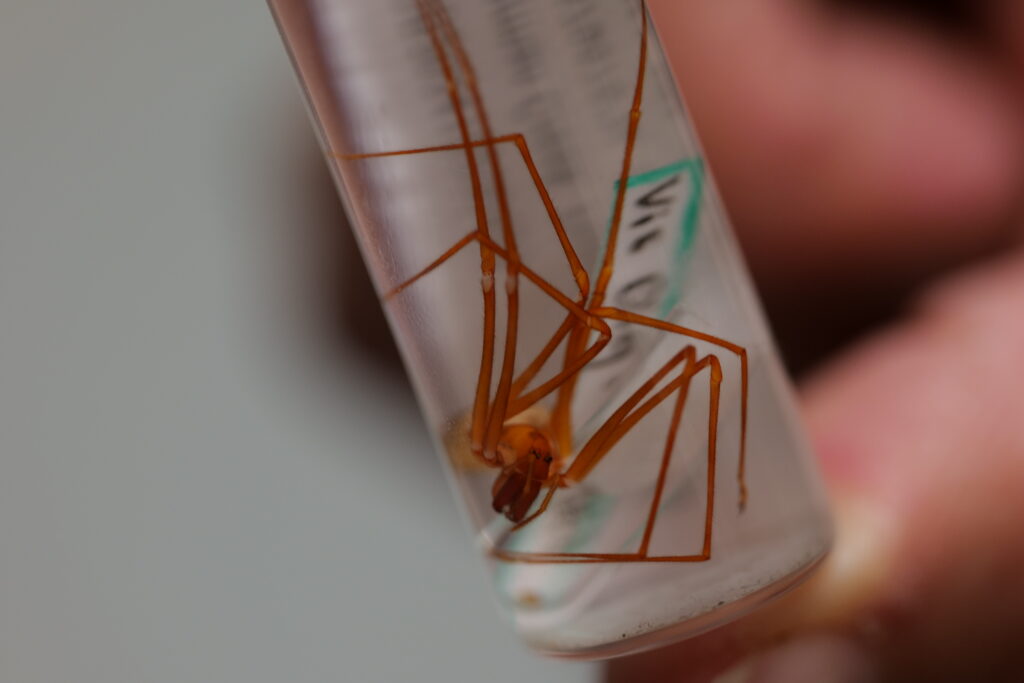
Trogloraptor translates to, “cave-dwelling beast of prey,” in Latin. Tulishpun translates to, “cave predator, master of domain,” in Ichiskíin.
“It’s the same thing,” Washines said. “It’s just a different translation but it also has a traditional ownership and depicts the resilience of not only ourselves but the ecosystem itself.”
Getting to reveal the name to the scientific world and celebrate with a traditional naming ceremony was a deeply spiritual experience for him and his community, Washines said.
“It’s a homecoming. It’s an awakening. It’s to show these plants and these animals that not only are they still here, but that I’m still here and that relatives are still here. We still have that connection,” he said.
What’s learned from the research
Recent Lewis and Clark College graduates, Jones and Finn Watson, are former students of Binfords. Jones, who holds a degree in biology and Watson who holds a degree in biochemistry and molecular biology, were integral to her research process.
Jones spent hours photographing the spiders and working on morphological analysis, which identifies the scientific study of the form, structure and internal components of organisms. In her work, Jones was identifying how T. tulishpun are different from the other species physically.
She also illustrated features of the spider that were published on June 9 this year, in the first paper about T. tulishpun, in the journal Zootaxa.
Jones was the one who suggested to Binford that Indigenous people from the Columbia River George should be included in the name selection process.
“I’m so, so thankful that we were able to do this, and that I feel really lucky to be included in something this meaningful,” Jones said.
“It feels so important to be able to acknowledge the spiders here where we collected them with all these people that have provided for this place, and I feel so incredibly grateful and appreciative for the kindness.”
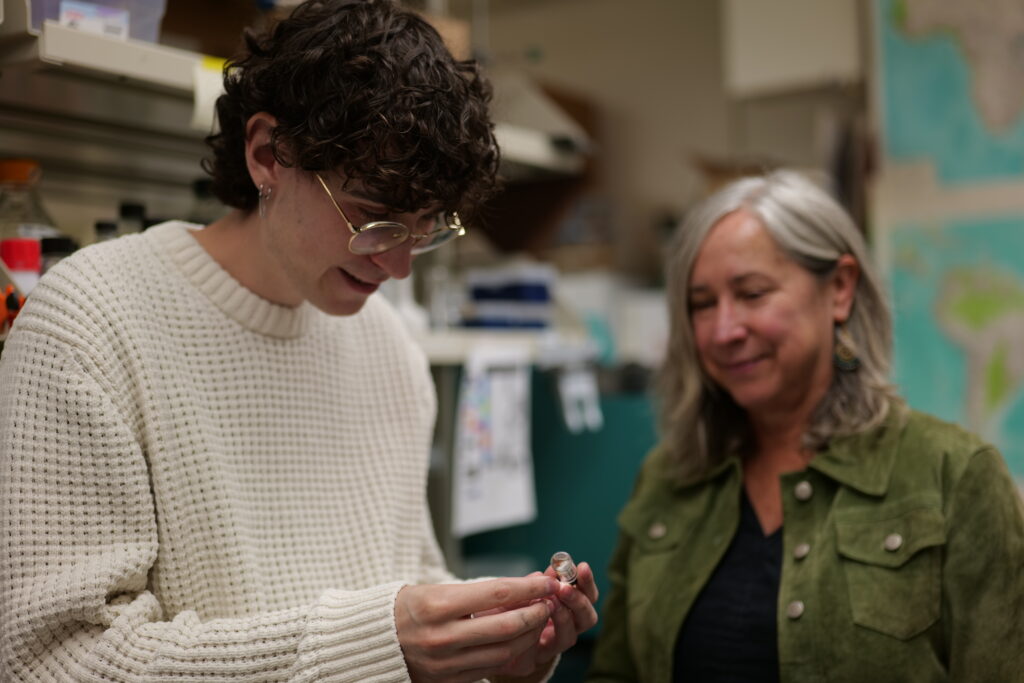
Watson spent nearly four years in the lab working with Binford on T. tulishpun. They primarily worked on DNA sequencing which is determining the order of the four chemical building blocks — called “bases” — that make up the DNA molecule.
This helps scientists understand the genetic makeup of species and be able to compare them to other Trogloraptor species and other spider species.
For Watson, getting to work on this project was their way of being able to make sure the legacy of this spider lives on in the scientific record.
“I’m just really happy to be able to contribute to this sort of permanent record of biodiversity,” they said. “Especially because these spiders are so endemic to this specific area, and because when the climate is changing, there’s no guarantee they’ll be here in the next 50 years [or a] century.”
Watson said working on this research of T. tulishpun was life changing.
“My whole life path has changed because of working with Greta,” they said. “I would not have gone to grad school for arachnology without meeting her and doing this work.”
For Binford, the discovery has shifted her career. Her previous work has been primarily focused on studying the venom of brown recluse spiders and why it affects humans the way it does. Now, she plans to study the venom characterization of T. tulishpun since, as of now, there is literally nothing known about it.
“To be able to contribute to our understanding of this lineage is just an honor,” she said. “I feel so dang lucky that they’re in my backyard.”
When asked if she thinks there are more Trogloraptors in “Oregon,” Binford said she thinks there’s a good chance.
“Absolutely. There are certainly more T. tulishpun, and possibly more species,” she said. “We just have to go underground and look.”
A naming ceremony
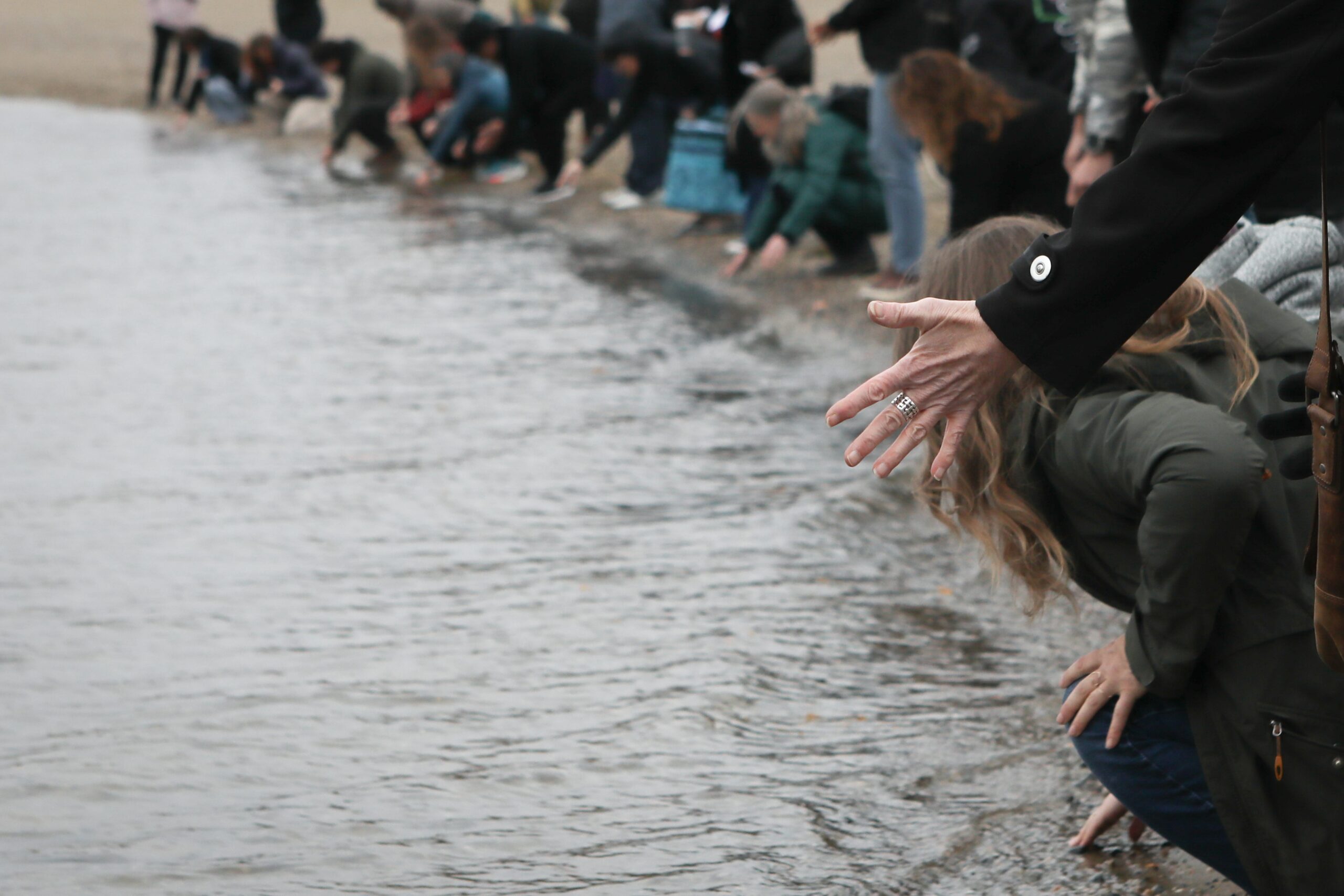
Gathered on top of Herman Creek Campground in the Columbia River Gorge, around two dozen scientists, Yakama tribal members, forest service workers, and Lewis and Clark College staff joined together to celebrate the spider’s name.
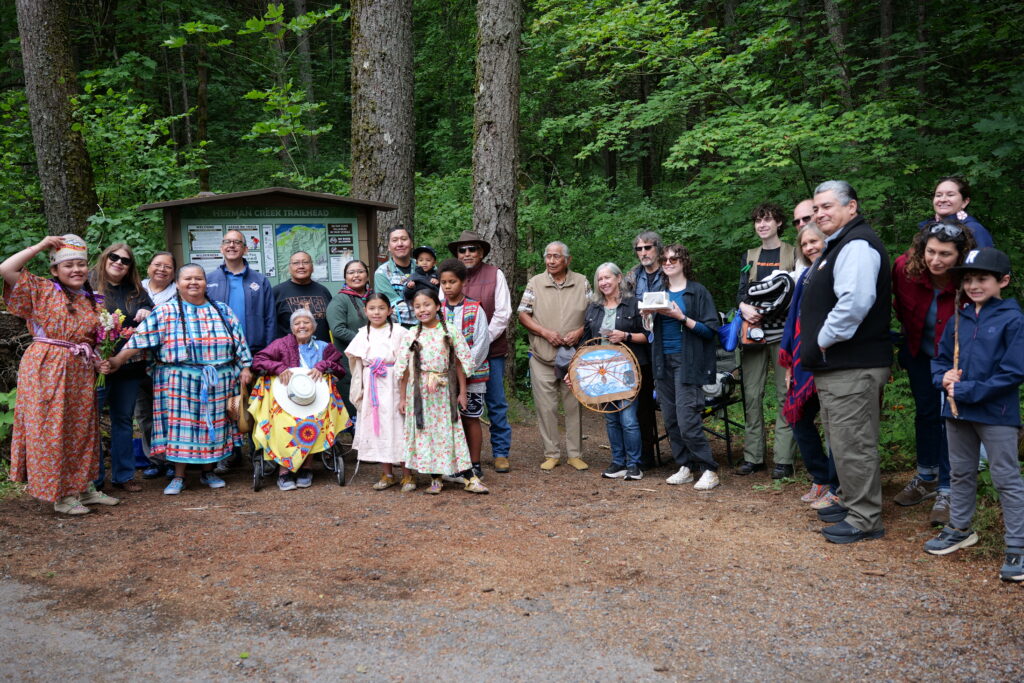
Children stared in awe as Binford and her research assistants, Jones and Watson, held live T. tulishpun samples in tiny, handmade boxes.
Donella Miller, Yakama tribal member and the Fish Science manager at CRITFC, organized the event and was deeply moved and excited about the naming ceremony.
“Names are a recognition of who you are and who your family is, and kind of where you’re from as well,” Miller said. “So this had all those same things. When we do these ceremonies, we bring people together to acknowledge it.”
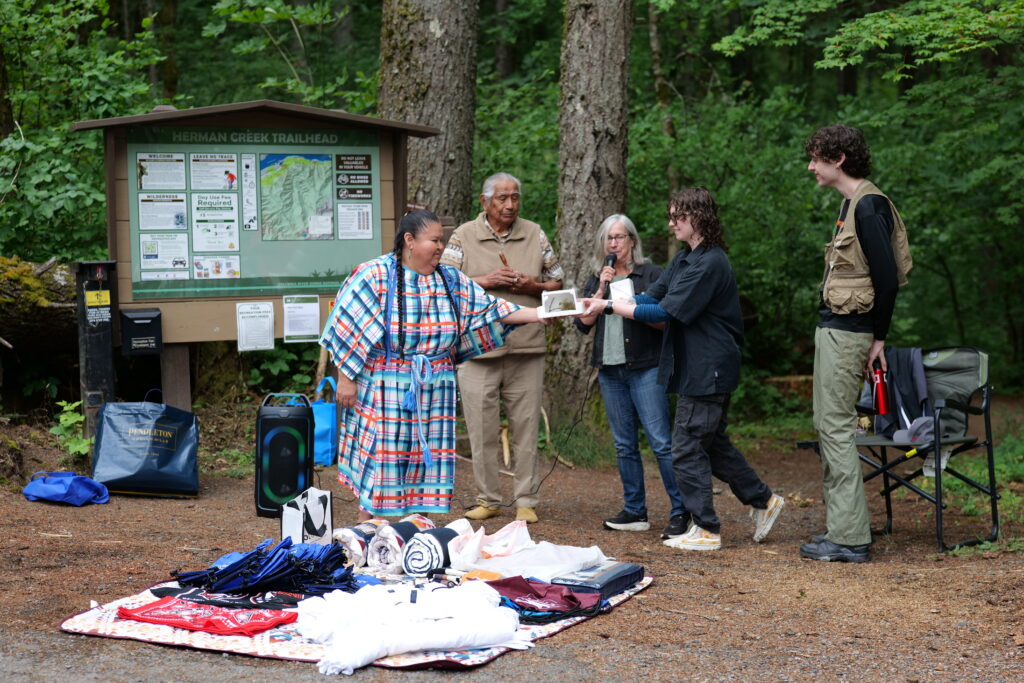
The ceremony included words from Binford and Washines. Prayers and songs were belted from the trailhead and carried in the cool June breeze as the community gathered cheerfully to name their relative, T. tulishpun.
After the name was revealed, Yakama citizens handed out gifts to every attendee as part of the traditional ceremony, that included canned salmon, stickers, bags, bandanas and other goodies.
“We share gifts for everyone in attendance because it’s thanking you for taking the time to come and recognize and acknowledge and be a part of the ceremony,” Miller said.
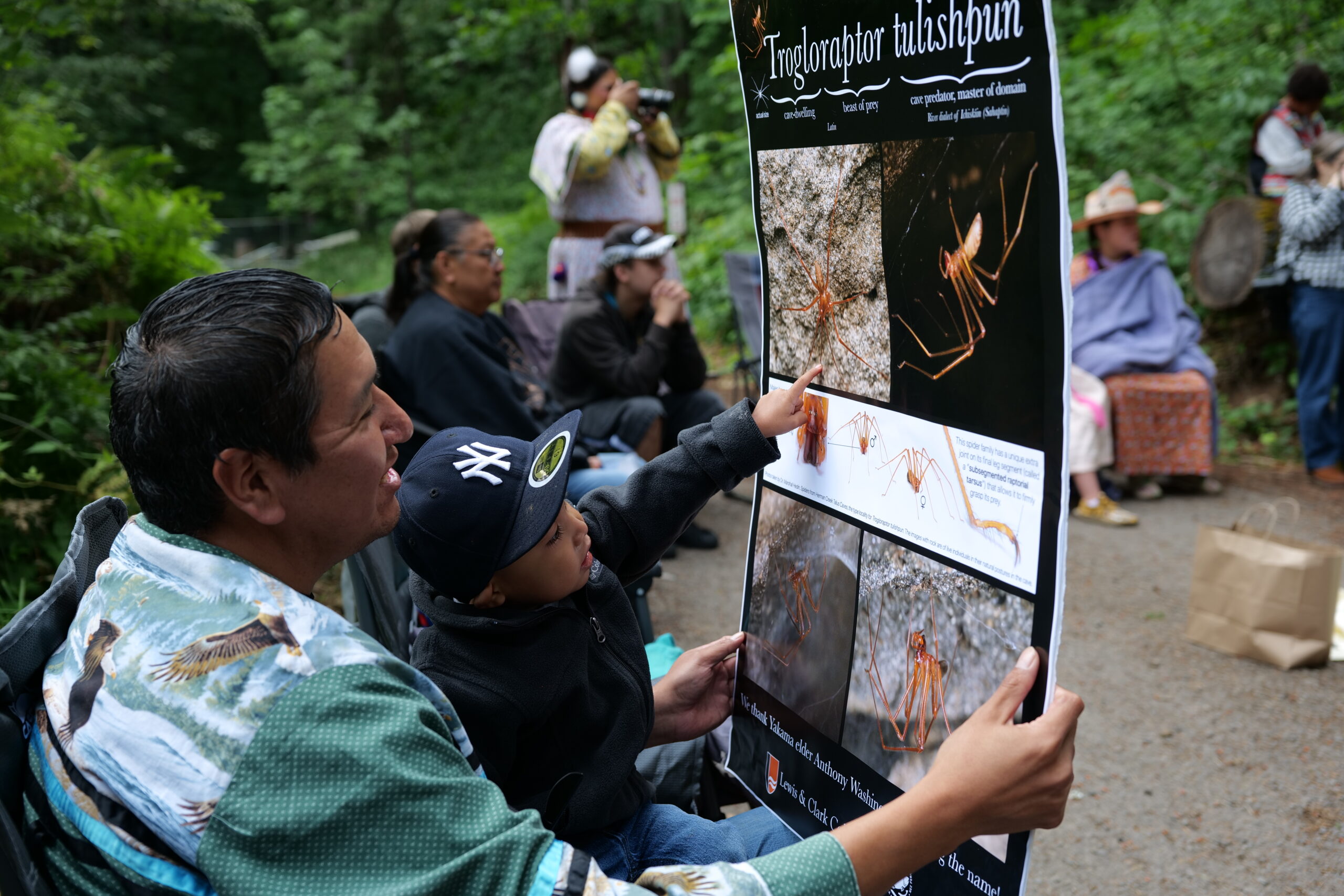
Newly elected Yakama tribal councilman, John Washines, brought his two-and-a-half year old grandson, Jakoby Kenoras, to the naming ceremony.
As his grandson awed at pictures of the T. tulishpun, Washines said it was important for his grandson to be surrounded by family, learning the traditions of his people.
“These are positive aspects that we create with these types of events and these types of ceremonies,” Washines said.
He added that since a lot of the traditions aren’t written down, people need to be present at events like this one in order to learn.
“I think it’s really important for us.”
According to Washines, being reached out to by the scientific community to take part in the discovery was an important way to bridge science and spiritual tradition.
“I felt seen as a person of my community and society. It felt as if we were not asked permission, but asked to be a part of something bigger than us,” he said. “I think that’s a real bridging partnership that we try to uphold on the spiritual side.”
Author
Latest Stories
-
Labrador Friendship Centre celebrates Inuit, Innu cultures on National Indigenous Peoples Day
Event will highlight local Indigenous communities and raise funds for programs with a new t-shirt design, as the province is accused of ‘erasure’
-
Clean-water legislation gets lukewarm reception from Indigenous leaders
Dozens of reserves are still under drinking-water advisories — most in ‘Ontario’ — as feds reintroduce First Nations Clean Water Act. But First Nations’ reactions have been mixed