IndigiNews of the week: Land protection
Your weekly roundup of news and information about what’s happening across the Nation.

In this weekly roundup, we have a variety of topics from across our Indigenous Nations. They cover the Tiny House Warriors who are at the frontlines defending their lands from the Trans Mountain pipeline, the noticeable changes to land/waterways and Indigenous people voicing their concerns on climate change, and ‘60s scoop survivors who are still waiting for their settlement payments.
Worth your time
- In Irreconcilable? Trans Mountain pipeline, racial divides and looming conflict, Brandi Morin’s latest with the National Observer, she talks with Kanahus Manuel and shows the racial divide, violence and human rights violations happening in Blue River. Morin explains, “Tension has been high for years, and it’s escalating rapidly. Over the last month, local townspeople have started holding weekly counter protest ‘sit-ins’ outside the barricades of the Tiny House Warriors village because they want them to pack up and leave. Pipeline supporters want the jobs and money that come with the development.” Morin faced derogatory comments while covering this story, and witnessed firsthand a man tearing down red dresses honouring Canada’s missing and murdered Indigenous women and girls.
- In Meet the people saving Canada’s native grasslands, by The Narwhal’s Stephanie Wood, she speaks with people working to save the grasslands. According to Wood, “Hundreds of plant species and more than 60 species at risk in Canada depend on grasslands. People also depend on the land. Kainai Nation citizens harvest medicine plants, hunt and hold ceremonies. Ranchers’ livelihoods depend on rich soil and healthy plants. In the face of climate change, grasslands also have a major role to play in sequestering carbon, storing as much as 180 tonnes of carbon per hectare, equivalent to the annual emissions of 39 cars. (A hectare is slightly smaller than a Canadian football field.) Some estimate the uncultivated grasslands of Western Canada may store two to three-billion tonnes of carbon.”
News of the week
- Memorial pole for families to be raised along Highway of Tears in B.C., from APTN National News, reports, “A memorial pole will be raised on Hwy. 16 in British Columbia infamously known as the Highway of Tears. The pole will honour missing and murdered Indigenous women who have disappeared along the highway that runs from the Alberta-B.C. border west to Prince Rupert on the coast.” The pole is being organized by Wanda Good and Gladys Radek. Radek, who is from Gitxsan Wet’suwet’en territory, and whose niece, Tamara Chipman, went missing along Hwy. 16 in 2005, says, “The idea of the totem pole came to me because I wanted a place on the Highway of Tears where our families could go and visit this pole in a peaceful way, spending a little bit of time with prayers honour their loved ones.”
- In ‘It’s very important to them’: 20 years of documenting Dene voices on climate change, APTN National News talks with Margaret Ireland, who has been listening to her community’s concerns over climate change since she was young. “My senior Elders are dying and there’s very few Elders left. I was interested in documenting the stories that they have. It was very difficult to convince them to document the stories because, to their way of thinking, it was orally given to the next generation,” she says. Ireland became an advocate for Indigenous voices when talks of the Mackenzie gas pipeline started in the 2000s.
Long-time land user and Ireland’s brother Billy Norwegian has noticed the changes to the land. He tells APTN, “One of the things I have noticed is that the trees are falling over on the forest ground. It makes it very difficult to go and both me and my brother have trap lines. So every year before we start using the trap line we have to spend a day or so cutting the fallen trees.” A few seasons ago, Norwegian’s skidoo went through the ice and he had to make it back into town, so Ireland stresses safety. “The changes in the weather is getting to be quite extreme, so to be out on the land on your own is becoming a very big safety issue. So we needed to know where everyone is out on the land and when to expect them back,” she said.
Okanagan latest
- In Vernon social justice group rallies to raise awareness for human trafficking victims, Kelsie Kilawna speaks with Vernonites who were marching together to raise awareness in their community. According to Kilawna, “The event was organized by Morgan Morrone, who has been spearheading the effort to bring awareness to the cause with her Facebook group #savethechildren.” Morrone shared what inspired her to take action: “I have never organized rallies! First time and way out of my comfort zone. But I have been so uncomfortable learning about the 30-million children being trafficked worldwide that I had to do something, anything.”
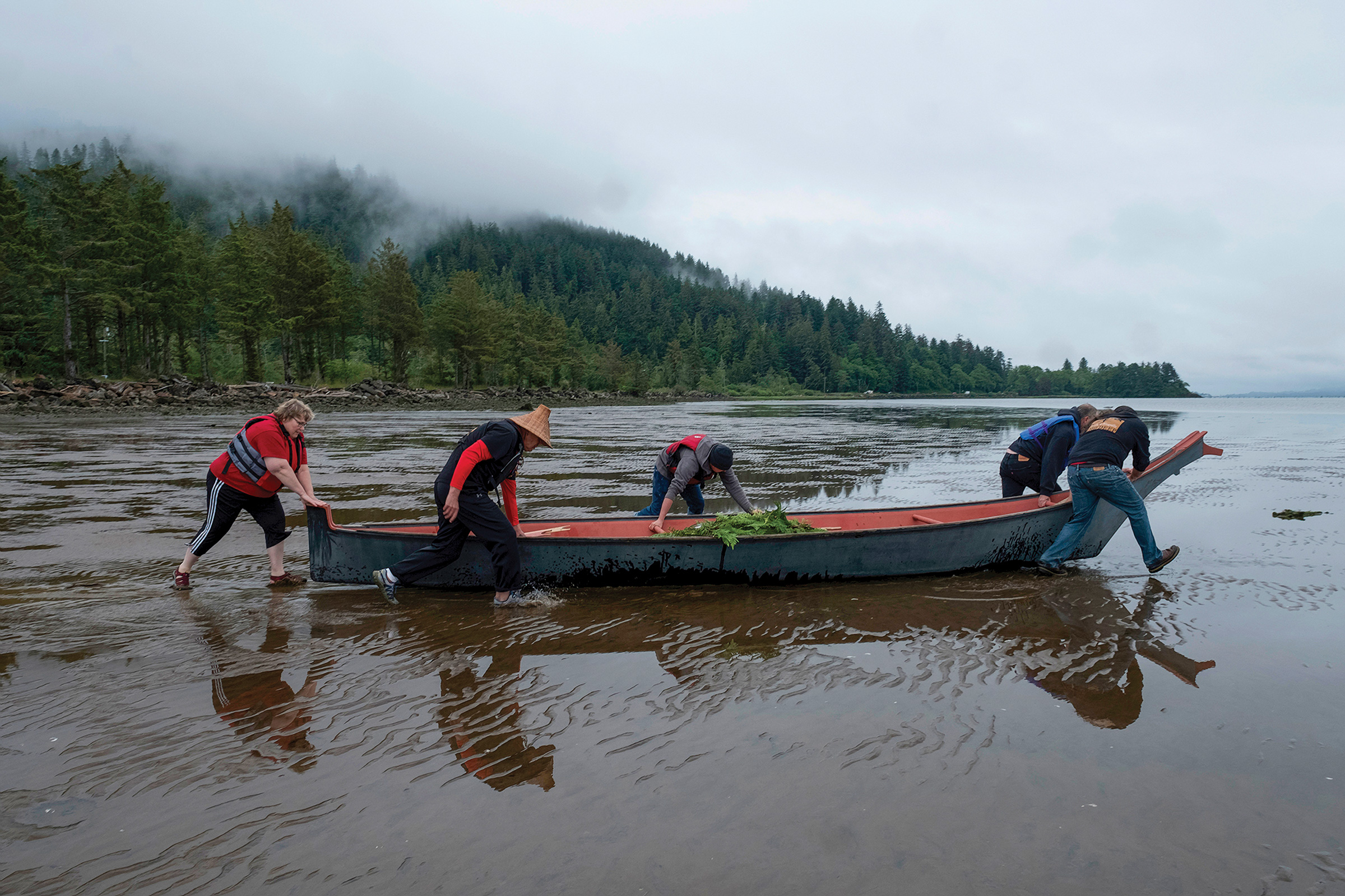
- In Westbank First Nation youth are reconnecting with canoe culture, I spoke with youth who are participating in the WFN youth works program, which provides cultural and traditional learning for those aged 12 to 18. Frank Marchand and his apprentice William Poitras are showing them how to build canoes., As Marchand explains, “The canoe culture is what I’m trying to bring back.” He says that he was afraid of canoe culture being forgotten and that’s what also pushed him to get it back into the schools. Encouraged by Elder Louise Gabriel in 2002, he began working with school districts in recent years in West Kelowna and Kamloops in hopes of keeping the custom alive. WFN youth Jordan Seddon looks forward to the completion of their current canoe project. He shared with me, “[I’m] happy that we’re doing our traditions. When it comes to an end, we have even more fun just riding around in the canoe.”
- In ‘60s Scoop survivors still waiting for settlement amid pandemic, Athena Bonneau explains the delay in payments and the confusion from survivors. According to Bonneau, “The settlement agreement was agreed to in principle in November 2017, and approved in August 2018. It’s meant to compensate survivors for ‘the loss of culture and language’ they experienced during this time and the ‘underlying impact of misguided past policies.’ Up to $750 million of the settlement is for Status Indian and Inuit who were adopted by non-Indigenous families, became Crown wards or who had been placed in permanent care homes between 1951 and 1991.”
Many survivors say they feel they are being ‘left in the dark’ and without any clear answers about why or when they will be paid. Doug Lennox, a senior class action lawyer at B.C.’s Klein Lawyers, one of the firms involved, says, “It took a lot of strength for people to submit their claim and, for many, waiting is taking a significant and understandable toll. We also worked closely with the other parties to ensure that no one’s application would be denied as a result of the impacts of COVID-19, right now, the process is moving.”
That’s it for this week! If you have news or information that you want to share, email me: chehala@indiginews.com.
Author
We live in a media ecosystem that thrives on misinformation. Big Tech and AI companies are consuming the work of real human beings and Canadian news has been banned on Facebook and Instagram.
And yet, I have hope for journalism because of the work we’re doing at IndigiNews.
At IndigiNews, we embody tâpwêwin — the Cree value of integrity and responsibility in truth-telling. We are committed to our independent, Indigenous-led newsroom rooted in community, accountability, and relationality. We believe storytelling is a sacred fire that connects our pasts, presents, and futures through the storytellers in our Storytelling Lodge. IndigiNews creates space for Indigenous journalists, storytellers, Knowledge Keepers, and communities to gather, learn, and share stories that matter.
As a registered charity, we are building a fire that allows our work not just to ignite but to thrive. Rather than relying on advertising or corporate acquisition, IndigiNews is sustained by people like you who believe Indigenous stories are important for the future of our communities.
Your support is making a real difference.
Our community of supporters, our Firekeepers, make it possible to grow our newsroom, publish award-winning journalism, train emerging Indigenous journalists through initiatives like the ReFocus Photojournalism Fellowship, and publish trustworthy stories that serve our communities across the country. Every story we publish helps fill in gaps left by mainstream media and ensures Indigenous perspectives are represented with care, accuracy and respect.
But there is still more work to do.
As the media landscape becomes more and more uncertain, community support is as necessary and essential as it’s ever been. Every new Firekeeper helps protect the independence of our newsroom and strengthens journalism that is accountable to our many and varied communities over corporations.
That’s why we’re inviting you to become a Firekeeper.
Firekeepers tend to and protect the sacred fire. Your monthly contributions directly support IndigiNews’s Storytelling Lodge, helps sustain our independent, Indigenous-led newsroom, and ensures future generations of Indigenous storytellers have the resources they need to do the work.
As a registered Canadian charity, all eligible donations receive a charitable tax receipt.
If you believe Indigenous stories matter, if you value independent journalism, and if you want to help build a strong future for Indigenous media, we invite you to join our circle of Firekeepers today.
Together, we can keep the fire burning.
— Eden Fineday, Publisher, IndigiNews
Support us nowLatest Stories
-
Through their lenses: Showcasing the work of our 2026 ReFocus fellows
Get to know our photojournalism training cohort through a series of portraits shot during a week in Kjipuktuk (Halifax)
-
AI data centers are booming. Indigenous People want help protecting their lands and knowledge
Indigenous leaders warn the UN that the rapid growth of artificial intelligence facilities threatens their rights