Children’s book tells residential ‘school’ story from a kid’s perspective
‘Shirley: An Indian Residential School Story’ — released today — was written by Joanne Robertson with, and about, Elder Shirley (Fletcher) Horn

A new children’s book tells the story of Cree Elder Shirley (Fletcher) Horn’s experience over a decade of attending residential “school” — recounting the experience from a kid’s perspective.
Shirley: An Indian Residential School Story was written and illustrated by Anishinaabe author Joanne Robertson, along with Horn.
The Elder said she wanted to make sure the story came from her viewpoint as a child — weaving in the depth of her experience in the institutions from the ages of five to 15. This way, the story is accessible to children reading the book.
“When you’re a child of five, six and seven, you’re not thinking like an adult, you’re thinking like a child,” reflects Horn.
“From a child’s perspective, it’s very different.”
Shirley: An Indian Residential School Story was released through Second Story Press on Feb. 10. The non-fiction book is aimed at children ages nine to 12.
Horn comes from the Missanabie Cree First Nation in “Ontario.” At the age of five, she and her siblings were taken to the St. John’s Indian Residential School where she spent two years, until later moving to the Shingwauk Indian Residential School where she stayed during the school year until the age of 15.
“Even though there were so many children, we were all still lonely,” she reflects in the book.
“I could see my siblings when I went to church and at mealtimes, but I was never allowed to speak with them. All the time, all together, all lonely.”
‘She was just the right person to be talking with’

Author Robertson — whose other credits include The Water Walker and Nibi is Water — is a member of Atikameksheng Anishnawbek.
She met Horn while both were attending Algoma University. The pair first sat together to discuss the Elder’s story in October of 2022. It was a smooth process to create the book from Horn’s stories through natural discussions, Horn told IndigiNews.
“I was talking about my life in the residential school and the different things we used to do, and it just sort of developed, and she was just the right person to be talking with about it,” Horn said.
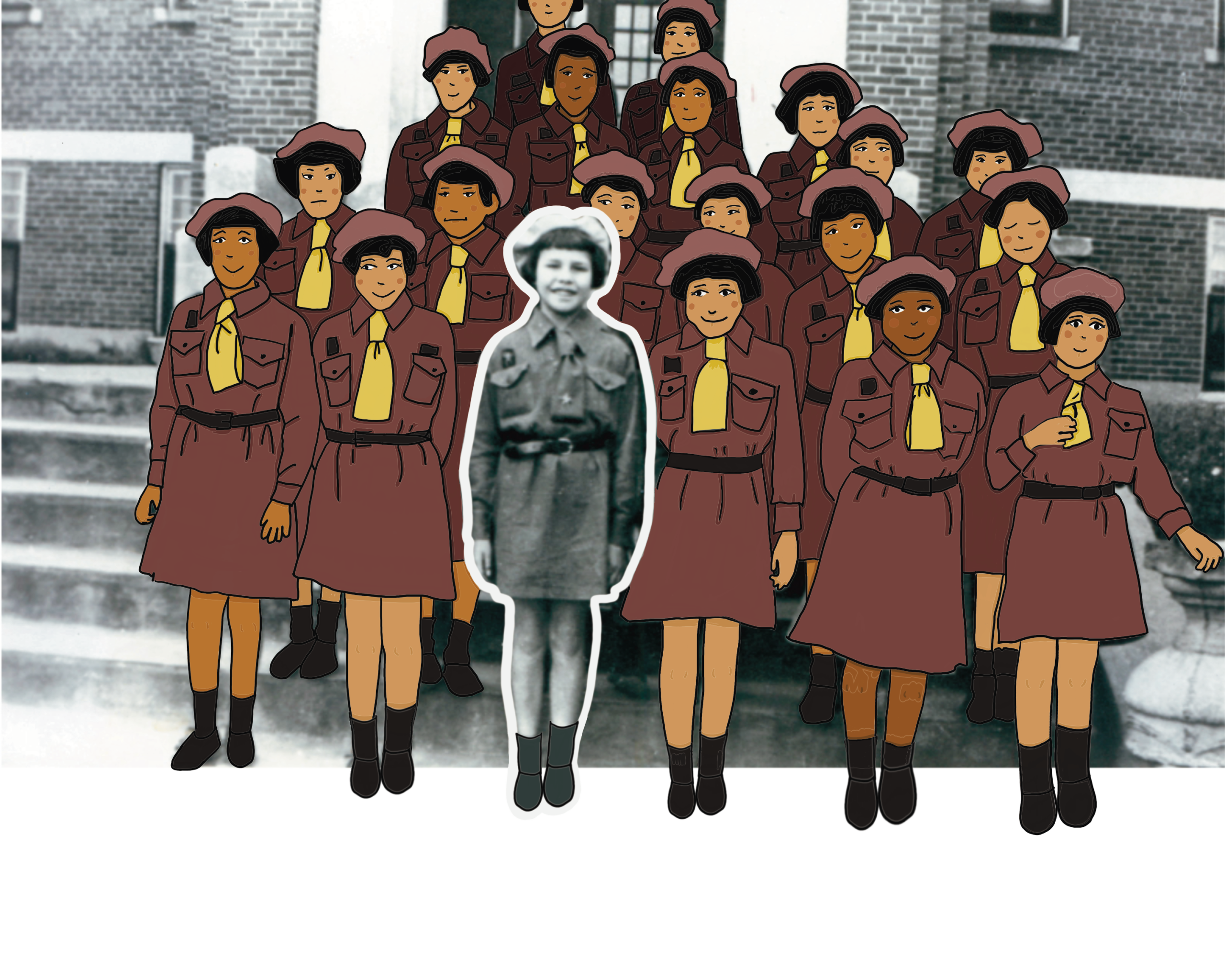
Robertson’s illustrations in Shirley: An Indian Residential School Story feature colourful characters representing Horn, her fellow students and family members who are superimposed over various photographs.
She spent time in the archives that are stored in Algoma University — which is built on the grounds of the former Shingwauk Residential School — after discussions with Horn to try to get an idea of where the stories took place.
Most of the photos used in the book come from the archives, while Robertson also captured some photos herself.
Robertson told IndigiNews the contrast of both photos — often in stark black and white — and colourful illustrations create a duality within the story.

“I was very careful to always bring people back to the reality of it and I think the photographs help a little bit with that,” she said.
Horn agreed, and commends Robertson’s research and creation of the images featured in the book.
“It’s got a whole different feel as a story,” Horn said.
“It’s not overly traumatic. There’s a truth element that is there through the photographs and then the story part through the drawings. So they work really well together.”
Balancing the narrative


Robertson spent time ruminating on how she wanted to write Horn’s story. She spent around two years “trying to build up my courage and trying to figure out how to tell her story without causing more harm,” she said.
“I wanted to make sure there was a balance between the reality, like the cruelty and the loneliness, along with her resilient stories.”
The theme of resiliency is constant throughout the book, with Horn sharing stories of how she got through her decade in residential “school.”
Stories of Horn and her friends enjoying time together by playing in a barn, and her carrying around a snake in her pocket that scared her peers, serve as reminders that the children were still trying to enjoy their childhoods while being forced to stay at these institutions, isolated away from their families.
Robertson was sure to incorporate those moments of friendship into the book as the lessons Horn shares through her stories are impactful in many ways.
“I think by her sharing her story she’s teaching us how to take it one day at a time, and to live with courage and to really appreciate our friends and the community that we build around us,” she said.
It was those moments of joy and friendship that were important in the children’s daily life.
“We were companions, we were the family that we didn’t have or weren’t allowed to interact with, even though our family was at that school,” Horn said.
Intertwined with her making the most out of her days were the moments of loneliness and rebellion as Horn tried her best to have agency over her time.
“Keeping that balance was really important,” she said, as the happy moments were what she needed to focus on while in the ”schools.”
For example, Horn describes the time with family during her summers at home as “a precious gift.”
“I knew it didn’t last long, but the thing about it is you feel the love in your heart, for your family, for your father, your mother, your sisters and brothers. It’s something that’s automatically in you when you’re a child, you have that incredible love for your family, and I still do,” she said.
“We were so happy to go home, no matter what the situation was, just the fact that we were home and we could be with each other, that was important.”
Each year when having to return to the “school” was a tough transition as her family was separated again.
Horn noted that her resiliency and journey have been a process to come to terms with and she can now share her stories in hopes of helping others as they come from a different place in her heart after a long healing process that still goes on today.
Over the years of telling her life’s stories Horn notes it’s easier to discuss now.
“When you get older it gets easier because you’re talking about a part of your history, because it’s history now, it’s not where I am anymore,” she said.
After a long process of organizing Horn’s stories, Robertson describes how the book came in what she calls “a big splash” after years of thinking about ideas.
“Because I’ve thought about it for so long, and it just all comes out,” she says.
Robertson notes how Horn told her to create the book her way and with input along the way, they were able to create a children’s book to showcase Horn’s life and resiliency.
“She trusted me, and that was a gift,” Robertson said.
Building on a lifetime of advocacy

While she was involved in the process throughout the construction of the book, Horn laughed as she recalled how anxious she was to see the finished product.
“It was so funny, the first lot I received in the mail was in the French language, so I had to wait,” she said.
After going through the French version, she was still so excited and happy with how it came together when she finally saw it in English.
“I’m very pleased with it,” she said.
Shirley: An Indian Residential School Story ties into Horn’s lifelong work of getting the truth of residential “schools” and the experiences of the children out to the wider world.
Horn is a founding member of the Children of Shingwauk Alumni Association (CSAA) and also served as the first chancellor of Algoma University — where she explained her focus was on advancing knowledge and cultural teachings.
“My goal has always been — since we organized The Children of Shingwauk — to tell the story to Canada and the world,” she said.
“To talk about what really happened with the residential (school) students because to this day there still are a lot of people who don’t know anything about the impacts.”
Sharing her story is healing for Horn on a personal level, as well.
“I find that every time I talk about and tell the stories, I heal a little more,” she shared.
“And so I feel really good about what I’m doing now, and I really feel good about working with Joanne and developing this story.”
She notes how well Robertson got her story onto paper, commending the work she did for the book.
“I hope people read the story and get a glimpse of what really happened without being traumatized by it, you know, because they can read further in other books and other documentaries and so on. But this is just one person’s, one little girl’s story,” she said.
Robertson agrees, and hopes that by sharing Horn’s story it allows for continual learning.
“There’s still impacts from residential schools in our communities and families, so it’s still important that we share these stories so that they don’t die because a lot of our family members that went to these schools are passing away now, and we can’t, we can’t forget what happened,” she said.
Author

Latest Stories
-
Children’s book tells residential ‘school’ story from a kid’s perspective
‘Shirley: An Indian Residential School Story’ — released today — was written by Joanne Robertson with, and about, Elder Shirley (Fletcher) Horn
-
‘B.C.’ group declares Similkameen River among province’s most ‘endangered’
Amidst opposition to mine’s expansion and other threats, LSIB continues to speak out in defence of its waterway, nməlqytkʷ