Smudging on skates: Indigenous roller derby team slams onto the big screen
Kanien’kehá:ka filmmaker Courtney Montour takes IndigiNews behind the scenes of the high-energy contact sport in her documentary ‘Rising Through the Fray’
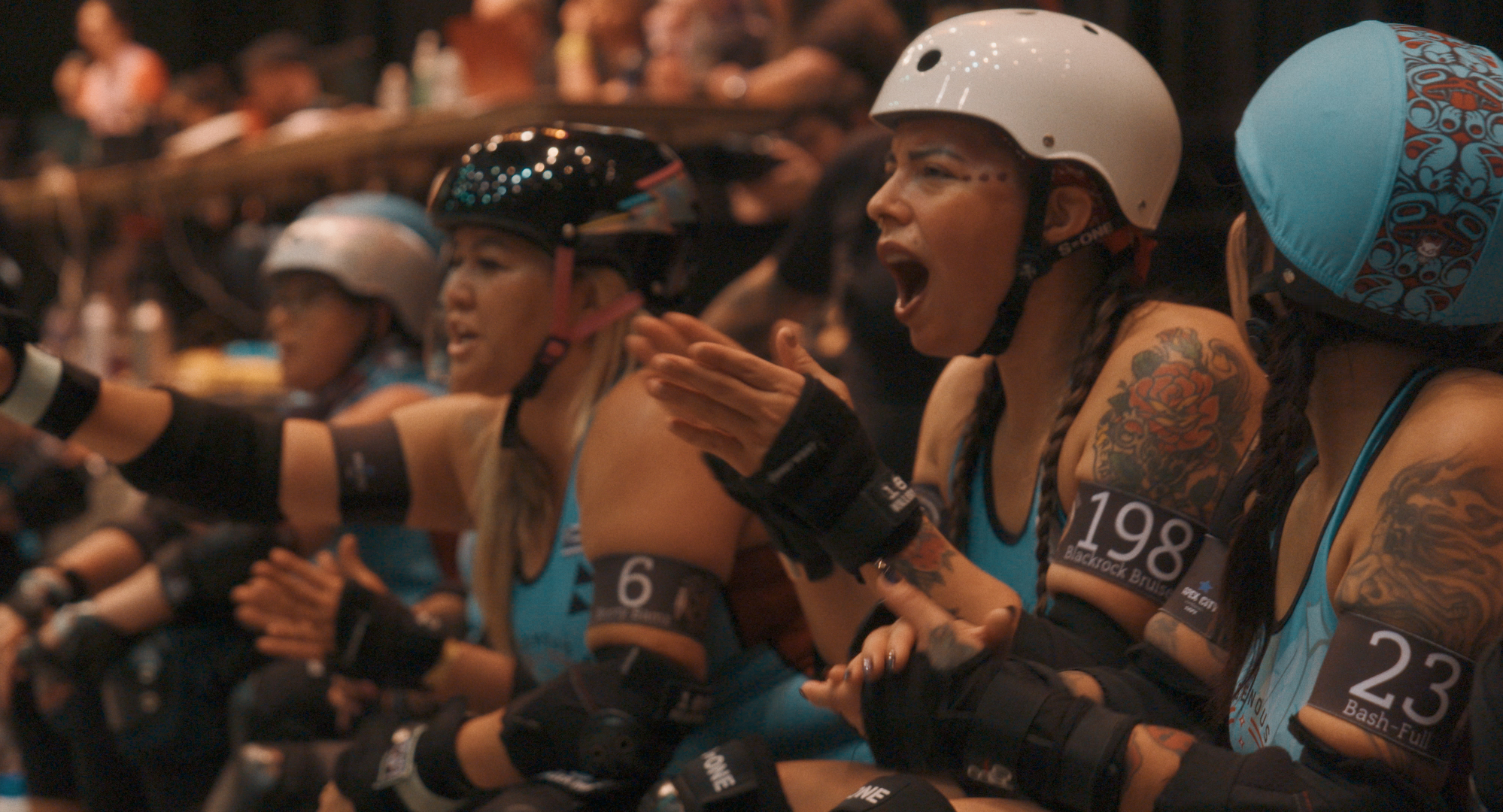

A documentary about a multinational all-Indigenous roller derby team is skating into theatres across the country this week.
Rising Through the Fray, by Kanien’kehá:ka (Mohawk) filmmaker Courtney Montour, chronicles the journey of Team Indigenous Rising.
The team, formerly known simply as Team Indigenous, describes itself as “borderless” because it’s rooted in cultural identity, not local geography — its skaters come together from dozens of nations despite colonial boundaries dividing them.
Montour, from the community of Kahnawà:ke, spent several years filming Team Indigenous Rising for her latest project.
In an interview with IndigiNews, she says she’d been following roller derby throughout her life.
But when she heard an all-Indigenous team would attend the Roller Derby World Cup in the United Kingdom, she knew the public had to hear its story.
Founded in 2017, the roller derby team boasts athletes from more than 30 Indigenous nations, according to its website.
“There’s just a real sense of pride,” Montour tells IndigiNews, “and again, something that’s historic and groundbreaking that we need to celebrate.”
Montour’s previous film credits include the 2021 documentary Mary Two-Axe Earley: I Am Indian Again, and a docuseries with journalist Tanya Talaga, The Knowing, for which the pair won a Canadian Screen Award.
Film much more than a sports documentary
A heavy-hitting, high-speed contact sport, roller derby is played on a flat track by athletes wearing rollerskates.
Montour’s 88-minute film guides viewers through the sport’s unique rules, scoring system, and colourful jargon — making it easy to understand how players with roles such as “jammer” and “blocker” compete during matches, known as “bouts.”
The film features high-energy scenes from competitions, as well as some of the players’ stories behind the scenes, highlighting the passion and athleticism of each teammate.
“Yes, it’s set against the backdrop of roller derby, but it’s not a sports documentary,” Montour says.
“It’s about finding community, belonging and representation.”
Montour first met Indigenous Rising in 2018, and her crew began filming the following year. But COVID-19 soon paused the project.
Three years ago they resumed filming, with filmmakers attending the team’s first reunion in years.
Since restarting, the crew followed players from tournament to tournament, documenting both the competitions and relationships that reveal Indigenous Rising’s strong sense of teamwork.
“Altogether, we brought these perspectives of, ‘How are we going to show the sport for people who might not know it?’” says Montour.
She ensured the film also portrayed Indigenous Rising team members’ home lives, not just their time on the track and tournament spaces.
The result is a heartfelt film encompassing many aspects of what goes into the impactful sport — and an in-depth look into how Team Indigenous Rising has broken the mold of this contact sport.

‘The protagonists’ story … lives on’ in film
To tell the story, Montour decided to focus her profile on three players on the team, nicknamed Krispy, Hawaiian Blaze and Sour Cherry, who “all had very different and unique stories of connection from their culture and identity,” she explains.
“But at the same time, it’s very universal. I think wherever you come from, their story resonates with many, many people.”
Her filming crew were able to capture the team’s “intimate moments” thanks to building trust thanks to “long relationship-building.”
“I think that’s something that’s really important in documentary storytelling,” Montour notes.
“In any documentary, it’s the participants — the protagonists’ story — that lives on,” she adds.
“And I always carry that message and thought when I’m working on films.”
For her, following the story of Indigenous Rising revealed the team’s own “evolution.”
Sagkeeng First Nation member Sherry Bontkes — whose chosen roller derby nickname is Sour Cherry — first became interested in roller derby as a child with her sister.
She tells IndigiNews she would sneak downstairs to watch the sport on TV.
In 2005, she decided to start a league of her own. She remembers soon finding more and more people jumping on board to join her.
“Roller derby back then is not what it is now,” she says. “So it was kind of neat being part of the revival.”
The sport traces its origins back roughly 100 years — but its roots lie in 19th century roller-skating race competitions.
Part of the competitive team sport’s more recent surge in popularity is its use of a flat track instead of the banked or angled track — a form which itself still has dedicated leagues.
Using a more common flat surface means roller derby bouts can happen almost anywhere in the world without specialized infrastructure.
Bontkes’ role in Indigenous Rising has changed over the years as injuries off the track have hindered her ability to compete in the tournaments. But she’s remained committed to her team.
She even broke her ankle during filming — but changed team roles to help coach her fellow players, staying tightly involved during what she remembers as an emotional time.
Her journey to recovery is followed in the film as Bontkes has to inform her teammates of her injury and is later shown attending physical therapy to determine her progress and if she can return to the track.
“It was devastating because I wasn’t sure if I’d ever be on skates again,” she says. “It’s always tough coming back out of an injury to play this game.
“But when you’re so passionate about playing, it’s hard not to come back … in some sort of capacity.”
She remains determined, however — and notes she hopes to find a way back onto her skates again.
“I hope I can come back,” she says. “I really want to, but I don’t know.
“I’ll be 55 in a few weeks, and it’s a tough call to make when you’re aging.”

Prayers, smudging and dances: community on the derby track
Montour and Bontkes both comment on the do-it-yourself nature of roller derby and the challenges that it puts on the players.
Bontkes notes that once you’re a part of the league there is a lot more to learn.
“You really do have to commit yourself to not only paying attention to the athletic part of it, but how to run a league,” she says.
She adds that they learn about the production and executive responsibilities as that falls upon people who volunteer to ensure the bouts run smoothly.
For Bontkes, she says the sport enveloped her.
While there were many positives for her, she mentions how taxing it could be on family, her body and her finances since expenses are out of pocket. But her feeling of accomplishment makes it all worthwhile.
“The rewards at the end of the day — at the end of the game, at the end of the practice, at the end of the tournament — that’s what mattered,” she says.
The film captures Team Indigenous Rising advancing its trailblazing journey as it held a tournament in “Colorado,” competing with other fellow teams that transcend international borders — including Black Diaspora, Fuego Latino and Jewish Roller Derby teams.
Through fundraising, Indigenous Rising was able to create this No Borders Derby Tournament for teams to come together and compete with one another and further their community bonds.
Before the event began, a local community member tells the filmmakers about the hostility experienced by Indigenous people there — a context that made such an intersectional sports competition feel even more important to participants and fans alike.
Offering a space for borderless teams to play brought positivity into the community.
Team member Hawaiian Blaze discussed how different the tournament feels as it’s all about representation and inclusivity.
She described being surrounded by players from many other “borderless” communities as a beautiful feeling.
The film captures that tournament’s laughter and joy, as teams cheered each other on — and even held a dance break during technical difficulties with the event’s scoreboard.
Packed with intense plays on the track and moments of togetherness — including prayers and smudging — the tournament demonstrated a beautiful sense of the community being built by teams joining together across both differences and shared experiences.

‘I found family in roller derby’
Montour explains what for her is “the beauty of the film” — as it explores the bonds forming between players, stemming from their similarities both in their love of the sport and from their own cultural backgrounds.
“When you’re surrounded by people who have similar stories and experiences like you, it falls into place, and it feels like family,” she says. “And you can sense that through the entire film.”
She explains that the documentary explores “issues that challenge Indigenous folk to connect and be a part of their culture and communities,” Montour says, “and to see the resiliency and the importance of representation in mainstream spaces to allow that reconnection.”
There’s another layer added to her project as she connected with members of Indigenous Rising, seeing players from many diverse communities come together as a group.
Player Bontkes recalls the self-discovery she uncovered being part of a team sharing similar stories and backgrounds as Indigenous athletes.
She recounts being removed from her birth parents during the Sixties Scoop — but finding herself unable to share that key experience to her local roller derby teammates.
Joining Indigenous Rising opened the door to feeling more comfortable sharing her story. And eventually she even went on to reconnect with her biological family, a life-changing moment she attributes to her time in roller derby.
“I don’t think I would have done that without my roller derby journey and discovering that I’m not the only one,” she says.
“I found family — and it wasn’t just my birth family, I found family in roller derby, I found family with my team.”
‘Finding our space — win, lose, it didn’t matter’
The film’s most emotional moments are at the heart of its story, Montour says. But teammates’ laughter, pride and celebration are also key parts of the documentary.
For Bontkes, the relationships forged with fellow teammates and their sense of community are what matter most.
“It was just about being together, it was about finding our space — win, lose, it didn’t matter,” she explains.
“We just had fun playing as an Indigenous team and being together on the track and, of course, off the track.”
She also commends Montour’s unique storytelling perspective in the film. The team’s audience at competitions see the players in action, but rarely get to see their story or journey off the track.
“I love the human story that this film portrayed,” Bontkes says.
She imagines herself reminiscing on being a member of Indigenous Rising, and being grateful for all that came from her time with the team.
“I think I’ll still look back on this and shine and just glow from everything that’s happened in my derby career,” she says. “And this is the highlight.”

Filming process meant to foster safety and trust
At the beginning of the film, one of the team’s coaches, Kristina Glass— nicknamed Krispy — discusses how roller derby has historically been primarily a women’s sport.
Montour ensured her film crew was also composed of women she had worked with before and trusted.
“I intentionally sought out an all-female crew for this film because of the subject matter,” she explains.
“Because of the sport itself being an all-female or female-identified non-binary sport, it was really important to also have that representation within our crew.”
Montour also hails roller derby as a queer-friendly space where community can gather, adding to the warm reception of the sport she hoped to capture on screen.
She sees her documentary as a proud showcase of some of the heart and passion behind the Indigenous Rising team — creating a well-rounded profile of its athletes’ connection and teamwork.
As she profiled the three main protagonists featured in the film, Montour ensured she was in close communication with each of them to portray their lives in a way that worked for each participant.
“One of the most important things for me is communication and relationship building,” she explains of her artistic process.

It was through constant conversations that she ensured stories each participant told were ones they were comfortable sharing, striving for a safe space for all involved.
Montour showed the players versions of her edits to make sure everyone was comfortable with the project.
“It’s their stories, their lives, that are going to live on in this,” she recalls, “and I want them to feel proud of what they shared.”
She also carefully considered cultural sensitivities during filming, too.
For instance, as she documented two of the team’s smudging ceremonies, she only included footage from a few short moments out of respect for the sacredness of the rituals.
“What they’re sharing in that space is for them,” she explains. “It’s for the team.”
Montour believes her film can connect and resonate with the experiences of many Indigenous people who see it.
She also hopes the general public can “see the incredible strength in Indigenous Rising,” she tells IndigiNews, “to connect with those universal stories of belonging and seeing the need for representation in the mainstream.”
Rising Through the Fray is set for cross-country screenings starting this Thursday in “Montreal,” followed by a Q&A with Montour. Subsequent showings are set for Friday in “Edmonton” featuring Bontkes, and on Saturday in “Winnipeg” with Montour.
The film will also have its international debut at the Santa Barbara Film Festival on Feb. 5 and 7.
Tickets and other upcoming screenings can be found on the documentary’s website.
Author

Latest Stories
-
Smudging on skates: Indigenous roller derby team slams onto the big screen
Kanien’kehá:ka filmmaker Courtney Montour takes IndigiNews behind the scenes of the high-energy contact sport in her documentary ‘Rising Through the Fray’
-

Tla’amin choreographer brings ‘Wild Man of the Woods’ ballet home to the West Coast
Cameron sinkʷə Fraser-Monroe is debuting his piece around ‘B.C.’ — but his sold-out show in his home territories feels particularly special